Peavy Builds a Mayoral Campaign Around a Familiar Face
Councilman John Peavy hired Mayor Mike Dow's last campaign manager, named co-chairs and told supporters he had no intention of leaving the 2005 Mobile mayoral race.
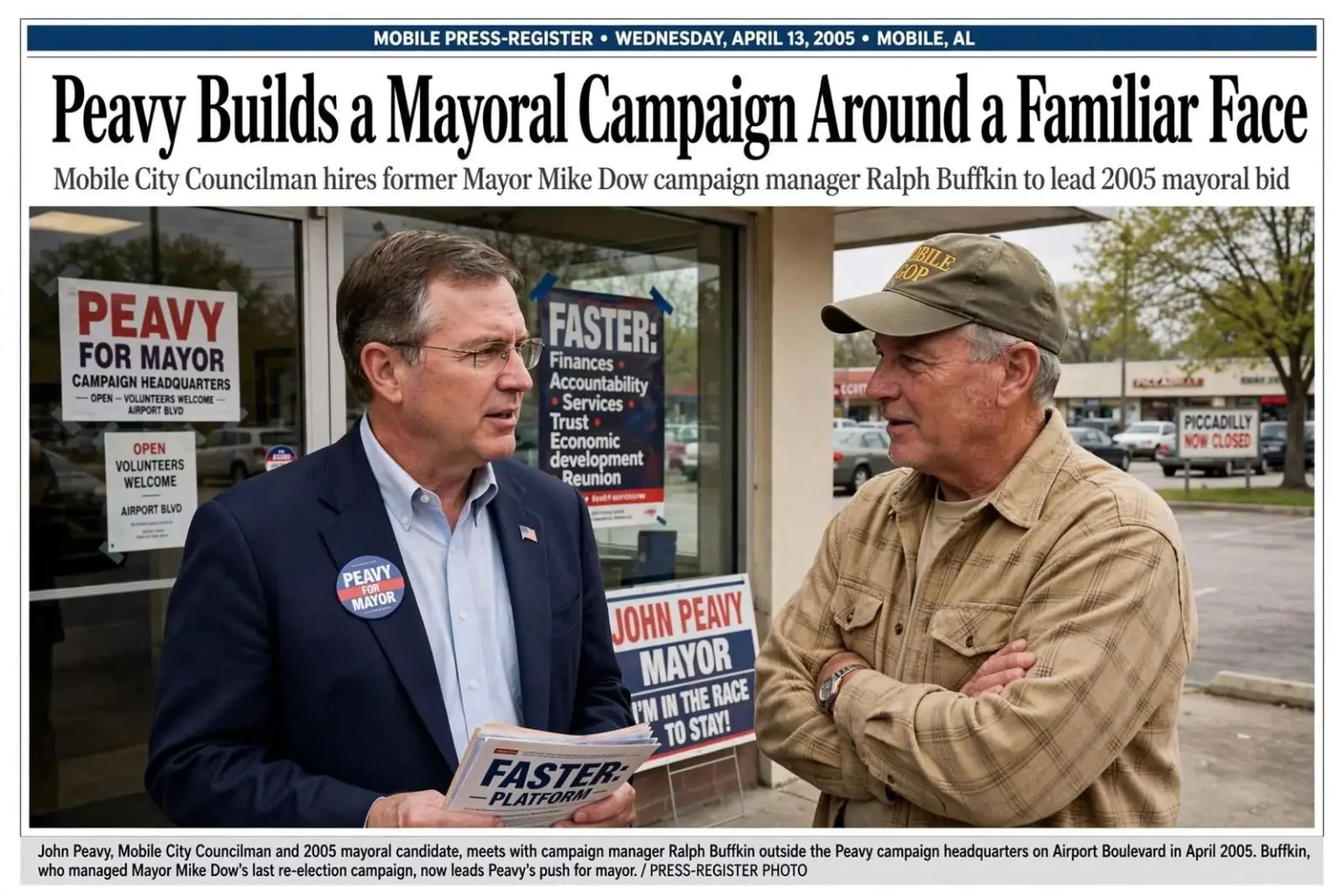
MOBILE — Mobile City Councilman John Peavy’s campaign for mayor took clearer shape in April 2005 with a hire that carried a message of its own: Ralph Buffkin, who managed Mayor Mike Dow’s last re-election campaign, signed on to run Peavy’s.
The move linked a challenger directly to the professional operation behind the incumbent he was trying to replace. Buffkin had just steered a sitting mayor through a re-election fight, and putting that machinery at the disposal of a councilman from District 1 signaled that the Peavy campaign intended to compete on organization as much as on issues.
The campaign also named co-chairs — Mobile dentist Dr. Mike Maitre Sr. and residential real estate broker Mickie Russell — and announced a steering committee that included Buffkin, Richard Weavil, Mike Tew, Mike Thompson, Suzanne Simmons, Paul Wesch, Tommy Tyrrell, Russell Buffkin, Doug Anderson and Matt McDonald, among others. The list drew from business, civic and political circles across the city, giving the campaign a working infrastructure months before the August vote.
“I’m in the Race to Stay”
The organizational news arrived alongside something more pointed. In an e-mail to supporters, Peavy, then 51, addressed head-on a question that had evidently been put to him by a rival.
“Even with all of this activity, one of the other candidates for mayor recently asked me if I intended to stay in the race,” Peavy wrote. “That is a fair question — so let me answer it once and for all.”
He described taking a couple of weeks in February to discuss his options with his wife, Kathy, and said the two of them had concluded that the moment was too important for him to be pressured out.
“Together, Kathy and I made our decision to stay in the race and I have never looked back,” he wrote.
The subtext was not hard to read. In a four-way race with two Republican-identified candidates and a Democratic county commissioner, there was persistent pressure on the field to consolidate — each campaign encouraging the others to fold so that a single alternative could face the frontrunner. Peavy was declining, and the e-mail was his public way of saying so.
FASTER
Peavy pitched a platform he called FASTER — Finances, Accountability, Services, Trust, Economic development and Reunion. Each letter mapped to a governing theme: tightening the city’s books, opening its operations to scrutiny, improving basic services, rebuilding confidence in city hall, and pushing job-creating growth.
He kept the last item deliberately mysterious.
“If you don’t know what Reunion means — don’t worry,” he wrote, “before this election is over you will understand exactly what it means and why it is so important to our progress.”
The teaser gave the campaign a talking point that had to be heard in person to be explained — a reason, in effect, for voters to attend the events where the candidate was speaking.
“I truly believe that the next four years will define Mobile’s future,” he added, “and this means that our next mayor must act fast.”
Why the Buffkin Hire Mattered
Buffkin was a former plant manager and local business owner who served as Gov. Bob Riley’s South Alabama team leader and had been a member of the Republican Executive Committee. His résumé mixed private-sector operations experience with Republican political work — an unusual pairing for the manager of a councilman’s campaign, and one that said something about how Mobile’s mayoral politics crossed party lines.
He had run for the Mobile County Commission in 2004, losing a GOP runoff to Stephen Nodine. That defeat, he suggested, was an asset rather than a scar. He had just spent a campaign season working precincts, intersections and civic groups across Mobile County, and he brought the contact list and the instincts from it directly to the Peavy operation.
Buffkin said the Peavy campaign would revive one of the signature tactics of his own commission run: a regular schedule of hailing motorists at busy intersections. The retail-style visibility — signs, waves and short conversations at rush hour — was cheap, relentless and, in his experience, effective at building name recognition across a city-sized electorate.
And he said he had recently campaigned across much of the same territory Peavy would now be working.
“In some respects, this is a bigger challenge and, in other respects, I think it is a little bit easier,” Buffkin said, comparing the job to running Dow’s re-election. “My deal with Mike was to get him where he needed to be and conduct campaign meetings. Whereas with John, I also make sure he gets to the right functions, but also we bounce a lot of things off each other.”
He added that he could stand in for the candidate when scheduling conflicts arose: “A lot of the audience will still recognize the name.”
The Co-Chairs
Maitre, 66, whose mother Martha ran the city Recreation Department for many years, framed his endorsement in terms of the campaign’s personnel as much as its candidate. His family name carried decades of civic history in Mobile, and his argument for Peavy doubled as an argument for the professional operation now assembled around him.
“John is a good man,” Maitre said. “Mobile needs him. We’ve got to go west and he’s the guy to take us there. These are the same people who worked for Bob Riley. Great people. He’s a straight arrow guy.”
Russell, an owner and broker at Dauphin Realty, emphasized the business argument. Her backing placed a leading figure from the city’s residential real estate market — a sector with a direct stake in growth, property values and quality of life — at the top of the campaign’s public list.
“I think it is very important that he is a good businessman and runs his own business,” she said. “I think he will apply his experience in running a successful business in running our city.”
She added that Peavy’s focus on economic development spoke to a worry many Mobile parents shared: “It is important to me that it is important to him that our children be able to stay in Mobile and have good jobs rather than have to move somewhere else.”
That concern — young people leaving the city for opportunities elsewhere — was a recurring theme of the 2005 race, and it gave the FASTER platform its most personal framing. Economic development was not an abstraction but the difference between a city that retained its graduates and one that exported them.
On the Ground
The campaign opened its main headquarters in the former Piccadilly location on Airport Boulevard near Hillcrest, a high-traffic commercial corridor on the city’s western side — the direction Maitre described when he said Mobile needed to “go west.” The site gave the operation space for volunteers, phone banks and supplies, with plans for smaller branch offices across the city to follow.
Peavy cited fundraising, sign placement and door-to-door canvassing as evidence of momentum. The metrics were the classic ones of a ground campaign: money raised, signs standing on corners and lawns, and doors knocked across the districts where the race would be decided.
Peavy had spent three terms on the council by the time the race began, representing District 1 in a city where the council’s district seats make each member the day-to-day advocate for a specific quarter of town. That record gave him a constituency and a history of constituent service to run on — and, in the four-way field, a claim to executive seriousness that challengers without office had to work harder to make.
The Vote
Mobile voted on Aug. 23, 2005. In a nonpartisan municipal election that drew four principal candidates into a single field, the consolidation pressure Peavy had resisted in the spring became the story of the summer — a race in which no candidate could claim a party base and every campaign fought for the same undecided middle.
County Commissioner Sam Jones won the mayor’s office, becoming the city’s first Black mayor. The result closed a chapter in which Mobile’s longest-serving modern mayor, Mike Dow, had spent much of his final term presiding over an ambitious redevelopment agenda, and it handed the city’s executive office to a new generation of leadership.
For Peavy, the April organization building — the Buffkin hire, the co-chairs, the steering committee, the headquarters on Airport Boulevard — was the visible architecture of a serious run. It promised professional management, street-level visibility and a platform organized around a single word, FASTER, that framed the choice as one between urgency and drift.
The race also left a mark on how Mobile campaigns would be run afterward. The intersection greetings, the branch offices and the business-led steering committees became part of the local playbook, and the candidates and managers of 2005 — Peavy, Buffkin, Maitre, Russell and the rest — remained fixtures in the city’s civic and political life long after the votes were counted.