University of South Alabama Bayou La Batre
Bob Shipp Named to Gulf of Mexico Fishery Management Council
Dr. Robert Shipp, chairman of marine sciences at the University of South Alabama, was appointed to the Gulf of Mexico Fishery Management Council, giving Alabama a seat at the table on Gulf catch rules.
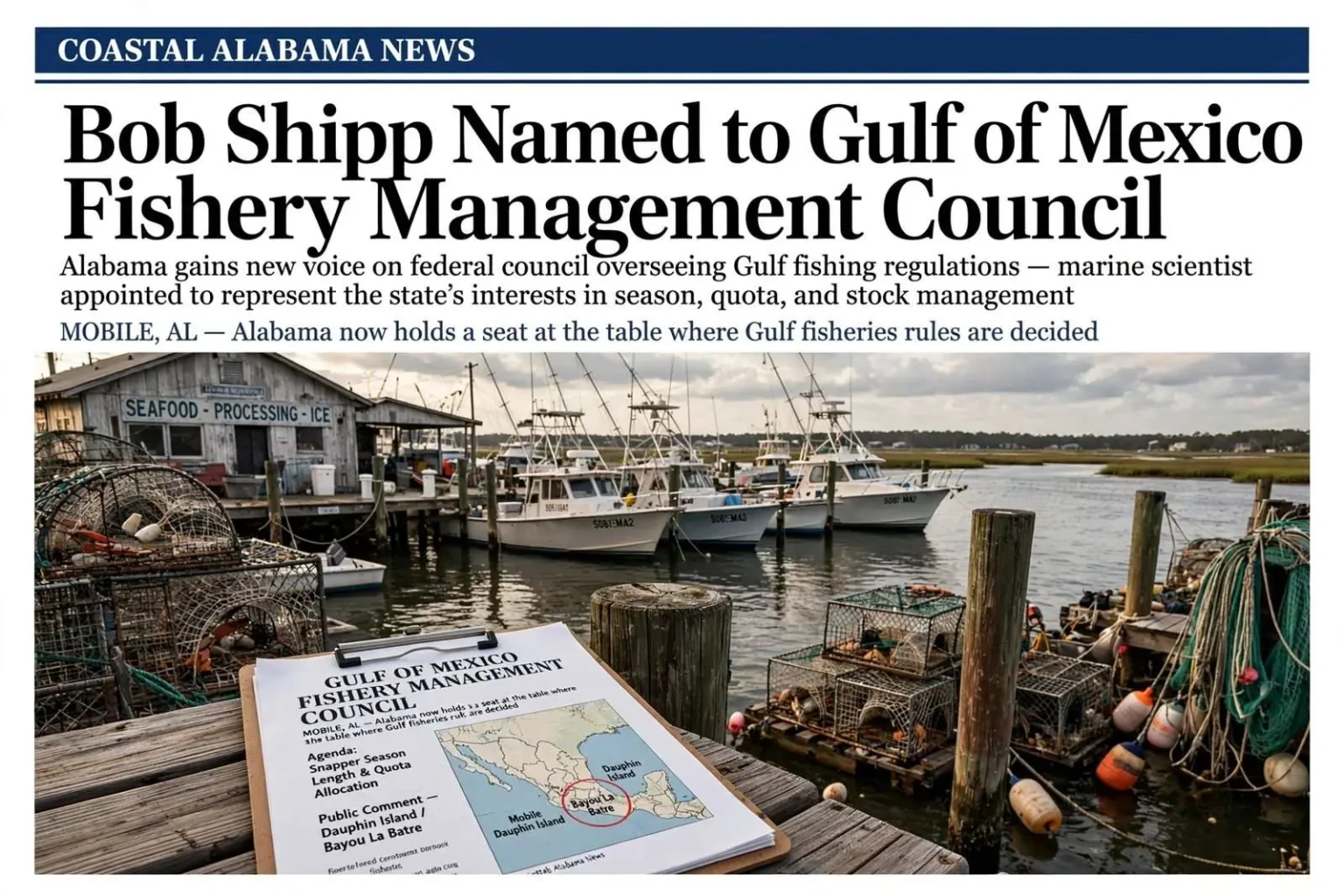
Alabama gained a new voice in the rule-making body that governs fishing in federal Gulf waters, as Dr. Robert Shipp, chairman of the Department of Marine Sciences at the University of South Alabama, was named to the Gulf of Mexico Fishery Management Council. The appointment was announced from Washington by U.S. Sen. Richard C. Shelby, R-Ala., who at the time chaired the Senate appropriations subcommittee on Commerce, Justice and Science — the panel with jurisdiction over the National Oceanic and Atmospheric Administration, the federal agency that oversees the regional fishery councils. Commerce Secretary Carlos Gutierrez made the selection.
The appointment placed a Mobile scientist at the table where the Gulf’s most consequential fishing rules are written. The council sets season lengths, bag limits, quota allocations and gear restrictions for stocks harvested in federal waters, and those decisions reach every dock, charter boat and seafood house on the Alabama coast. For a state that lives off the Gulf but holds only a short stretch of open shoreline, the seat was worth more than its size suggested.
A Scientist With Three Decades on the Water
“I am pleased that Secretary of Commerce Carlos Gutierrez has selected Dr. Bob Shipp as a member of the Gulf of Mexico Fishery Management Council,” Shelby said in announcing the appointment. “Dr. Shipp is uniquely qualified and a widely published scientist with more than thirty years of experience in marine fisheries management. He is well-respected and has a strong relationship with both recreational and commercial fishing groups.”
That last point mattered a great deal. The council is where two constituencies that rarely agree — the charter and recreational fleet on one side, the commercial harvesters on the other — argue out how many fish may be taken from the Gulf, by whom, and when. The split is structural, not seasonal. Recreational anglers measure their catch in weekends and bag limits, while commercial boats measure theirs in pounds landed and prices paid, and every allocation fight turns on which measure the council weighs more heavily. A member trusted by both camps was, in the senator’s telling, exactly what Alabama needed.
“Dr. Shipp’s appointment will provide the State of Alabama with a strong voice on the Gulf of Mexico Fishery Management Council, and I am confident that he will be a true asset to the Council,” Shelby concluded. The senator’s subcommittee held the purse strings for NOAA, which gave Alabama’s congressional delegation an unusually direct line into the agency that both funds and implements council decisions.
Why the Seat Matters to Coastal Alabama
For a state with only a short stretch of open coastline, Alabama carries outsized weight in the Gulf fishery. Alabama had the second-largest charter fleet in the United States, and Bayou La Batre ranked among the top ten seafood ports in the country. Orange Beach, Dauphin Island and Gulf Shores added thousands more boat trips each year, and the seafood processors of Bayou La Batre and Coden moved product into markets across the Southeast.
The decisions made by the council — season lengths, bag limits, quota allocations — land directly on the docks at Bayou La Batre and Coden, on the charter boats working out of Dauphin Island and Orange Beach, and on the packing houses and shipyards that depend on both. When a snapper season is shortened by a week, the effect shows up first in the booking calendars of the charter fleet and in the trucks waiting at the Bayou La Batre docks. When a quota is shifted between sectors, the argument is heard in the coffee shops of both towns on the same morning.
The Gulf of Mexico Fishery Management Council is one of eight regional councils created by federal fisheries law to manage stocks in federal waters, generally from the edge of state jurisdiction out to 200 miles. Its members are appointed by the U.S. Secretary of Commerce from lists submitted by the Gulf state governors, and its recommendations are implemented by NOAA Fisheries. The councils were built into the federal fishery management framework precisely because fish do not respect state lines, and because Washington has never had the local knowledge to set a red snapper season on its own.
Council seats are among the few places where a single well-informed member can meaningfully shift how a resource worth hundreds of millions of dollars is divided. There is no professional staff behind each seat; members arrive with their own experience, their own reading of the science, and the constituents they happen to hear from. Meetings rotate among Gulf cities — Tampa, New Orleans, Corpus Christi, Key West, Mobile — and the public comment periods draw crowded rooms of captains, dealers, conservationists and processors who have driven hours to be heard for two minutes each.
A Familiar Name on the Mobile Waterfront
Shipp was already a fixture in coastal Alabama’s scientific and civic life. As chairman of the University of South Alabama’s marine sciences department, he had spent decades studying Gulf fish populations and had become a frequent and plainspoken commentator on the health of red snapper and other reef species. His department, housed at the university’s Dauphin Island Sea Lab presence, sat at the center of the state’s marine research establishment, and its graduate students worked the reefs and estuaries that the council’s rules would govern.
His research and his public advocacy had, at various points, put him at odds with federal stock assessments — a posture that endeared him to anglers who believed the science understated how many fish were actually swimming over the Gulf’s artificial reefs. In fishing circles along the northern Gulf, the question of whether the snapper population was truly as scarce as the assessments claimed was not an academic dispute; it was the dispute, and Shipp was one of the scientists most willing to say so out loud.
Those artificial reefs are themselves a distinctly Alabama story. The state permitted a vast reef zone off its coast, seeded over the years with everything from surplus military hardware to concrete pyramids and scuttled vessels, and it became the engine of the state’s recreational fishery. Structures placed on the otherwise largely featureless Alabama shelf give reef fish a place to congregate, which in turn puts them within reach of the charter boats and private anglers who built the state’s second-largest fleet. Making the case for that fishery in a Gulf-wide forum — against much larger states with much longer coastlines — had long been a chief concern of Alabama’s fishing community.
The physics of the situation gave the argument its edge. Texas, Louisiana and Florida each control far more Gulf coastline than Alabama, and their delegations on the council reflect it. Without a strong seat at the table, Alabama’s interests could be outvoted on nearly any allocation question. With one, the state’s reef-zone model — an artificial reef program that concentrates fish close to port and makes a small state’s fishery unusually productive per mile of coast — had a scientist to defend it who had spent a career studying the fish on those structures.
Looking Ahead
Council appointments run for fixed terms and members serve without the protection of a large staff of their own; the work is done in long public meetings that rotate among Gulf cities and that draw crowded rooms of captains, dealers, conservationists and processors. Members are unpaid beyond travel expenses, and the preparation load — stock assessment documents, amendment drafts, economic analyses — falls on their evenings and weekends. It is not a ceremonial seat, and no one who has sat through a two-day snapper allocation session has ever mistaken it for one.
For Mobile County, the practical significance of the appointment was straightforward: someone who knew Bayou La Batre and Dauphin Island firsthand, and who had studied the fish in question for a generation, would be in the room when the votes were taken. The seafood economy of south Mobile County — the shrimp boats, the oyster houses, the processing plants — had been through lean years before, and fishermen there had learned that federal rules written without local input tended to read like they were. A council member who had spent the better part of thirty years walking those same docks could translate between the numbers on the page and the boats behind them, and that translation was what the appointment was really buying.
Two decades later, the tensions that defined that council table — recreational versus commercial allocation, state versus federal management of red snapper, the reliability of stock assessments — remain the central arguments of Gulf fisheries policy, and coastal Alabama remains one of the loudest voices in them. The seat Shelby announced from Washington that week did not settle any of those arguments. It simply guaranteed that when they were argued, the shortest coastline in the Gulf would have its scientist in the room.