Bedsole Opens Campaign Headquarters With Supply-Side Message
Former state Sen. Ann Bedsole opened her main mayoral campaign headquarters in June 2005, pairing praise for Mobile's revitalization with a call for lower taxes and a leaner city payroll.
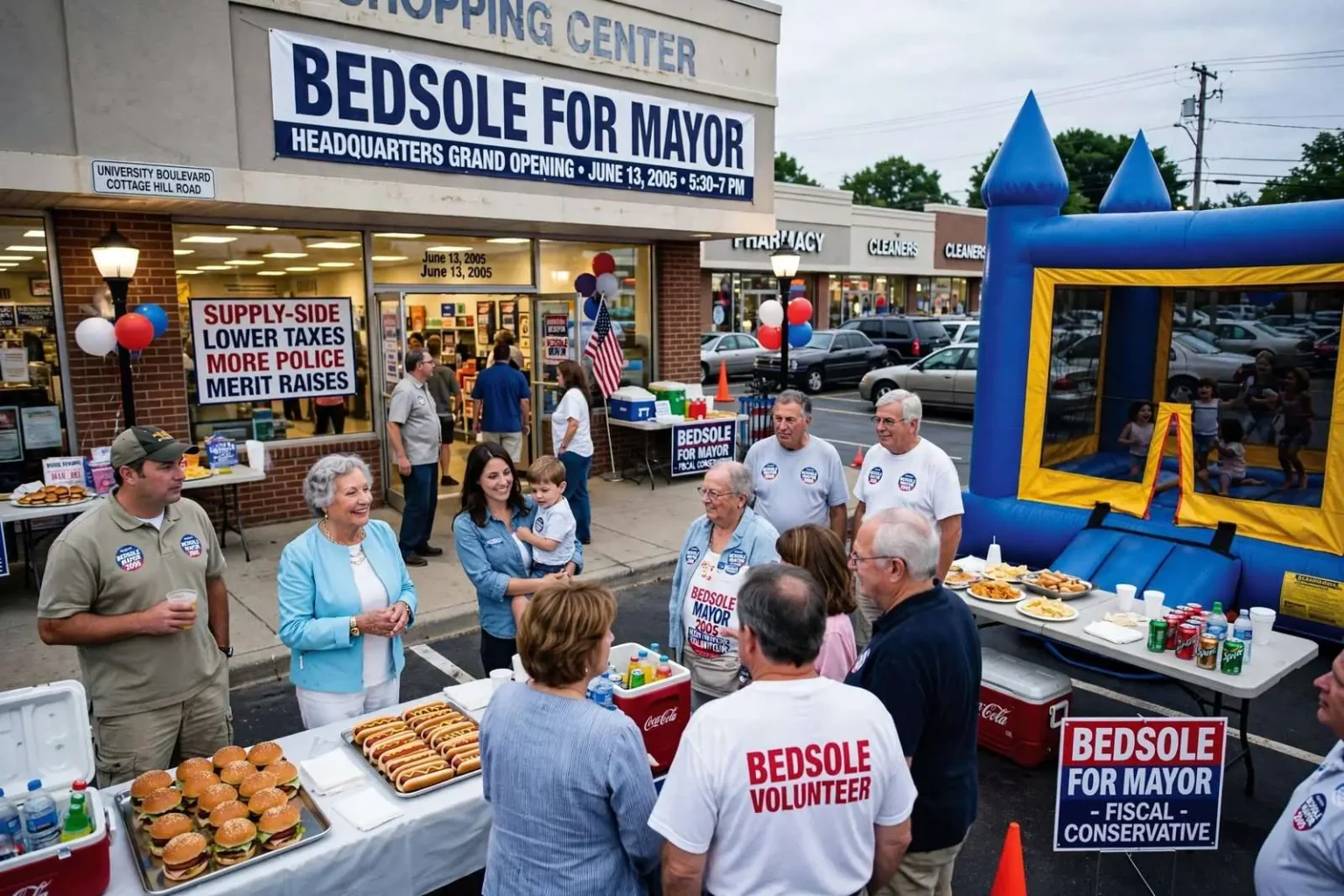
MOBILE — The Ann Bedsole campaign for mayor staged the grand opening of its main headquarters on Monday, June 13, 2005, from 5:30 to 7 p.m., in the strip shopping center at the northwest corner of University Boulevard and Cottage Hill Road.
The event was pitched to families as much as to activists: mini-hamburgers, mini-hot dogs, soft drinks, balloons and an inflatable Space Walk.
The campaign said it would also establish satellite offices around the city for the convenience of prospective voters — a signal of the scale of the operation Bedsole intended to run.
The headquarters sat in the heart of west Mobile’s retail corridor, a stretch of University Boulevard where the city’s postwar growth concentrated, and the choice of a storefront in a busy shopping center was deliberate. City hall campaigns in Mobile at the time lived and died on visibility, and a headquarters with a parking lot full of balloons, food and children bouncing in a Space Walk was designed to turn a June evening into a campaign event that reached beyond the party regulars. Satellite offices promised to extend that presence into neighborhoods across the city, giving the campaign a physical footprint in more parts of Mobile than any single storefront could cover.
The Message She Was Carrying
In public appearances over the preceding month, Bedsole had worked to sharpen what a Bedsole administration in City Hall would actually mean, and the answer she gave was a careful balancing act.
She was an ally and staunch supporter of the outgoing four-term mayor, Mike Dow, and she regularly praised the initiatives of recent years that had begun to revitalize the city — the downtown investment, the convention center, the civic projects that had reshaped Mobile’s self-image during the 1990s. She was not running against that record.
What she was running against was its cost.
Her campaign argued for fiscal conservatism and a likely trimming of the administrative overhead of city government. Specifically, Bedsole pledged to:
Bolster the police department, which she described as undermanned. Restore merit raises for city employees. Reduce the sales tax, warning that without a cut, businesses would continue fleeing Mobile’s city limits for the suburbs and unincorporated county. Trim administrative costs in city government.
Bedsole described herself as a believer in supply-side economics — the proposition, as she framed it, that lower taxes and increased revenues can and do go hand in hand.
That platform made her campaign an unusual thing in Mobile politics: a bid to succeed an ally by arguing for a correction rather than a change of course. Dow’s Mobile had invested heavily in its core — an aquarium-era renewal of the waterfront, the Arthur R. Outlaw Convention Center, restored historic districts — and the city’s self-image had shifted accordingly. Bedsole’s argument accepted all of it and asked the next question: whether the bill for that renewal had grown faster than the city’s ability to pay, and whether the people paying it were the same ones being taxed out of the city limits.
The Sales Tax Problem
That last plank was not an abstraction in Mobile in 2005. The city’s sales tax rate had become a recurring complaint from retailers, who argued that shoppers and businesses alike were simply crossing the line into unincorporated Mobile County or over the bay into fast-growing Baldwin County.
Sales taxes were, and remain, the backbone of municipal revenue in Alabama, which lacks the property tax base that funds cities in most other states. That structural fact makes any Alabama mayor’s budget unusually dependent on retail activity within the city limits — and unusually vulnerable when that activity moves a few miles away.
The pressure on Mobile’s retailers was coming from both sides of Mobile Bay. To the west, the unincorporated county and its suburban municipalities could court big-box development without the city’s tax stack; to the east, Baldwin County was booming with coastal growth, drawing shoppers who found themselves paying less by driving an extra twenty minutes. Every store that moved out of the city limits took sales tax revenue with it, which forced the city to either raise rates on the businesses that stayed or cut services — a squeeze that made the tax rate itself a campaign issue.
A candidate promising both a tax cut and more police officers was therefore making a bet that growth would cover the difference. Bedsole made that bet explicitly.
It was a supply-side argument in miniature: reduce the rate, the reasoning went, and the activity that has been fleeing to the county and across the bay comes back — new retail inside the city limits, more sales, and a broader base that generates more revenue at the lower rate than the old base did at the higher one. Skeptics in city budgeting would have pointed out the risk: sales tax revenue does not rebound on a schedule, and police manpower costs do not wait. Bedsole’s answer was the other half of her platform — trimming administrative overhead in city government — which was meant to fund the public-safety commitment while the tax cut did its work.
Her pledge to restore merit raises for city employees added a labor dimension that reached beyond economics. City workers who had gone years without the raises their classification systems called for were a constituency in every neighborhood, and the promise signaled a broader argument that the city had money for projects but had squeezed the people who kept it running. Combined with the police pledge — aimed at a department she described as undermanned — the platform framed fiscal conservatism as something other than austerity: fewer administrative layers and lower taxes, alongside better pay and more officers on the street.
The Candidate and the Race
Bedsole was a former state senator with deep roots in Mobile’s civic and philanthropic life, and she had been the first Republican woman elected to the Alabama Legislature. She had also run for governor in the 1994 Republican primary, and her enthusiasm for the party had been the subject of periodic debate among GOP activists ever since.
That résumé made her the most experienced officeholder in the field. Her years in the Alabama Senate had given her a working knowledge of state-local finance — knowledge directly relevant to a campaign built on sales tax policy, since Mobile’s tax structure interacts with state law at every turn. Her civic and philanthropic profile connected her to the city’s institutional leadership, the same circles that had backed the downtown renewal she now proposed to keep while trimming its cost. And her 1994 gubernatorial run, whatever its outcome, had made her name known statewide and given her campaign experience none of her rivals could match.
She was one of four principal candidates in the Aug. 23, 2005, municipal election, the first open contest for mayor since 1989.
The others were Mobile County Commissioner Sam Jones, City Councilman John Peavy and former Councilwoman Bess Rich.
The open seat changed the character of the race. Mike Dow had held the mayor’s office for four terms, and an election without an incumbent scrambles every coalition: council members, county officials and civic leaders who had spent years in Dow’s orbit now had to choose sides or run themselves. Each of the four principal candidates carried a distinct base — Bedsole the west Mobile establishment and GOP network, Jones the county commission constituency he had built, Peavy his council district, Rich the fiscal-watchdog following she had earned on the council. What united the field was the sense that the city stood at a choice point about the cost and direction of its renewal.
Jones won the election, becoming the first Black mayor in the city’s history, and served two terms.
His victory ended the era Dow had defined and began a new one, with Bedsole’s supply-side argument folded into the city’s ongoing debate about taxes, growth and the size of government rather than enacted wholesale.
How Campaigns Worked in That Era
The headquarters opening captures something about how city campaigns worked in that era: a strip mall storefront on a busy west Mobile corner, a Space Walk in the parking lot, and a candidate explaining supply-side economics over a plate of mini-hot dogs.
There was a logic to the format. Mobile’s municipal elections are nonpartisan on the ballot but never in practice, and a summer evening event drew the kind of mixed crowd — families, neighborhood activists, downtown business figures — that a private fundraiser could not. The inflatable in the parking lot was not decoration; it was a statement that the campaign wanted children in the picture, an image that suited a candidate whose platform promised lower taxes for shopkeepers and better pay for the city employees who lived in the neighborhoods around them. Storefront headquarters, in an era before a campaign’s front door was a website, also functioned as a months-long billboard in a location where thousands of commuters passed daily.
The event also reflected Bedsole’s particular strengths as a campaigner. Her civic and philanthropic work had given her a network across the city’s clubs, churches and institutions, and the headquarters opening was the kind of occasion that network could fill on short notice. Setting the tone early — a full storefront, a crowd, satellite offices to follow — was a way of signaling momentum more than three months before election day.
The Stakes Behind the Platform
Looking back, the platform Bedsole carried that summer laid out the arguments Mobile would keep having long after the 2005 election was decided.
The sales tax question never went away: the tension between the rate the city charges and the retail that flees to lower-tax jurisdictions remains the central fact of municipal finance in Alabama, where property tax limitations leave city budgets leaning on consumption. The police staffing question recurred in one form or another in every mayoral race that followed. And the debate Bedsole embodied — how much of the city’s renewal budget the taxpayers can carry, and whether the investment pays for itself — was the same argument the city would revisit each time a major civic project came before it.
Her candidacy also marked a moment in the city’s political history: the first open mayoral race in sixteen years, a field that included the man who would become Mobile’s first African-American mayor, and a candidate who had already made history of her own as the first Republican woman in the Alabama Legislature. That Bedsole lost in August 2005 does not diminish what the headquarters on University Boulevard represented — a serious campaign, organized citywide, running on a fully formed fiscal philosophy, in a city deciding what its post-Dow decades would look like.
The mini-hamburgers, the balloons and the Space Walk belong to their summer. The argument about taxes, growth and the size of city government never left town.