Fairley Rejects Plea Deal in Mobile County DUI Case, Trial Set
Former Williamson High and Auburn standout Nick Fairley turned down a plea offer in his Mobile County DUI case, setting up a February trial date.
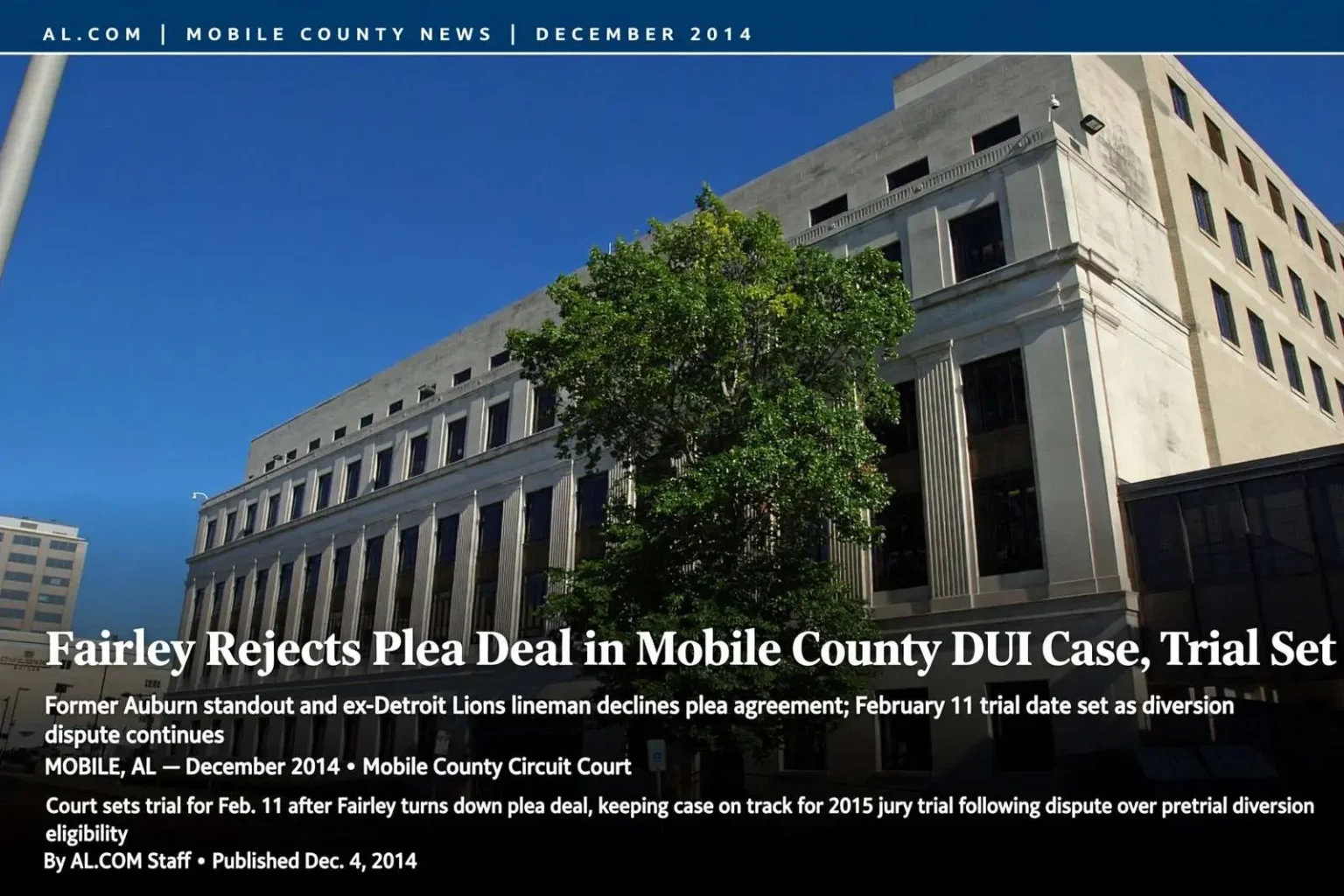
A Mobile County court case involving former Auburn University standout and Williamson High School football player Nick Fairley moved a step closer to trial in December 2014, after the ex-Detroit Lions defensive lineman turned down a plea agreement offered by the Mobile County District Attorney’s Office. The rejection set the case on a path toward a February trial and capped more than two years of wrangling over a DUI arrest that had already produced a guilty plea, an appeal and a fight over diversion eligibility.
The case dates back to a May 2012 traffic stop on Interstate 10 near U.S. 90 in the Tillman’s Corner area, where an Alabama state trooper accused Fairley of driving at speeds approaching 100 mph. Fairley was charged with DUI and reckless driving following the stop, a routine citation in form but a high-profile one given the driver’s fame across the state where he played his college ball.
A guilty plea, then an appeal
Fairley initially pleaded guilty to both charges in September 2012 and was sentenced to a six-month suspended jail term, a year of probation and a $600 fine. But he later appealed, seeking entry into a pretrial diversion program that could have led to the charges being dismissed from his record. That request touched off a dispute between his defense team and prosecutors over whether such an arrangement had ever been agreed to.
Pretrial diversion programs occupy a particular place in Alabama’s court systems. They allow first-time, generally low-risk defendants to complete supervision, classes and community requirements in exchange for having charges dismissed and records restricted, sparing them a conviction that could follow them through professional life. Eligibility rules are strict, and disputes over who qualifies are common — but rarely litigated as publicly as this one, where the defendant’s NFL career made every filing newsworthy.
The diversion dispute
Prosecutors with the Mobile County DA’s Office argued that a separate marijuana possession arrest in April 2012 made Fairley ineligible for the diversion program, since eligibility requires a clean criminal record. That marijuana charge was ultimately dismissed in December 2012, but it remained central to the office’s position that Fairley did not qualify for diversion.
The timing was the crux. The earlier arrest occurred before the DUI, and the dismissal came after — leaving both sides to argue about which fact governed. Fairley’s lawyers maintained that with the marijuana charge dismissed, their client’s record was clean when the diversion question was decided; prosecutors countered that eligibility had to be measured when the case began, and that a pending drug arrest disqualified him then and there. The disagreement never got a definitive ruling because the case kept moving in parallel, with the appeal and the diversion fight unresolved at the same time.
The rejected deal
With the appeal unresolved, prosecutors offered Fairley a new plea deal in Mobile County Circuit Court. Under the proposed agreement, presented to Circuit Judge Sarah Stewart, Fairley would have received a six-month suspended sentence and a year of probation on the DUI count, along with a $600 fine and court costs. He also would have been required to complete DUI school and attend a victim impact panel. On the reckless driving charge, the deal called for an additional $250 fine plus court costs.
In practical terms, the offer mirrored the sentence he had received in 2012 — the same suspended term, probation and fine — which made the state’s position clear: the deal was available, but the record would stand. For a professional athlete whose playing career and endorsements depended in part on his standing with the league, a DUI conviction on his record carried consequences beyond the fine and probation, and that calculus drove the decision that followed.
Fairley rejected that offer during a court appearance, with one of his attorneys telling the judge the decision was driven by his continued hope of being admitted to the diversion program rather than accepting a conviction on his record. Fairley did not comment to reporters as he left the courthouse.
Following the rejection, Judge Stewart set a trial date of February 11 for the case to move forward. Trial dates in circuit court are firm markers even when negotiations continue, and both sides spent the weeks after the hearing preparing as though the February docket would hold — prosecutors organizing their witnesses from the 2012 stop, defense counsel readying their challenge to the stop and the diversion dispute.
A hometown case with a national profile
The proceedings drew local attention in part because of Fairley’s roots in the Mobile area — he starred at Williamson High School before playing at Auburn, where he helped lead the Tigers to a national championship, and was later a first-round NFL draft pick of the Detroit Lions. In Mobile, where high school football loyalties run deep, Fairley’s rise from Williamson to a national title and the league was a point of local pride, which made his legal troubles a recurring topic on sports radio and in the courthouse gallery.
His Auburn pedigree amplified that attention. Fairley’s 2010 season on the Tigers’ defensive line was among the most dominant in recent college football memory, and it carried the program to the BCS national championship. When a player with that resume appears in local court as a defendant rather than an honoree, the case draws a kind of scrutiny ordinary DUI dockets never see.
The case is a reminder that even athletes with national profiles remain subject to the same local court processes as any other resident when charges are filed in Mobile County. Judges rotate through the same dockets, prosecutors apply the same eligibility rules, and the schedules of a professional football season buy no continuances by default. Whatever accommodations a celebrity defendant’s attorneys can negotiate, they negotiate within the same framework any defense lawyer faces across the street from the courthouse.
What happens next
Circuit Court proceedings such as this one continue to work through the standard docket, with plea negotiations, appeals over diversion eligibility, and scheduled trial dates all playing out under the review of local judges and prosecutors. As of the December 2014 hearing, the matter remained unresolved, with both sides preparing for the possibility of a trial in early 2015 unless a new agreement could be reached beforehand.
A trial would put the 2012 traffic stop itself under the microscope — the trooper’s observations, the speed readings, the field sobriety tests and the stops’ documentation — in a public setting where every element must be proved beyond a reasonable doubt. That prospect is precisely what gave the defense reason to keep pressing for diversion rather than lock in a conviction: a jury verdict, favorable or not, would resolve the charges once and for all in a way a negotiated dismissal never would.
For Mobile County’s courthouse watchers, the case also offered a window into how diversion policy is enforced at the street level. Eligibility rules that look straightforward on paper — clean record, no pending charges — become contested terrain when applied to real timelines, dismissed cases and high-stakes defendants. Every ruling in the Fairley matter became a reference point for defense attorneys handling ordinary clients facing the same program.
Whether the case ended in a February trial, a last-minute agreement or a renewed diversion bid, its outcome would be watched from two directions at once: from Detroit, where the Lions evaluated the defensive tackle’s availability and standing, and from Mobile, where the hometown star’s case served as a reminder that a reputation built on Friday nights and Saturdays in Tuscaloosa and Auburn offers no shield in a Monday morning docket at Government Plaza. The February 11 date stood, the February trial loomed, and the only certainty was that the case’s long detour through appeals and eligibility disputes had finally arrived at a junction where it would be resolved — one way or another — in open court.
The stop that started it all
The May 2012 stop on Interstate 10 remains the foundation of the entire case, and everything that has followed — the plea, the appeal, the diversion fight, the rejected deal — circles back to what a state trooper observed on a stretch of highway near the Tillman’s Corner interchange. Interstate 10 runs through south Mobile County as the region’s main east-west artery, and the U.S. 90 exit marks one of its busiest interchanges, a corridor where high-speed driving is both common and heavily patrolled.
In a trial, the stop would be reconstructed witness by witness: the speed at which the vehicle was said to be traveling, the manner in which it moved through traffic, the decision to initiate the stop, and the sequence of roadside tests that followed. Each element is subject to challenge, from the calibration of speed-measurement equipment to the administration and scoring of field sobriety evaluations. That is the material a February jury would be handed, and it is why neither side treated the trial date as a bluff.
The DUI charge also carries its own procedural machinery in Alabama courts — license consequences administered through the state separate from the criminal case, court-ordered programs for offenders, and the victim impact panels that defendants attend as a condition of sentencing. The presence of a victim impact panel requirement in the proposed deal reflected the standard practice in Mobile County DUI cases rather than any special feature of this one.