Mobile Council Backs ‘Ban the Box’ Resolution for Job Applications
Mobile's city council unanimously backed a resolution urging removal of criminal history questions from initial job applications countywide.
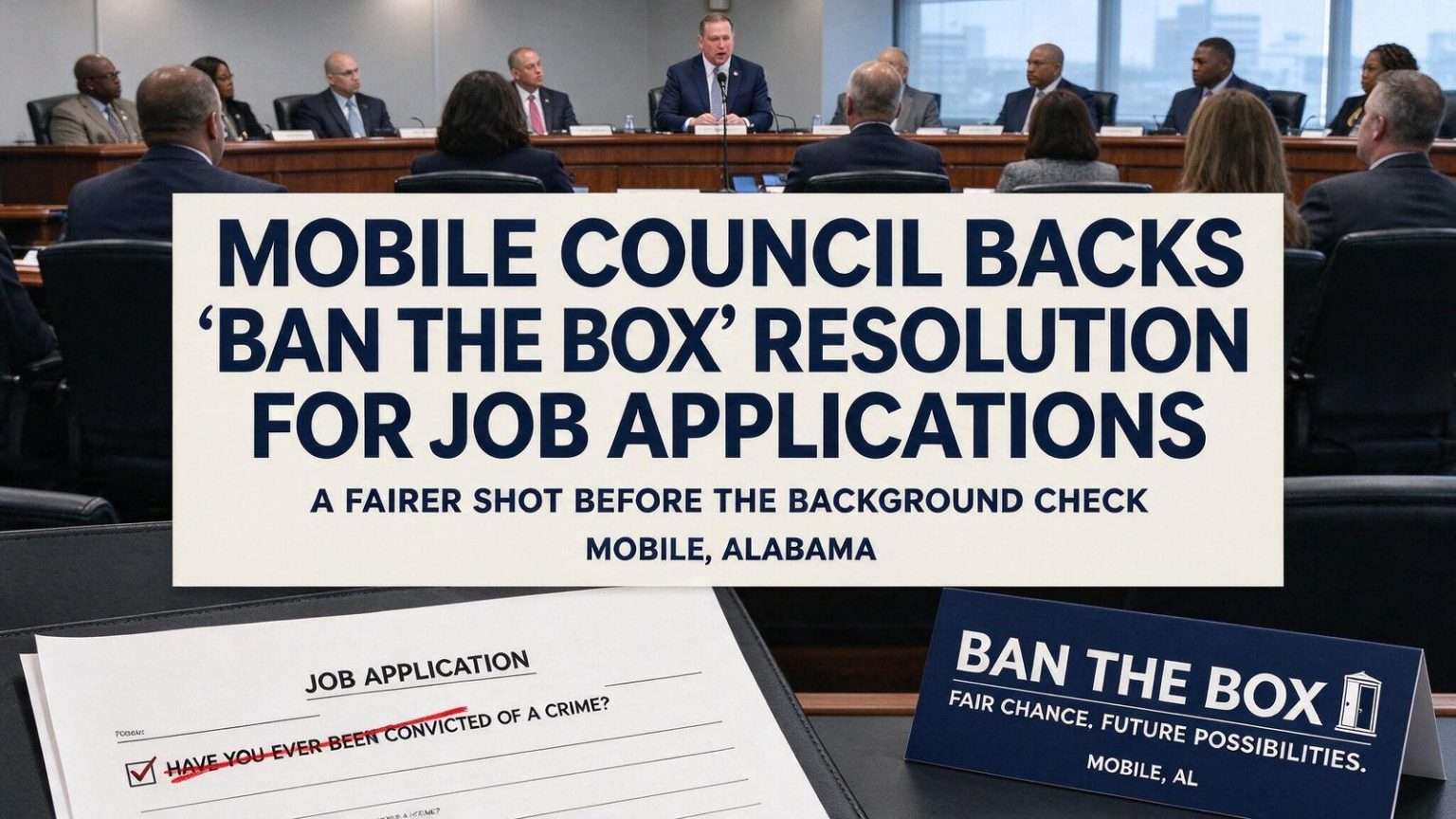
MOBILE, Alabama – The Mobile City Council gave unanimous approval to a resolution supporting the national “Ban the Box” movement, a step that would make Mobile the first city in Alabama to formally back the initiative aimed at removing early-stage barriers to employment for people with criminal records. The vote placed Alabama’s oldest city at the front of a policy conversation that has swept through city halls across the country over the past decade, as communities large and small have re-examined how early questions about criminal history shape who gets a fair look at a job.
The resolution, sponsored by a council member representing part of the city, calls on the Mobile County Personnel Board to eliminate questions about criminal convictions from initial job applications. The Personnel Board administers the merit system for city and county government positions, handling recruiting, testing and certification for thousands of public jobs across Mobile County, which means the practical effect of the change would reach a broad slice of the local public workforce rather than a single department.
Supporters argue the change would give qualified applicants a fairer shot at being considered for jobs based on their skills and experience before a background check enters the conversation later in the hiring process. The “box” in the movement’s name refers to the checkbox that has long appeared on job applications asking whether an applicant has ever been convicted of a crime. Advocates for the change note that applicants who disclose a conviction on the first page of an application are often screened out before anyone reviews their qualifications, even for positions unrelated to the offense.
The measure passed without discussion after a council rules committee had already voted to recommend it earlier in the month. That quiet path to approval stood in contrast to the way similar measures have been received elsewhere, where ban-the-box proposals have sometimes drawn extended debate between business groups, civil rights advocates and public employers. In Mobile, the groundwork laid in committee appears to have smoothed the way for a council that rarely speaks with one voice on contested policy questions.
A Conversation About Policing and Promotion
The same council session included a lengthy and, at times, pointed discussion about diversity in the Mobile Police Department’s hiring and promotion practices. City officials debated a proposal to pay an outside consultant roughly $500,000 over three years to overhaul how public safety employees are evaluated for promotion, with the police chief framing the effort as a way to boost both efficiency and diversity within the department’s ranks. The scale of the proposed contract reflected how consequential promotion systems are inside a department the size of Mobile’s, where advancement decisions shape leadership for decades.
The city attorney argued strongly in favor of the proposal, while at least one council member pressed the chief on ensuring diversity starts at the point of hire rather than only at promotion. The exchange captured a familiar tension in public safety personnel policy: promotion systems can only draw from the pool of officers already on the payroll, so departments that struggle to recruit a diverse workforce often find that imbalance compounded with every promotion cycle. Testing and evaluation methods for police promotions have come under scrutiny nationally for their potential to disadvantage candidates in ways unrelated to job performance.
A community advocate also urged the council to consider creating a citizen review board to oversee law enforcement issues, though the council president indicated that idea was not something members intended to pursue at that time. Citizen review boards exist in dozens of American cities and take many forms, from advisory panels that audit complaints to bodies with subpoena power, and proposals to create them tend to surface in moments when police accountability is already under public discussion.
Mobile’s police chief instead pointed to body-worn cameras as a tool that could provide additional transparency and accountability, a position the mayor said he supported. Body camera programs had been spreading rapidly among departments across Alabama and the nation, with agencies citing benefits that included documented evidence in use-of-force cases, improved civilian complaints resolution and a measurable reduction in disputes over what occurred during encounters between officers and residents. The cost of equipment, data storage and staff time to manage footage has remained the principal obstacle for departments weighing such programs.
Elfapalooza and the MoonPie Drop
On a lighter note, council members also received an update on Elfapalooza, a family-friendly community event planned for Bienville Square in which Mobile County Public Schools students hoped to help set a world record for the most people dressed as elves gathered in one place. The event’s organizers were aiming to top an existing record of nearly 1,800 participants. Bienville Square, the leafy downtown park named for the city’s French colonial founder, has long served as Mobile’s front yard for gatherings of exactly this kind, close to the businesses and schools that make up the city’s core.
The council also touched on preparations for the city’s New Year’s Eve MoonPie Drop celebration, with one member playfully teasing the identity of the year’s headline performer during the meeting. The MoonPie Drop has become Mobile’s signature New Year’s Eve tradition, a distinctly local answer to the ball drop in other cities that leans on the Gulf Coast’s affection for the marshmallow-and-graham snack that originated in Chattanooga but found its most devoted fans in the Deep South. Each year, thousands of revelers fill the streets of downtown Mobile as an oversized electric MoonPie descends to mark the midnight hour.
Why the Ban the Box Vote Matters
Together, the session reflected a mix of substantive policy work and community event planning typical of Mobile’s weekly council meetings, with the Ban the Box vote standing out as a notable local policy shift with implications for job seekers across Mobile County. For the people most directly affected, the practical difference can be significant: an application that begins with work history and skills rather than a conviction question gives formerly incarcerated residents and those with old records a chance to compete on their merits before the background conversation begins.
The resolution’s significance also lies in its timing. Mobile has worked in recent years to market itself as a city on the rise, courting aerospace, manufacturing and maritime employers along the waterfront while grappling with the economic challenges that persist in many of its neighborhoods. Community advocates have argued that removing employment barriers for people with records is inseparable from that broader effort, since steady public employment is one of the most reliable paths out of the cycle of poverty and re-offending that challenges many families in the city.
Nationally, the Ban the Box movement has gained momentum as employers and governments alike have recognized that criminal background questions on initial applications can filter out candidates before qualifications are ever considered. Public agencies were among the earliest adopters, reasoning that government should model the hiring practices it would like to see in the private sector. Alabama’s other cities have watched such measures advance elsewhere, but Mobile’s action made it the first municipality in the state to formally endorse the approach, a distinction supporters hope will encourage other city councils to follow.
The Personnel Board now faces the question of implementation. Removing a question from the application is administratively straightforward, but the broader practice involves training hiring managers, adjusting screening software and establishing the point in the process at which background checks are performed and reviewed. Background checks themselves are not going away, and supporters of the resolution have been careful to say they should not; the goal is sequencing, giving every applicant an interview and a fair evaluation before conviction history enters the discussion.
What Comes Next for the City
For council members, the vote was one of the easier calls of a session that otherwise included harder questions about money, policing and public trust. The half-million-dollar promotion study proposal, the citizen review board request and the body camera conversation all touched on the same underlying issue of confidence between the police department and the communities it serves, an issue that continues to command attention in cities across Alabama and the country.
Business advocates have sometimes pushed back on ban-the-box measures in other jurisdictions, raising concerns about compliance burdens and about the timing of background checks in safety-sensitive positions. Public safety jobs, positions involving work with children and roles with access to sensitive financial information typically retain earlier and more detailed screening under such policies, and Mobile’s resolution directs its change at the initial application stage rather than eliminating background checks altogether. That distinction is central to how supporters describe the measure: not a retreat from scrutiny, but a reordering of when scrutiny begins.
As the meeting closed, the contrast was hard to miss: a city weighing serious questions about its police department and its hiring practices in one breath, and counting down to a world record elf gathering and a giant glowing MoonPie in the next. That blend of weight and whimsy is a fair portrait of municipal government in Mobile, where the policy decisions that shape thousands of lives share an agenda with the traditions that bring the community together under the oak trees of Bienville Square.