Giant 154-Pound MoonPie Set to Headline Mobile’s New Year’s Eve Bash
A massive 154-pound MoonPie took center stage at Mobile's downtown New Year's Eve celebration, continuing a beloved coastal Alabama tradition.
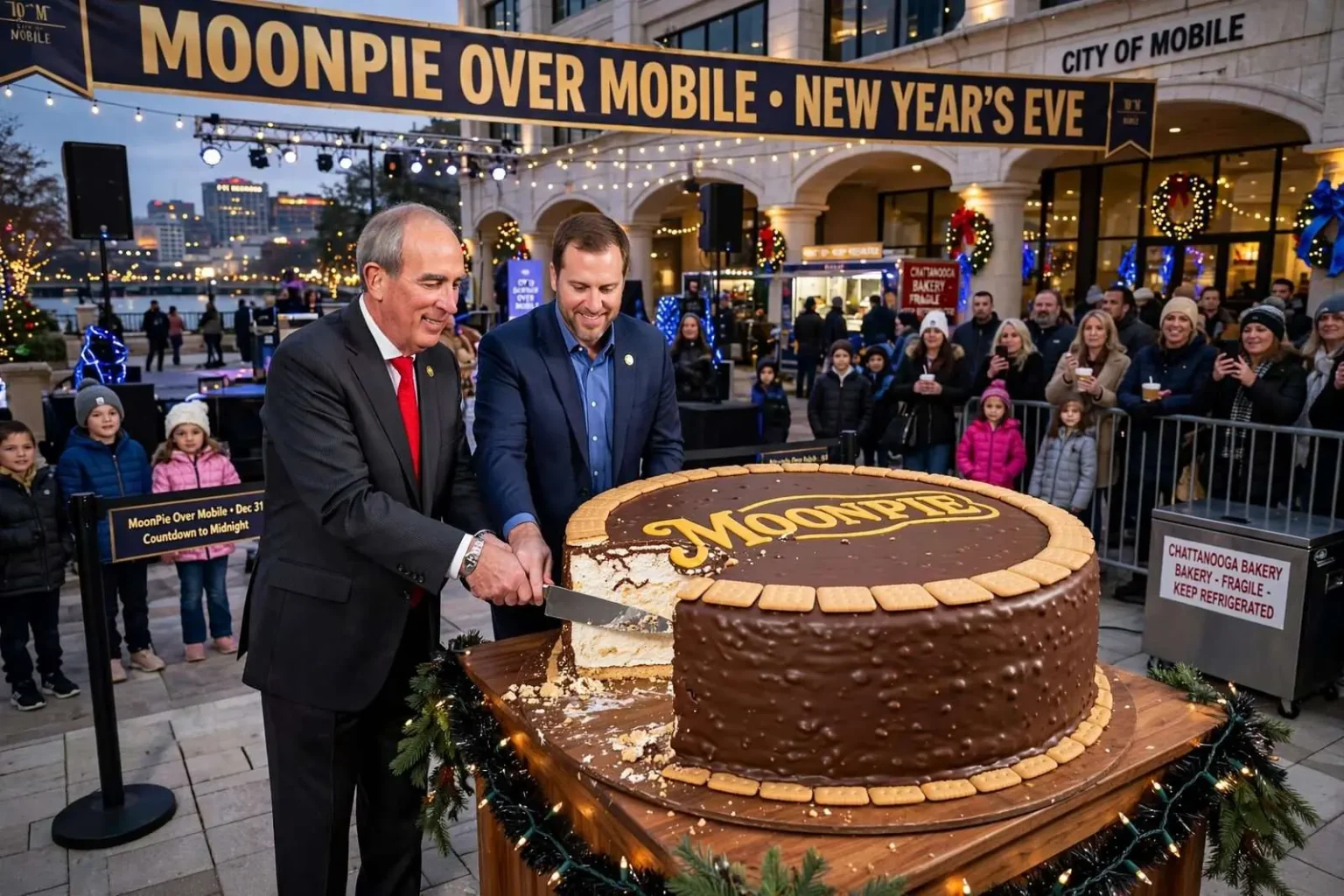
Downtown Mobile sliced into a 154-pound MoonPie as part of this year’s MoonPie Over Mobile New Year’s Eve celebration, continuing a tradition that has become one of the city’s signature holiday events. The oversized confection — roughly the height of a fire hydrant and thousands of times the weight of the snack-aisle original — served as the centerpiece of an evening that drew families downtown for music, food and the countdown to midnight.
The giant treat was baked by Chattanooga Bakery, the Tennessee company behind the original MoonPie, and arrived in Mobile in the days leading up to the celebration after roughly a full day of production. Event organizers said the giant confection was the last MoonPie of its kind made for the year, capping off a busy holiday production run at the bakery. Getting a five-foot dessert across state lines in one piece is its own logistical exercise: the pie travels refrigerated, is handled by a small team, and is kept under watch until the cutting.
Mobile Mayor Sandy Stimpson and a city councilman made the ceremonial first cut into the massive dessert during the evening event at the Renaissance Riverview Plaza courtyard downtown. From there, the pie was carved into slices and handed out to the crowd, a ritual that has become one of the night’s most photographed moments. Last year’s giant MoonPie served more than 170 people once it was carved up and handed out to the crowd gathered for the countdown.
A tradition with deep local roots
The MoonPie occupies a special place in Mobile’s culture, and not only at New Year’s. The marshmallow-and-graham sandwich has been a staple of the city’s Mardi Gras celebrations for generations, tossed from floats by masked riders to crowds who consider the chocolate-covered treat the official snack of carnival season. That long association made the MoonPie a natural choice when city boosters went looking for a symbol for a New Year’s Eve celebration that could put Mobile on the holiday map alongside bigger cities and their famous ball drops.
The result is a lighted MoonPie lowered at midnight, a Gulf Coast twist on the Times Square formula that plays to the city’s strengths. Instead of a glass ball, the crowd watches an enormous replica of its favorite snack descend above the street, timed precisely to the countdown. Mobile has leaned into its unofficial identity as the “MoonPie Capital” in recent years, and the New Year’s Eve event has grown into one of the city’s most recognizable holiday traditions.
The choice of venue matters as well. The Renaissance Riverview Plaza courtyard sits in the heart of downtown, steps from the convention center and the riverfront hotels, letting the event spill comfortably through surrounding blocks. Downtown bars and restaurants stay open late for the crowd, and the city’s street grid makes it easy for families to walk between the stage, the vendors and parking garages.
What the night looked like
The MoonPie cutting is one piece of a larger New Year’s Eve celebration in downtown Mobile that typically draws thousands of residents and visitors to the riverfront for music, food and a midnight countdown. Local bands and school groups anchor the entertainment lineup in the early evening, with headliners taking the stage closer to midnight. Food vendors line the closed blocks, and the city’s skyline and river provide the backdrop for the final countdown.
City officials and event organizers use the celebration to draw visitors downtown during the holiday week, giving local restaurants, bars and shops a boost during what can otherwise be a quiet stretch between Christmas and New Year’s. Hotel rooms around the convention center fill for the weekend, and downtown businesses that might otherwise close early for the holidays keep extended hours for the crowd. For a city that markets itself on its festivals, the event extends the tourism season one week past Christmas.
Families were encouraged to arrive early to find parking and good viewing spots along the riverfront before the evening’s festivities kicked off, with the city publishing a detailed schedule of music acts, food vendors and the exact timing of the MoonPie cutting and midnight drop in the days leading up to the event. Early arrivals found the best sightlines for both the stage and the descent of the lighted pie, while organizers used the early hours to spread crowds across several blocks rather than stacking them at a single bottleneck.
Weather is always part of the equation for a late-December outdoor event on the Gulf Coast. Most years the night is mild by national standards — cool enough for jackets, rarely cold enough to thin the crowd — which is part of the event’s pitch to visitors from farther north. Organizers build the schedule with contingencies for rain, but the lighted drop and the cutting go on in most conditions.
The pie behind the party
The original MoonPie dates to the early twentieth century, when a Chattanooga bakery salesman conceived a filling snack for Appalachian coal miners. The recipe — two graham rounds sandwiching marshmallow, coated in chocolate — has barely changed since, and the snack became a vending-machine and convenience-store icon across the South. Alabama’s affection for it runs deepest of all, thanks to Mobile’s Mardi Gras tradition of throwing MoonPies from the floats.
That history is why the partnership with Chattanooga Bakery carries symbolic weight. The giant New Year’s pie is baked in the same ovens that make the originals, scaled up under the bakery’s own supervision, and shipped as a one-of-a-kind piece. Organizers treat it less like dessert than like a visiting dignitary: it has its own transport, its own handlers, and a designated moment on stage before the knives come out.
The 154-pound edition continued the event’s pattern of staging the cutting in the evening before the midnight drop, splitting the night into two peaks — one for families with young children who may not last until midnight, and one for the countdown crowd. The slice giveaway doubles as the event’s signature act of hospitality, turning a stage prop into hundreds of servings shared among strangers in the cool night air.
For Mobile, the celebration is also a statement of civic identity. The city traces its Mardi Gras heritage to the colonial era and markets itself year-round on that history; the MoonPie drop lets the city make the same pitch in a national conversation dominated by bigger destinations. Each year the event runs smoothly, the argument gets easier to make that the Gulf Coast’s oldest party city also knows how to throw a New Year’s Eve worth traveling for.
By the time the lighted MoonPie settled at midnight and the fireworks washed over the riverfront, another edition of the tradition was in the books — 154 pounds of it, sliced and shared downtown, with Chattanooga Bakery’s production line already a year behind the next one.
The economics of the event reward the city in ways that are easy to underestimate. A single December weekend that keeps hotels full, restaurants staffed and garages collecting fees pushes sales tax receipts at a moment when municipal budgets are usually flat. Festival economics researchers have long noted that signature events give cities a return that goes beyond the weekend itself, building the reputation that attracts conventions and return visits. Mobile’s convention business around the holiday season benefits from exactly that halo.
The celebration also functions as a homecoming. The week between Christmas and New Year’s brings former Mobilians back to visit family, and the MoonPie Over Mobile schedule gives them a reason to come downtown rather than celebrate at home. Local organizers have leaned on that dynamic in promotion, framing the event as the city’s annual reunion as much as a tourist draw — one where three generations might share a slice of the same giant pie.
Behind the scenes, the production involves a year-round calendar. Permits, street closures and vendor contracts are settled months in advance. The stage and sound equipment arrive the day before, the lighted MoonPie structure is tested in the afternoon, and public safety staff — police details, fire medics and emergency management liaisons — stage around the footprint in case of weather or medical issues in the crowd. The cutting itself is rehearsed down to where the first slices go.
The 154-pound pie, meanwhile, has a working life measured in days. It is baked near the end of Chattanooga Bakery’s holiday run, cooled, wrapped and transported with the care of fragile cargo, then held refrigerated downtown until show time. Once cut, nothing goes to waste: slices are handed to the crowd until the pie is gone, and the board it rode on becomes a keepsake that usually ends up in a city office or event warehouse.
For all the spectacle, the heart of the event remains simple. A city that throws MoonPies from parade floats eleven months of the year decided to build its own midnight tradition around the same snack, and the crowds that gather on the riverfront each Dec. 31 keep telling organizers the idea works. The music, the vendors and the lighted drop are the production; the pie is the point — a piece of Mobile’s identity, big enough to share.