Downtown Mobile’s Toilet Paper Parade Draws Biggest Labor Day Crowd in Years
The 69th annual Labor Day parade through downtown Mobile drew its largest crowd in years, with 2,000 marchers and 17 union floats.
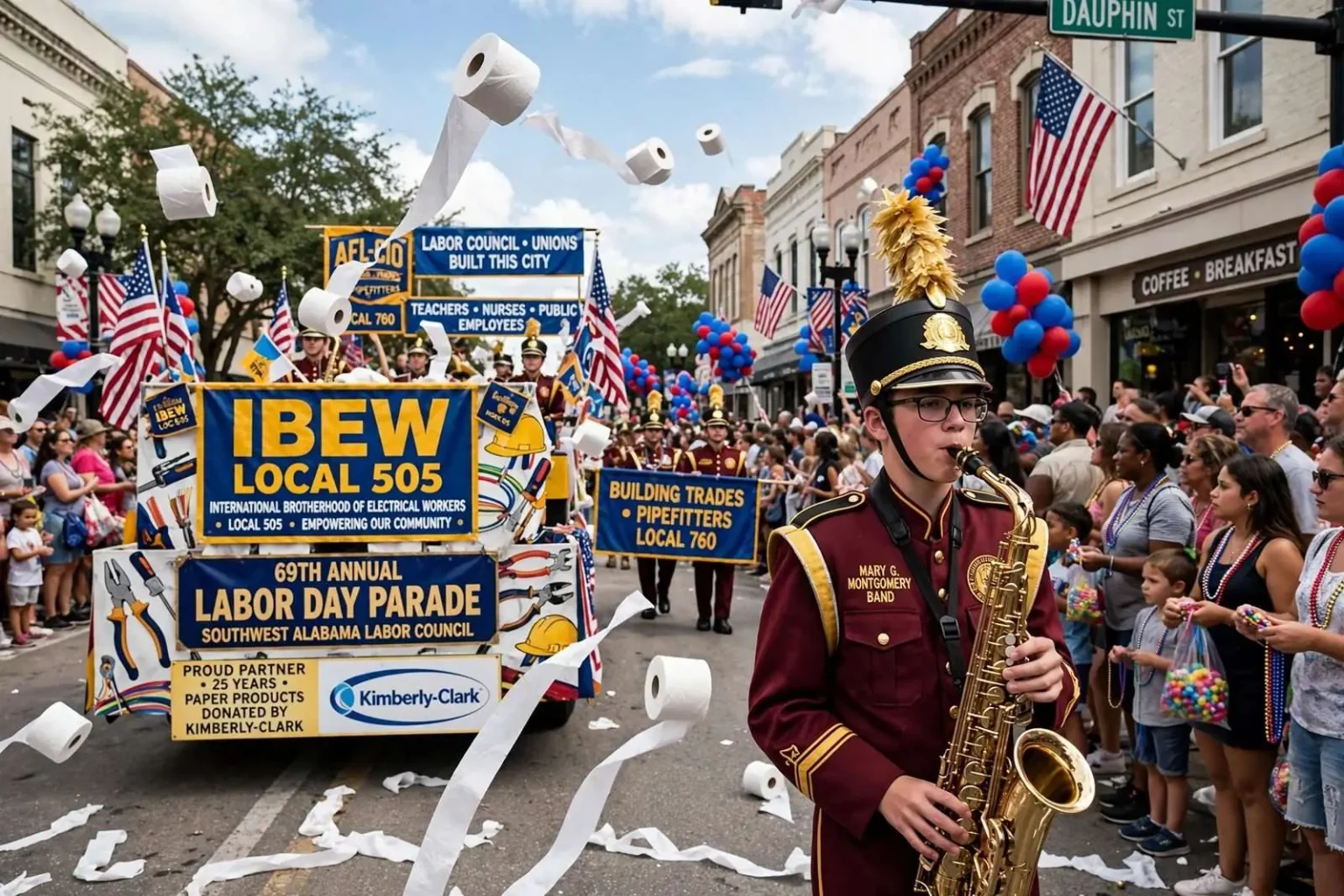
Downtown Mobile’s long-running Labor Day tradition, affectionately nicknamed the toilet paper parade, pulled in its biggest crowd in years on Monday morning, according to organizers with the Southwest Alabama Labor Council. The 69th annual parade, sponsored by the labor council, sent roughly 2,000 marchers and 17 floats representing various trade unions winding through the streets of downtown Mobile. Spectators lining the route were showered with the parade’s signature mix of beads, candy and rolls of toilet paper, a quirky tradition that has given the event its lasting nickname among locals.
Donald Adams, a member of International Brotherhood of Electrical Workers Local 505, said the turnout was noticeably larger than in each of the previous four or five years. He said the parade exists to give Mobile’s working people a day to call their own and to push back against negative stereotypes about organized labor. Adams joked that despite the popular image of union leadership, big labor bosses don’t always wear pinstripe suits and smoke big cigars.
Leslie Schraeder, who handles communications for the AFL-CIO’s Southwest Alabama Labor Council, said the parade is meant to honor working people as the backbone of the community. She described the event as a chance for laborers to celebrate both Labor Day and the country together, calling it a tradition worth being part of. The pairing of patriotic and labor themes has defined the holiday since Congress made Labor Day a national holiday in 1894, and Mobile’s parade keeps that double meaning alive more than a century later.
A Quarter-Century Partnership Behind the Paper
The toilet paper and other paper products tossed to the crowd were donated by manufacturer Kimberly-Clark, continuing a partnership with the parade that Schraeder said has lasted 25 years. Local union workers at Kimberly-Clark facilities have long supplied the paper goods that give the parade its distinctive character. The relationship is a natural one: the company’s plants in the region employ union members who take pride in seeing their products fly through downtown streets every Labor Day, and the donation turns a household staple into the parade’s calling card.
The toilet paper toss has become the detail outsiders remember most about Mobile’s Labor Day observance, but for the unions that march it is simply the playful surface of a serious purpose. The parade gives each local an opportunity to display its colors alongside the building trades, industrial unions and public employees who share the route, reminding spectators that the region’s bridges, hospitals, schools and shipyards are staffed by organized workers.
Seventeen floats is a substantial showing for a parade of any size, and the roughly 2,000 marchers represented the full range of the labor council’s affiliates. Union members walked with their local banners, handed out treats and waved to the families that lined the route, many of whom stake out curbside spots well before the first marcher steps off.
First-Time Spectators and a Band on the Move
Among the families in the crowd Monday were Heather and Dean Hayes, attending for the first time to watch their ninth-grade son David march with the Mary G. Montgomery High School band. David played alto saxophone as the band moved through downtown, one of many school and community groups that round out a parade otherwise dominated by union locals. Heather Hayes said the family had heard about the parade for years and finally made the trip downtown to see David perform in person, a decision that made the holiday feel complete.
High school bands have long been fixtures of the Labor Day parade, giving students a holiday-stage showcase and giving parents a reason to fill the sidewalks. For a freshman like David, marching a downtown route in front of one of the biggest crowds in years is an early highlight of a four-year band career, and his parents’ first-time attendance made the morning a family milestone as much as a civic one.
The bigger turnout this year did not surprise parade watchers who had noticed the event’s momentum building. Organizers attribute the rebound to a mix of old-fashioned word of mouth, the parade’s multigenerational pull and a renewed sense that Labor Day belongs to the people whose work built the city.
Why Unions Still March on Labor Day
Labor Day parades are the holiday’s original form. When the first Labor Day was celebrated in the 1880s, and when it became a federal holiday in 1894 following the turmoil of the Pullman strike, the centerpiece was a public procession of working people through the streets of their own cities. Mobile’s version carries that history forward, making the port city one of the Southern communities where the tradition has never lapsed. The Southwest Alabama Labor Council, the AFL-CIO body that coordinates member unions across the region, has sponsored the Mobile parade for decades and counts the event among its signature activities each year.
The council’s message, as Schraeder framed it, is that working people are the backbone of the community. That claim is easy to illustrate in Mobile, where the port, the shipyards, the hospitals, the schools and the construction trades all rest on union-represented and hourly workers alike. A parade is a simple way to make that contribution visible once a year, in a format children can enjoy and grandparents can remember from their own childhoods.
Adams’s observation about turnout carried particular weight because organized labor’s public profile has fluctuated over the decades. A parade that draws its biggest crowd in four or five years suggests that the event is finding new audiences, including families like the Hayeses who had never attended before. Newcomers mix with longtime regulars, and the crowd that results looks more like the city itself.
The Strange History of a Signature Tradition
Exactly how toilet paper became the parade’s trademark throwable is a story locals tell with a shrug; the tradition simply took hold and stuck, the way many parade customs do. What matters to organizers is that it makes the event unmistakable. Children scramble for the fluttering rolls the way children elsewhere scramble for Mardi Gras throws, and the image of paper streaming over Government Street has become shorthand for Mobile’s Labor Day itself.
The bead-throwing, meanwhile, links the parade to the Gulf Coast’s broader festival culture. Mobile takes understandable pride in its claim as the original home of Mardi Gras in the United States, and the city’s parade calendar borrows freely between holidays. A Labor Day morning that ends with sidewalks littered in paper and beads fits comfortably into that pattern, even if the occasion is workers rather than carnival krewes.
The donations from Kimberly-Clark keep the tradition affordable. Paper goods are the parade’s largest consumable expense, and a quarter-century of support has meant organizers could pour their resources into floats, bands and logistics instead. The company’s local facilities, staffed in part by the same union members who march, have become as much a part of the parade’s story as any float on the route.
What the Parade Means for Downtown Mobile
A big parade Monday morning also delivers an economic nudge to downtown. Spectators fill parking garages, buy breakfast from nearby restaurants and linger after the last float passes, giving businesses a holiday boost on a day when many offices are dark. Events that draw families into the city center reinforce downtown’s role as the region’s gathering place, a role Mobile has worked to strengthen through years of waterfront and street improvements.
For the unions, the day ends with the satisfaction of a well-run event and a message delivered. The parade honors the dignity of work in a city built by dockworkers, electricians, pipefitters, teachers and nurses, and it hands the next generation a reason to understand why the first Monday in September is a holiday at all. David Hayes and his fellow band members will graduate knowing what it feels like to march for a crowd of thousands, and the crowd will come back next year for the 70th round of beads, candy and paper in the streets.
IBEW Local 505 and Mobile’s Electrical Trade
The union Adams belongs to, International Brotherhood of Electrical Workers Local 505, represents electrical workers across the Mobile area, a local with roots in the city’s growth as a port and industrial center. Electricians wired the downtown buildings, the port facilities and the industries that anchor the regional economy, and the local’s participation in the parade gives the public a face for a trade that usually works behind walls and above ceilings. Members say events like the parade help counter the caricature of unions as faceless bureaucracies, replacing it with neighbors, coaches and Little League volunteers who happen to belong to a local.
That is the point Adams was making when he joked about pinstripe suits and big cigars. The stereotype of the fat-cat labor boss has followed organized labor for a century, but the people who show up to march on a September morning in Mobile are more likely to be journeyman electricians, millwrights and school employees taking time off on their own holiday. The parade lets them speak for themselves, in their own city, in front of their own neighbors.
A Tradition That Spans Generations
Sixty-nine years of parades means the event has marched through nearly every chapter of Mobile’s modern history, from the postwar industrial boom through the decline and rebirth of downtown. Families attend the way families attend church picnics, because their parents did, and the labor council counts on that generational handoff to keep the sidewalks full. The arrival of new faces like the Hayes family shows the handoff is still working.
The parade also serves as an annual reunion for the region’s union halls. Members who work on far-flung job sites cross paths downtown, retirees catch up on the route, and locals compare floats in friendly rivalry. For one morning, the everyday competition for contracts and crew slots gives way to a shared display of numbers, colors and pride.
Labor Day’s Double Meaning, Preserved in Mobile
Schraeder’s description of the parade as a chance to celebrate both Labor Day and the country together captures the holiday’s original spirit. The founders of the American labor movement framed their cause as inseparable from the nation’s promise, and parade marshals for generations have carried both the American flag and the local’s banner down the same streets. Mobile’s version keeps that framing intact, blending patriotism and worker pride without embarrassment.
The 69th edition closed with the usual mix of paper scraps drifting through downtown and families heading home with bags of candy and beads. Organizers, having seen the biggest crowd in years, are counting on the momentum to carry into next year’s 70th parade. If the trend holds, the toilet paper parade will enter its eighth decade with the same combination it has always offered: union banners, high school brass, thrown candy, and a city’s one-day tribute to the people who do the work.
For the Hayes family, the day delivered what first-time parades deliver, a memory and a plan to come back. For David, a ninth-grade alto saxophonist with three more football seasons of marching ahead, downtown Mobile on Labor Day now ranks among the biggest audiences of his young playing career. And for the labor council, the message went out as it has for nearly seventy years: Mobile’s working people showed up, in numbers worth talking about.