Mobile GOP Committee Keeps Two Members, Presses Case Against Common Core
The Mobile County Republican Executive Committee fell short of the votes needed to remove two members who had favored a Constitution Party candidate, and it joined the push against Common Core standards.
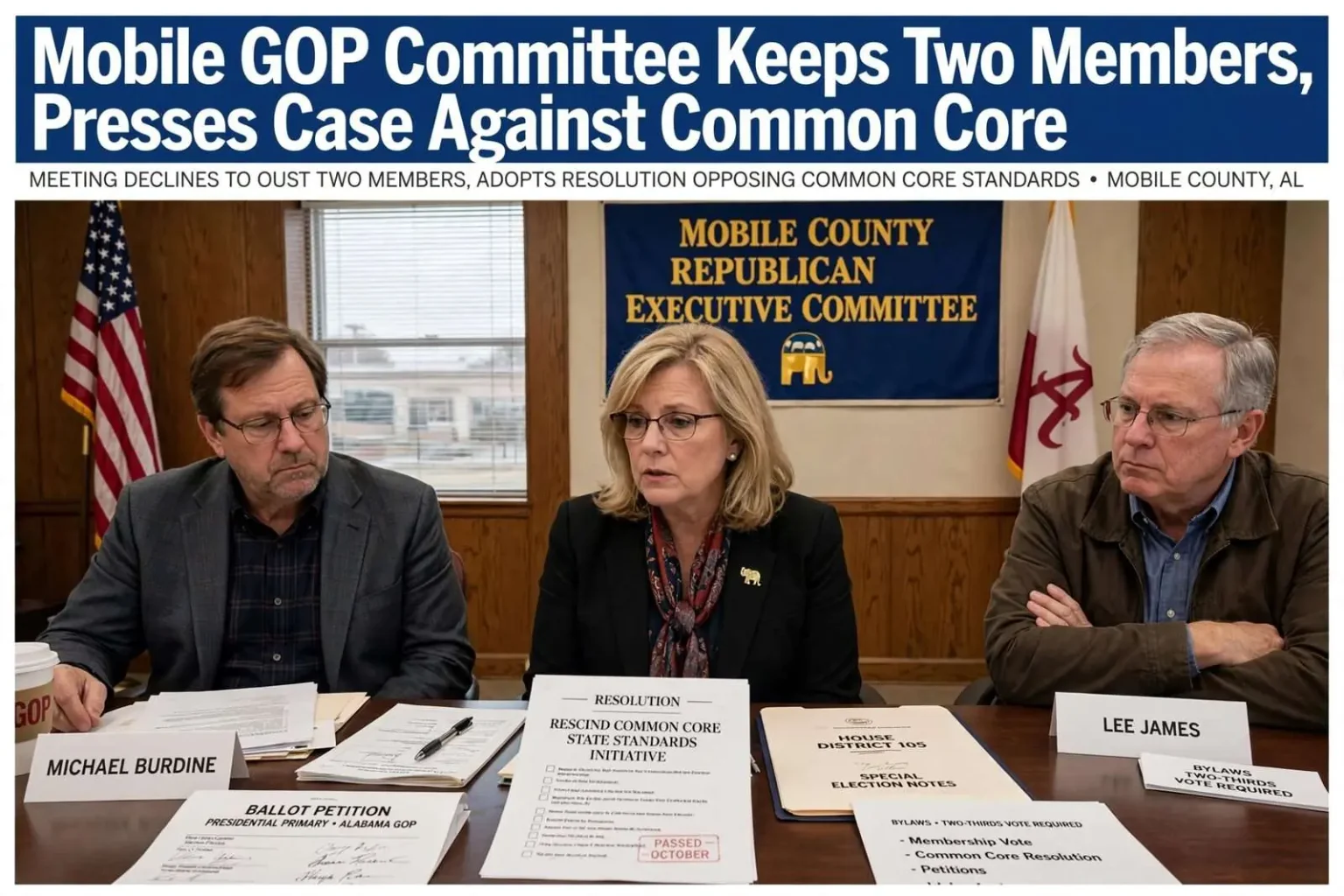
The Mobile County Republican Executive Committee declined to remove two of its members who had come under fire for favoring a Constitution Party contender over the party’s own nominee, and in the same session it joined a growing conservative campaign against national education standards. The meeting bundled together the committee’s internal politics, its routine election-cycle business and a statewide policy fight — a combination that made it one of the more consequential gatherings of the local party in recent memory.
Michael Burdine and Lee James had faced calls for their ouster after they declared Constitution Party candidate Bill Atkinson the true conservative on the ballot, in preference to Republican nominee and ultimate winner David Sessions, in a special election for House District 105 earlier that year. Burdine had himself sought the GOP nomination, giving his break from the party’s nominee an added edge that made the dispute personal as well as political.
An ouster falls short
Meeting that month, the committee failed to record the two-thirds vote its bylaws required to rescind the pair’s membership. As a result, both men remained on the committee despite the controversy over their conduct in the special election. The outcome reflected the practical difficulty of assembling a supermajority to punish members over speech during a campaign — a threshold the bylaws set deliberately high, and one that ensures internal discipline requires consensus rather than a narrow majority.
The seat had opened because former state Rep. Spencer Collier vacated it to accept Gov. Robert Bentley’s invitation to join the administration as director of the state Department of Homeland Security, setting off the special election that produced the intraparty friction. Special elections, by their nature, compress campaigns into a few months and give frustrated factions less time to reconcile, which is precisely the dynamic that played out in the district along Mobile County’s western suburbs.
Ballot access and party business
The committee also handled the mechanics of the coming presidential cycle. Members conducted a grassroots effort to place the names of presidential contenders on the Alabama Republican Party ballot, a process that required petitions bearing set numbers of signatures along with a substantial qualifying fee. The committee forwarded the petitions it gathered to state party officials.
Ballot access work is unglamorous but essential, and it typically falls to county committees because Alabama’s presidential primary rules make the parties, not the state, responsible for verifying which candidates qualify. The petition drive gives county organizations an early organizing task months before voters cast a ballot, and completing it faithfully is one of the quiet ways a county committee demonstrates competence to the state party.
In addition, the body passed a pair of resolutions, one honoring the life and service of former state Sen. Hap Myers, and another that thrust the committee into a statewide policy fight. Resolutions of this kind are the standard currency of party politics — part tribute, part positioning — and the second of the two would travel far beyond the committee room.
A stand against Common Core
The second resolution asked the Alabama State Board of Education to rescind its 2010 vote adopting the Common Core State Standards Initiative. In doing so, the Mobile County committee joined the state GOP executive committee and many other county committees in opposing the standards, making the issue one of the few points of uniform agreement across party organizations at multiple levels that year.
Committee Chairperson Terry Lathan, a former schoolteacher, described a massive movement across Alabama to rescind what she called an ObamaEd program. The initiative, she argued, amounted to a one-size-fits-all approach that would nationalize curriculum and textbooks, potentially allowing a committee in Washington to determine what was taught while leaving state and local officials on the sidelines. It had been adopted, she contended, through the administration and committees rather than by Congress or a vote of the people.
That argument — adoption by state boards rather than legislative action — became the organizing grievance of the anti-Common Core movement in Alabama and across the country. Because the standards were adopted by state boards of education and tied to federal grant incentives and testing requirements, critics argued that a policy governing every public classroom in the state had been set without a single vote in the Legislature or a signature from an elected lawmaker accountable to voters. Supporters of the standards countered that they set benchmarks for what students should know, not how teachers must teach, and that Alabama’s board had voluntarily raised the bar at a time when the state’s reading and math results ranked near the bottom nationally.
A broader campaign
Lathan said state legislators were also pressing the Board of Education to reverse itself, and that candidates for the state school board were being questioned about their positions on the standards. She anticipated that the issue would surface at upcoming gatherings of Republican organizations, including a biennial convention of Republican women and the state party’s winter meeting — venues where the resolution passed by the Mobile County committee could be duplicated by other local parties and carried to the state level.
The strategy reflected how education policy fights travel through party structures in Alabama. County executive committees pass resolutions; state conventions adopt platforms; legislators file bills pointing to the groundswell; and school board campaigns become referendums on the issue. Each step builds a record that officials can cite as evidence of grassroots sentiment, which is precisely why a county committee’s vote on a matter technically outside its jurisdiction is never merely symbolic.
In Mobile County, the fight had a practical edge as well: the county school system is one of the largest in Alabama, and any statewide change in standards would touch more classrooms here than almost anywhere else in the state. Teachers, administrators and parents in the county had a direct stake in whichever way the State Board moved, giving local party members both expertise and strong opinions on the question.
Taken together, the committee’s actions reflected the currents running through local party politics, from lingering tensions over the House 105 race to a coordinated effort to roll back education policy. For the Mobile County GOP, the meeting underscored both its internal divisions and its alignment with a statewide conservative push on schools. The two members it declined to expel would remain at the table for future debates; the Common Core resolution would echo in statehouse hearings and party conventions long after the meeting adjourned; and the presidential petitions it gathered would help set the ballot that shaped the coming primary season. It was, in short, a meeting where a local party body made itself felt on everything from its own membership rolls to the state’s education policy.
The House 105 backdrop
Understanding the ouster fight requires looking back at the special election itself. House District 105, anchored in communities along Mobile County’s southwestern edge, had been held by Collier, a Republican whose departure for the Homeland Security post was framed by the governor’s office as a step in reorganizing the state’s security apparatus. The district’s registration tilted strongly Republican, which meant the party’s nomination was effectively the election — and made any public defection from the nominee by party officials all the more galling to loyalists.
Sessions carried the district despite the high-profile split, but the damage was measured less in votes than in the example it set. Party discipline, long taken for granted in south Alabama legislative politics, had visibly cracked: two members of the county committee itself had campaigned for the other side, and the committee’s inability to muster the votes to remove them suggested the split ran wider than two names. For activists who had pushed the ouster, the failed vote was a rebuke; for Burdine and James, it amounted to vindication by attrition.
What the resolutions mean locally
The tribute to Myers honored a figure whose career spanned both city and state politics, and the resolution gave the committee a moment of unity in a session otherwise defined by division. The Common Core resolution, by contrast, committed the committee to a fight that would extend for years — through legislative sessions in which repeal bills were filed, state board campaigns in which the standards were the central question, and continued pressure from parent and activist groups who made school standards their organizing cause.
County committees rarely control outcomes in such fights, but they supply something national debates cannot: local legitimacy. When a Mobile County body with hundreds of members passes a resolution, area legislators can cite it as evidence that sentiment in their own districts supports action. That is the quiet mechanism by which the meeting’s votes were designed to matter, and it explains why the committee devoted floor time to issues that would never appear on its own agenda otherwise.