University of South Alabama Baldwin County
Courthouse Politics Heat Up in Mobile and Baldwin Judicial Races
A wave of maneuvering reshaped judicial politics across Mobile and Baldwin counties, with a Mobile attorney challenging a sitting judge and a contested probate race taking shape in Baldwin.
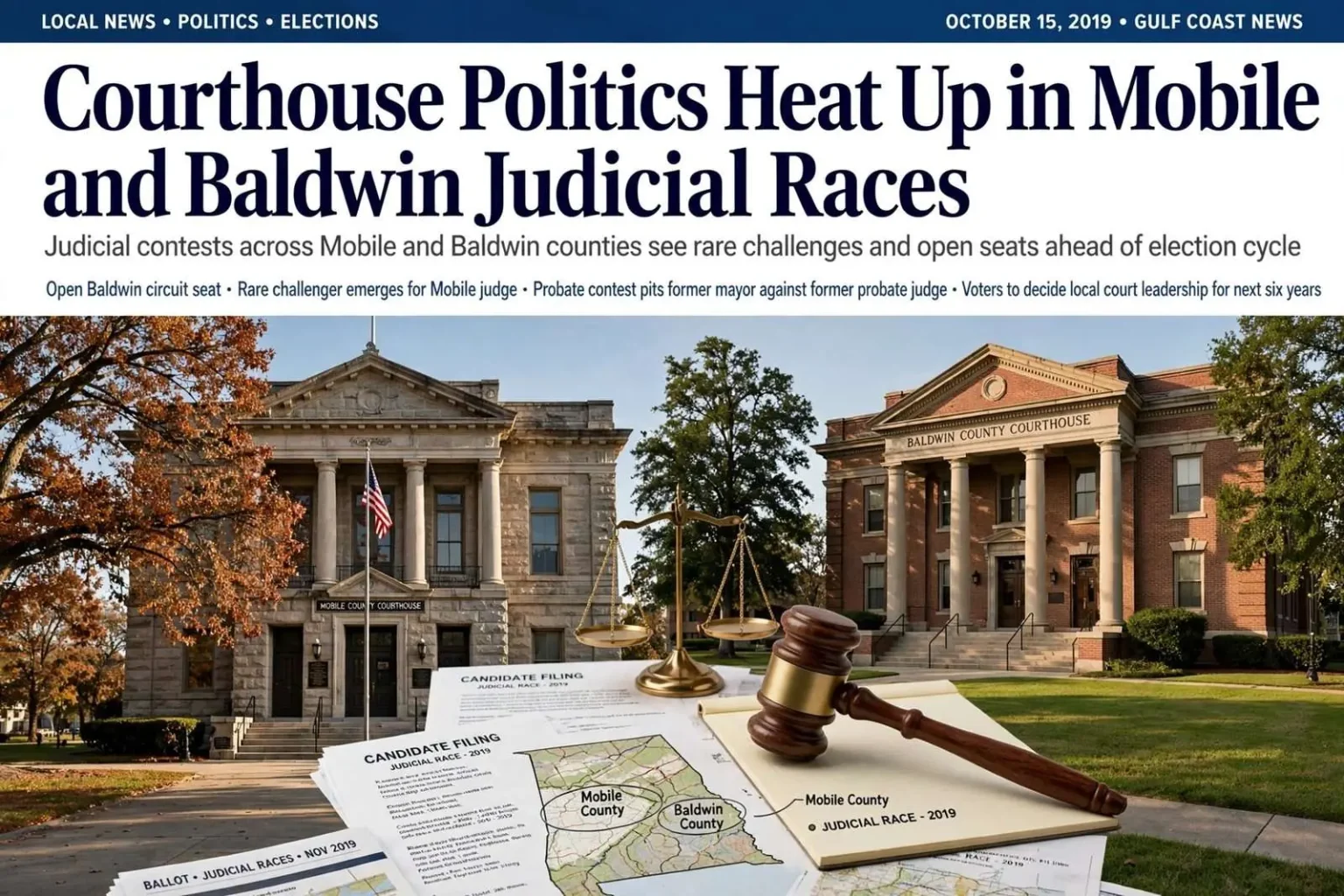
Judicial politics across Mobile and Baldwin counties grew unusually active, as a fresh round of candidacies and rumored challenges reshaped the field of courthouse contests heading into the coming election cycle. The races, spread from circuit benches in both counties to a contested probate seat in Baldwin, promise to give voters a closer look than usual at how local courts are staffed — and at the personal rivalries and party dynamics that shape the ballot below the top of the ticket.
In Mobile County, the typical quadrennial speculation over whether some attorney might challenge one of the county’s dwindling number of Democratic circuit judges gave way to a more novel development. With Judge Jim Wood barred by age from re-election, only well-respected Judges Rick Stout and John Lockett remained as Democratic circuit judges, and their status as Democrats in county-wide voting left them potentially vulnerable. Alabama remains one of the states where judicial candidates run under party labels, and in a county where the electorate has trended Republican in top-of-ticket races, incumbency and name recognition have mattered as much as the letter beside a candidate’s name.
A Challenge From Within the Bar
The biggest surprise came when Mobile attorney Michael Wing decided to run for the circuit judgeship occupied by Judge Rusty Johnston. Wing’s entry, some observers noted, might have been anticipated given his long-running clash with the judge over litigation on Johnston’s docket. Wing had contended that Johnston harbored a bias against him and had sought the judge’s recusal from all of his cases — a dispute that played out in filings rather than on the campaign trail, but one that courthouse observers had followed closely.
Wing, described as a 16-year veteran of the legal profession, was assembling a campaign committee and had contacted local Republican officials about his candidacy. A spokesperson said the challenger would have more to say about his campaign soon, and his early success in signing up supporters and donors would reveal the viability of the effort. Challenges to sitting circuit judges are rare in Mobile County; filing a race against a judge whose courtroom a lawyer regularly appears in is rarer still, and members of the local bar were watching to see whether the contest would reshape professional relationships long after the votes were counted.
The dynamics illustrate how Alabama’s judicial elections differ from the merit-selection systems used in many other states. Circuit judges in Mobile County serve six-year terms and run county-wide, which means a challenger needs the money, name recognition and organizational muscle to reach hundreds of thousands of voters across a metro area. Races at this level are often decided less on courtroom records than on yard signs, bar-association reputations and the quiet endorsements that flow through the county’s legal community.
A Baldwin Comeback Under Consideration
Across the bay, former Baldwin County District Attorney Judy Newcomb told past supporters she was mulling a run for the circuit judgeship being vacated by the retirement of Presiding Circuit Judge Jim Reid. District Judge Jody Bishop had been building a campaign to succeed Reid for months, positioning himself as the ready-made successor while other potential candidates weighed their options.
Newcomb did not confirm a bid, saying she was focused on completing an advanced law degree in tax and finance and on spending time with family, but she left the door open, indicating she would explore future opportunities after finishing her coursework in November. As the county’s former top prosecutor, she carried the kind of county-wide name recognition that most judicial candidates spend years trying to build, and her decision loomed over the race even without a formal announcement.
Some allies reportedly cautioned that Bishop held too large a head start. In a growing county like Baldwin — among the fastest-growing in Alabama, where new residents arrive with no ties to the courthouse establishment — early organization can matter more than long institutional memory. Bishop’s months of fundraising and contact-building meant any late entrant would need to run an accelerated campaign against an opponent who had already been shaking hands through much of the county.
The probate bench in Baldwin County drew its own contest. Former Foley Mayor Tim Russell announced he would seek a full term as probate judge, challenged by former probate judge Harry D’Olive Jr. The office carried a salary of nearly $119,000 for a six-year term — a payoff that reflects the breadth of the job, which in Alabama stretches well beyond wills and estates.
Probate judges in Baldwin County preside over estate and guardianship matters, adoptions, commitments, and a long list of administrative duties that touch daily life across the county. The position also sits at the center of county elections, with the probate office playing a key role in administering voting in one of the state’s fastest-growing jurisdictions — a responsibility that has drawn increased attention as Baldwin’s voter rolls and precincts expand.
D’Olive, a Bay Minette native and Spanish Fort resident, held a criminal justice degree from the University of South Alabama and had served 15 years with the Baldwin County Sheriff’s Office before earning a law degree. His late father had served as probate judge for 28 years, giving the family name an unusual continuity in a county office. That legacy cuts both ways: it offers instant recognition among long-time residents, while a challenger can argue that voters should look forward rather than to a family dynasty.
Russell, for his part, brought a resume that included service as Foley’s mayor and as a state revenue and land commissioner, along with his role leading the state’s homeowners insurance commission. The insurance commission work in particular gave him standing on an issue with direct relevance to coastal Alabama, where homeowners’ premiums and coverage availability have been persistent concerns for residents from Mobile Bay to the Baldwin County beaches. His time as Foley’s mayor also made him a familiar figure in the county’s southern end, where growth along the Highway 98 and Foley corridors has transformed the landscape.
A Season of Contests
Taken together, the developments pointed to an eventful season in the region’s courthouses. Russell planned to launch his campaign with a kickoff rally at a Fairhope farm, and the various races promised to test incumbents and challengers alike. For candidates, the calendar ahead would demand the retail politics of fish fries, civic clubs and church suppers — the same ground game that decides county commission and school board races, applied to offices most voters rarely think about until they need one.
For voters in both counties, the crowded slate of judicial contests offered a rare window into the inner workings of local legal politics, where personal rivalries, party dynamics and long careers all shaped the choices that would ultimately land before the electorate. Judicial races rarely draw the advertising blitzes of statewide contests, but their outcomes shape the courtrooms where divorces, estates, felony cases and county elections are decided for years afterward.
The coming months would also test how much attention voters actually pay to the bottom of the ballot. Turnout in county judicial races typically trails the top of the ticket by wide margins, which rewards campaigns that can mobilize reliable blocs — the bar associations, party organizations, veterans’ groups and neighborhood networks that show up in every election. A challenge born of a docket dispute, a comeback bid by a former district attorney and a probate contest between two familiar names gave both counties something unusual: a full slate of reasons to read all the way down the ballot.
What remained to be seen was whether the early maneuvering would produce more contested races or clear the field. In courthouse politics, the period between a rumored candidacy and a formal announcement is where most challenges die — funding falls short, family objections mount, or a potential rival decides the timing is wrong. Mobile and Baldwin voters had watched that cycle play out every four years for decades.
This time, though, the ingredients for a full season were already in place: an open Baldwin circuit seat with a well-organized favorite and a well-known prospect still weighing the race, a sitting Mobile County judge facing a challenger from his own courthouse, and a probate contest between two names every long-time county resident would recognize. Whatever the final field looked like when qualifying closed, the 2019 maneuvering made one thing clear — the region’s judicial ballots would be worth reading all the way down.
The races also arrive at a moment when the two counties’ courthouses are handling more work than ever. Baldwin County’s population growth has strained dockets and pushed county government to expand facilities and staffing, while Mobile County’s courts continue to manage one of the largest caseloads in the state. The judges chosen in the coming cycle will preside over that growth for six-year terms, long after the campaign signs come down and the kickoff rallies are forgotten — which is, in the end, the strongest argument for the attention this unusual season has drawn.