Mobile Council Weighs ‘Ban the Box’ Resolution to Aid Job Seekers With Records
Mobile could become Alabama's first city to formally back 'Ban the Box,' removing criminal history questions from initial city job applications.
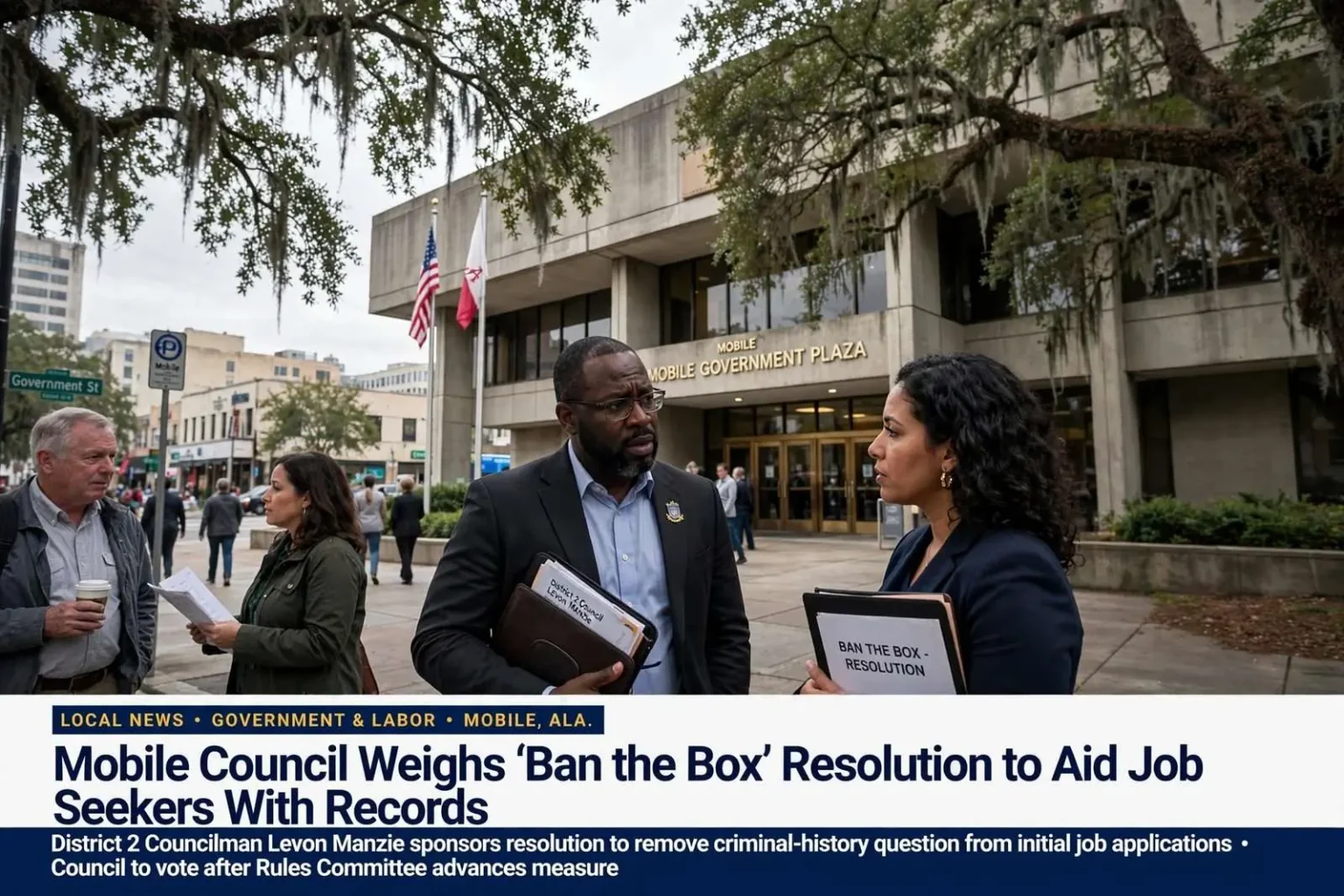
The Mobile City Council is considering a resolution that would make Mobile the first city in Alabama to formally back the national “Ban the Box” movement, which seeks to remove questions about prior arrests or convictions from the initial phase of job applications.
District 2 Councilman Levon Manzie is sponsoring the resolution, which asks the Mobile County Personnel Board to strip conviction and arrest history questions from applications for most city job openings. Manzie said the idea grew out of conversations with elected officials in other cities that have already adopted similar policies, as well as feedback from constituents in his district who described struggling to find steady work because of past mistakes.
Under the proposal, the change would apply to nearly all city positions currently being advertised, with exceptions carved out for jobs involving public safety, finance, or direct work with children or seniors. Rather than eliminating background checks altogether, the policy would move those questions later in the hiring process, giving applicants a chance to be evaluated on qualifications first.
“I believe it’s incumbent upon us to ensure that the least among us have opportunities,” Manzie said, describing the resolution as an effort to help residents who have “paid their debt to society” find a path back into steady employment. He said the city should “lead by example” for private employers in the region, framing the move as both a fairness issue and a practical step toward reducing repeat offenses among people who cannot find legal work.
The resolution first went before the council’s Rules Committee, which heard testimony on both sides of the issue before recommending it advance to the full council for a vote. Manzie said that step allowed members to weigh the potential benefits against any concerns before bringing it to the broader body.
A movement with national reach
Supporters of Ban the Box policies, which have been adopted by cities and counties around the country, argue that the checkbox asking about criminal history on an application does more than gather information — it filters people out before anyone reads a word about their skills. The campaign takes its name from that small square on standard job forms, and its goal is deceptively modest: delay the question until later in the process, after a candidate has had the chance to interview and demonstrate qualifications.
The movement traces its origins to organizing work in the 1990s and early 2000s and has since spread to hundreds of public and private employers nationwide. Major cities across the country, along with a growing number of states, have adopted some version of the policy for government hiring. Several large national retailers and staffing companies have followed, and federal guidance has encouraged employers to consider the timing and individualized nature of criminal-history inquiries under employment law.
Advocates point to the arithmetic behind the issue. A substantial share of American adults carry some kind of arrest or conviction record, and Alabama’s prison system has historically ranked among the most crowded in the nation, meaning thousands of residents return to communities like Mobile each year after completing sentences. Employment is widely identified by researchers and reentry organizations as one of the strongest factors in whether a person returning from incarceration stays out of the system. A record that surfaces on page one of a job application, supporters argue, effectively imposes a lifetime penalty on people who have already served their time.
Critics of the approach raise concerns of their own. Some employers worry that delaying the question forces them to invest time in candidates they ultimately cannot hire for certain positions, and business groups in some cities have pushed for exemptions that preserve flexibility for sensitive roles. Others argue that such decisions should rest with employers rather than city hall. Mobile’s proposal attempts to thread that needle by exempting public safety, finance, and positions involving children or seniors — the categories where the concern about delayed disclosure is strongest.
What it would mean locally
Because the resolution directs the Mobile County Personnel Board rather than rewriting city ordinance, its practical effect would be felt in the paperwork of municipal hiring. The Personnel Board administers the civil service system for city jobs, processing applications for positions ranging from clerical staff and maintenance crews to professional and administrative roles. Under the proposed change, an applicant for one of those jobs would no longer encounter an arrest or conviction question until the process had advanced past the initial screening stage.
Manzie’s District 2 includes portions of downtown Mobile and historically working-class neighborhoods north and west of the city center, areas where the economic consequences of a criminal record hit hardest. In conversations that shaped the resolution, residents described a familiar cycle: a conviction from years earlier appearing at the first step of every application, followed by silence from employers, and eventually a retreat from applying altogether.
The stakes extend beyond individual applicants. Mobile’s economy has been on an upswing in recent years, anchored by the port, the Airbus final assembly line at the Brookley Aeroplex, and the industrial expansion along the Mobile River and in the county’s northern corridor. City government is itself one of the city’s larger employers, and a hiring policy change there carries a visibility that ripples outward. Manzie’s argument that the city should “lead by example” is aimed squarely at that dynamic — the idea that municipal practice can shape regional norms among private employers who watch what the city does.
The fairness argument and the public-safety argument, in the view of supporters, point the same direction. Studies of recidivism consistently find that joblessness is among the most reliable predictors of reoffending, and Alabama policymakers across party lines have emphasized reentry programs in recent years as the state works to reduce prison overcrowding. A city policy that widens the front door to legitimate work, advocates argue, is a crime-prevention measure as much as a civil-rights one.
The timing question — when in the hiring process a criminal-history inquiry is appropriate — has become a mainstream one in employment practice. Federal Equal Employment Opportunity Commission guidance has for years encouraged employers to assess convictions individually, weighing the nature of the offense, how long ago it occurred, and its relevance to the job, rather than screening by category. Ban the Box policies align municipal hiring with that framework by ensuring the assessment happens with a full picture of the candidate, not a checkbox alone.
Next steps at City Hall
The resolution’s path through the Rules Committee gave council members a first structured look at the arguments on each side, with testimony from supporters and from those with reservations. Its advancement to the full council sets up a vote in the council chamber on Government Street, where members routinely weigh symbolic and practical measures alongside the city’s budget and zoning business.
If adopted, Mobile would become the first city in Alabama to formally endorse the Ban the Box approach for its own hiring. That distinction carries weight in a state where no other municipality has taken the step, and supporters hope it provides a template for Birmingham, Montgomery, Huntsville and smaller cities considering similar questions.
The vote would not end the debate. Implementation details — how the Personnel Board sequences background inquiries, how exceptions are documented, how applicants are informed of the change — would follow adoption, and the measure’s real impact would show up over time in who applies for city jobs and who advances through the process.
For the residents whose stories shaped the resolution, the measure represents something more concrete than policy language: a chance to be seen first as a worker and only afterward as a person with a record. Manzie has framed it the same way, describing the city’s obligation in terms of opportunity for those who have completed their punishment and are asking for a way back into the economy. The full council now has the chance to decide whether Mobile becomes the first Alabama city to say yes.
The measure also arrives at a moment when Alabama’s own state government has been rethinking consequences for people with records. Lawmakers in recent sessions have expanded certificate-based relief and worked through court-organized supervision reforms designed to shorten supervision terms and clear paths out of the system for compliant individuals. Those changes operate at the state level; what Manzie’s resolution offers is a local, practical complement aimed at the first hour of a job search rather than the last day of a sentence.
Supporters acknowledge that a resolution does not transform the labor market overnight. Private employers in Mobile remain free to structure their applications as they see fit, and no provision of the measure compels anyone outside city government to change a form. What it does change is the example the city sets — the largest visible employer on the Gulf Coast deciding, formally, that a person’s qualifications deserve to be read before their record is. In cities that have adopted similar policies, advocates say the private sector often follows within a few years, first through larger employers with formal diversity commitments and eventually through the smaller businesses that make up most of the local economy.
For now, the question before the council is a narrow one: whether the city’s own application forms should ask about a person’s past at step one or step five. How members vote will determine whether Mobile leads the state on the question or waits for another city to go first.