A Newcomer on a Flatbed Truck: Nathan Davis Signals a Challenge in House District 104
Political newcomer Nathan Davis appeared in the Tillman's Corner Christmas Parade with campaign signs, signaling a possible challenge to state Rep. Jim Barton in House District 104.
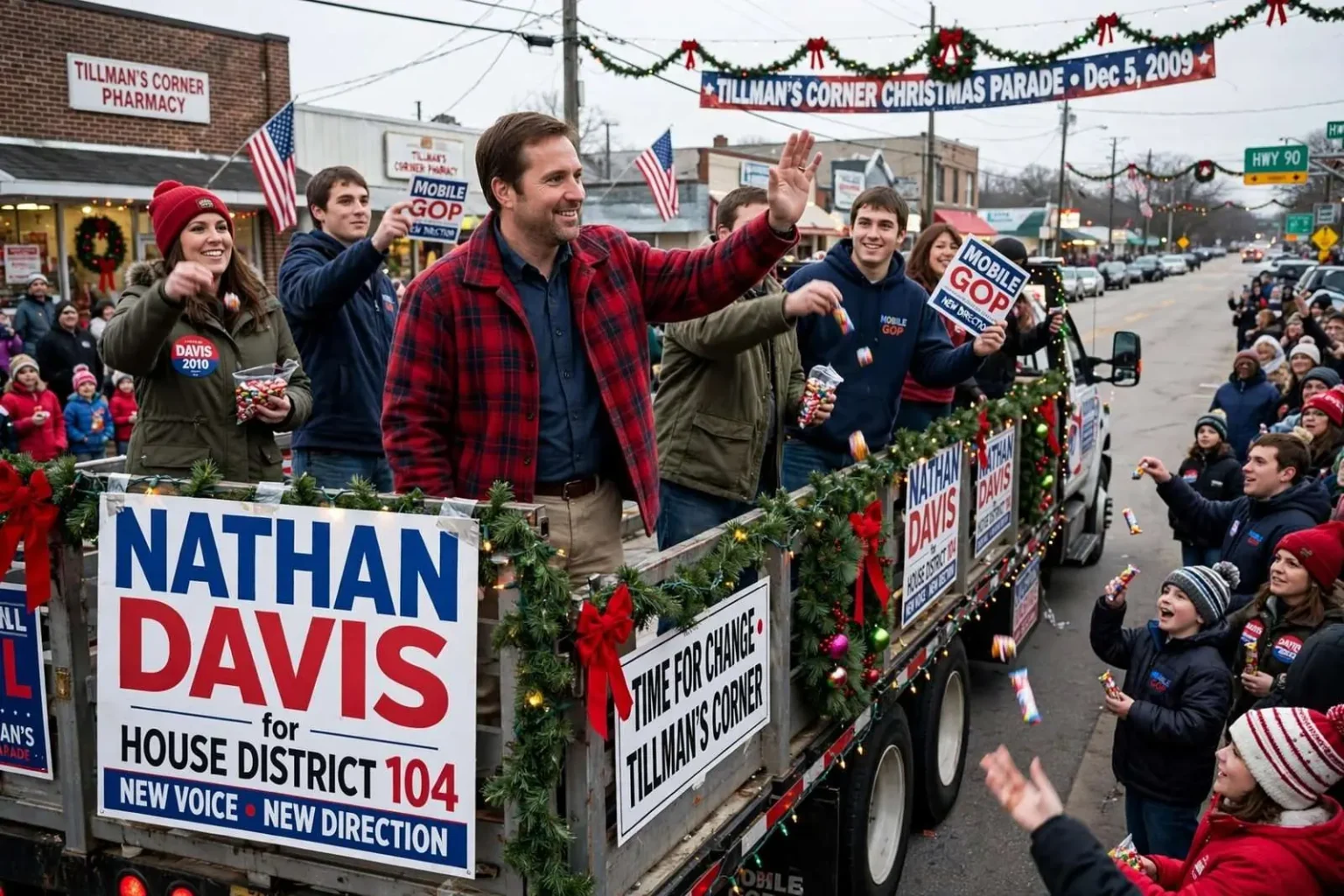
The first sign of a challenge to state Rep. Jim Barton came, appropriately enough for Mobile County, on a flatbed truck in a Christmas parade. Political newcomer Nathan Davis was reported to have taken part in the Tillman’s Corner Christmas Parade on Dec. 5, 2009, riding with supporters who tossed candy to the crowd and waved signs announcing a campaign for the House District 104 seat — the seat Barton, a Mobile Republican, had held and would be defending in the 2010 elections.
In most of Alabama, a challenger’s first public move is a press release or a qualifying filing. In Mobile County, it is more likely to be a parade float. The Tillman’s Corner Christmas Parade draws the sort of neighborhood crowd that legislative candidates court for months, and its route runs through the commercial heart of the very district Davis hoped to represent. Showing up there with printed signs and a truckload of supporters was, in effect, the opening argument of a campaign.
Working the Room, and the Route
Davis had reportedly been attending meetings of local Republican organizations in the preceding weeks, including the Young Republicans and MobileGOP. That is the conventional path for a first-time candidate in Mobile County: appear at the club luncheons, shake the hands of the people who hand out sample ballots, and see whether the party’s activist base is receptive before committing to a race.
Those clubs matter more than their membership rolls suggest. In county races where name recognition starts near zero, the regulars who attend monthly luncheons are the volunteers who staff polls, forward emails and answer the phone when a neighbor asks who to vote for. A newcomer who earns their goodwill in the fall before an election can inherit an infrastructure no flatbed truck can buy.
A parade is a different kind of test. Anyone can rent a flatbed truck; the question is whether anyone rides on it with you. Turning up in the Tillman’s Corner parade with a crew of supporters and printed signs is a way of announcing, without formally announcing, that a campaign exists. It buys no votes by itself, but it tells the incumbent — and any other would-be challengers — that the seat is being contested.
Understanding the District
House District 104 covers a stretch of southwest Mobile County anchored by Tillman’s Corner, the unincorporated community at the crossroads of Highway 90 and Interstate 10 where much of the county’s working population lives and shops. It is a district of subdivisions, small businesses, churches and industrial employers — not the moneyed precincts of Spring Hill, and not the rural reaches of north Mobile County either.
Tillman’s Corner itself grew from a rural crossroads into one of the county’s busiest commercial nodes, its identity shaped by decades of annexation battles and unincorporated self-reliance. Residents there have historically been attentive to state government in practical ways: road widening, school zones, drainage projects and the tax questions that follow growth. A representative from the district spends as much time on those nuts-and-bolts issues as on anything debated in the State House.
The district’s voters also tilt Republican, which made Davis’s choice of audience unremarkable and his challenge unusual. Primaries, not general elections, have typically decided the seat, and a challenger entering in December of an election year was already late by the standards of the county’s party machinery. What Davis lacked in time, though, he appeared ready to trade for visibility — parades, club meetings and wherever else the district’s voters gathered that winter.
The Stakes of the 2010 Cycle
Barton had built a reputation in Montgomery as one of the more visible members of the Mobile County delegation. Like every other Republican in the Legislature that year, he was preparing for a cycle in which his party believed, for the first time in more than a century, that it could take control of both chambers.
That prospect changed the calculus for every legislative race in Alabama. For more than a hundred years, Democrats had controlled the state House and Senate, and Republicans had poured resources into legislative districts hoping to break through. An incumbent like Barton could expect attention and money flowing into Mobile County legislative races; a challenger like Davis could expect the opposite — a party focused on protecting what it had, and donors hesitant to fund a race against a sitting Republican in a year with so much at stake down ballot.
For the incumbent, the arithmetic of incumbency in a district like 104 usually holds: name recognition built over years of constituent service, relationships with the county delegation and local officials, and a record of the road and drainage projects that Tillman’s Corner voters actually call about. Challengers have to introduce themselves from scratch, and the parade circuit is where that introduction begins.
How Challenges to Local Incumbents Take Shape
The pattern Davis was following — club meetings in the fall, a parade appearance in December, a formal announcement later — is one that Mobile County legislative watchers have seen many times. Challengers test the waters quietly because a failed challenge is costly in a small political community. Backing a losing primary candidate can burn relationships that business owners and party activists need later, so few people commit publicly until a challenger demonstrates traction.
A parade float is a low-cost way to demonstrate that traction. Candy and signs cost a fraction of a billboard or a mail campaign, and the audience is exactly the district’s own voters rather than the broader media market. If the float draws volunteers and the club meetings keep producing invitations, the campaign has the early evidence it needs to approach donors and, eventually, to qualify.
If it does not — if the same handful of supporters ride the truck from event to event — the campaign usually ends the way most exploratory campaigns do, quietly, before qualifying ever opens. That is why December appearances are read closely by the county’s political class: they are the first measurable signal of whether a challenge is real.
What the Seat Means Locally
House District 104’s concerns in that era were the practical ones of a growing suburban-unincorporated area: congestion on the Highway 90 and Interstate 10 corridors, school construction in a county system absorbing steady growth, and the perpetual question of how Mobile County’s legislative delegation divided influence over local bills and state spending. Whoever held the seat sat in the room when those decisions were made, and voters in Tillman’s Corner had long paid attention to who that was.
Barton’s visibility in Montgomery gave the district seniority and a voice in budget conversations; Davis’s campaign, whatever its outcome, promised to test how much that mattered to voters against a desire for new representation. The race would play out through the spring and summer of 2010, through qualifying and, if it reached that stage, a primary in June.
But the sequence that started it was pure Mobile County: not a kickoff press conference downtown, but a flatbed truck crawling down a parade route in Tillman’s Corner, throwing candy to the same families whose votes would decide the seat the following June. In the county’s political culture, that is how campaigns are born — out where the voters are, one waving sign at a time.
A District That Watched Its Roads
If one issue defined the politics of southwest Mobile County in that era, it was transportation. The interchange at Highway 90 and Interstate 10 funneled thousands of commuters through Tillman’s Corner daily, and growth down Airport Boulevard and along the I-10 corridor kept pressure on roads that the state rebuilt a piece at a time. Residents tracked the schedules of those projects the way other communities track football seasons, and the legislator who could report progress — or explain a delay — had a constituent-service story to tell at every civic club meeting in the district.
Schools ran a close second. The Mobile County Public School System, the largest in the state, was managing enrollment shifts as subdivisions spread south and west, and district voters had opinions honed by years of building programs, rezonings and tax referendums. A representative from House District 104 sat in the caucus room when education budgets were divided, and parents in the district knew it.
Drainage and development rounded out the list. Unincorporated Tillman’s Corner depended on county government and the legislative delegation for the infrastructure decisions that annexed cities made for themselves, giving the area a distinctive political character: pragmatic, attentive to results, and skeptical of politicians who talked about issues that never reached the neighborhood.
The Winter Ahead
As the 2009 Christmas parade receded, the real test of the Davis campaign began. Qualifying deadlines in the spring would force a formal decision, and until then the challenger’s task was to convert parade waves into club memberships, club contacts into volunteers, and volunteers into the network a primary campaign requires. Barton, for his part, would run the race incumbents run — on record, seniority and the visible results of years in office.
Whatever happened between the flatbed truck and election day, the episode captured how politics actually works in Mobile County’s neighborhoods. The county’s campaigns begin where its people gather: at luncheons with rubber chicken, at holiday parades down Highway 90, at the crossings where a district’s daily life happens in plain view. A newcomer who understood that — as Davis apparently did — was already halfway to being taken seriously.