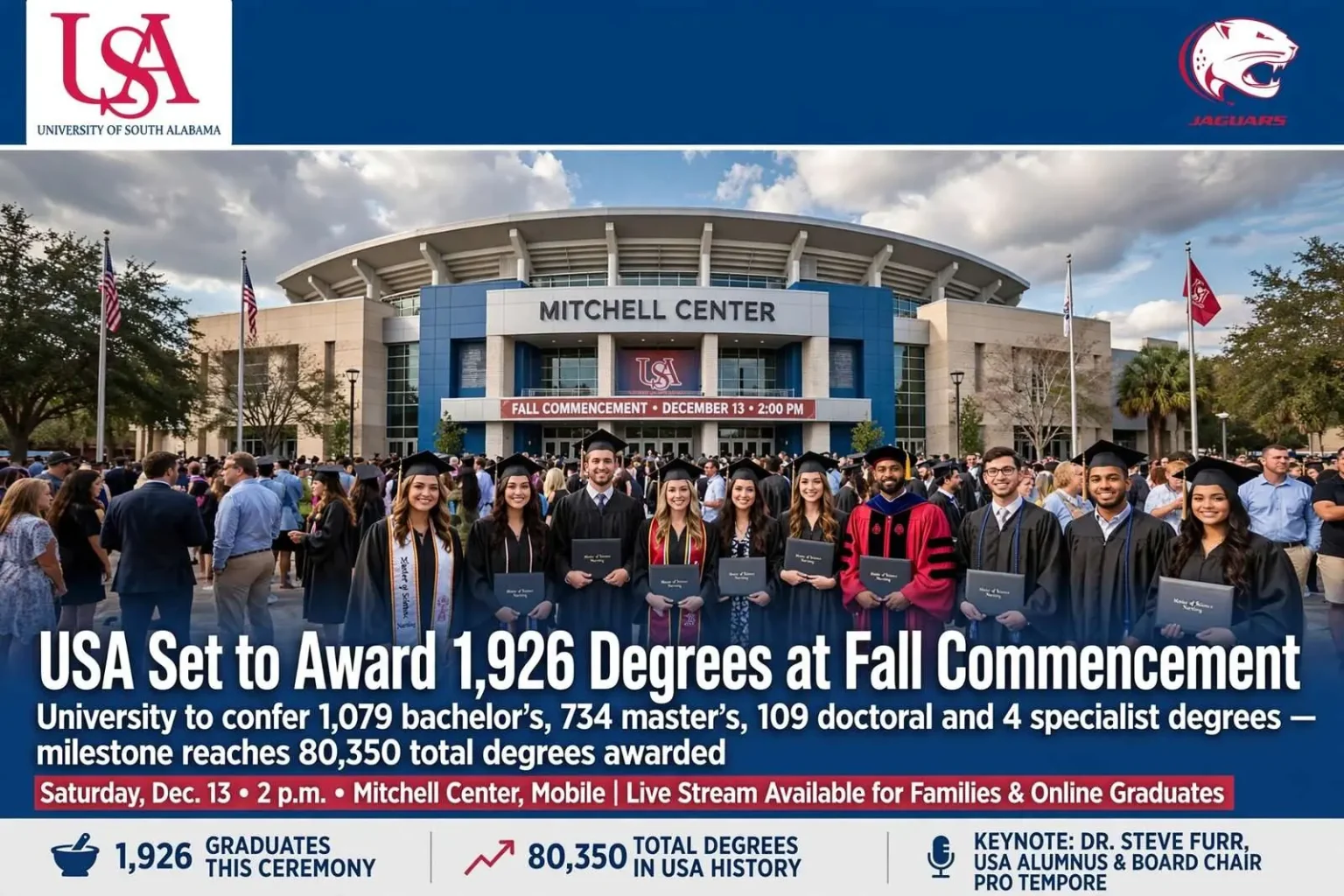
The University of South Alabama is preparing to award nearly 1,930 degrees at its fall commencement ceremony, scheduled for Saturday, Dec. 13, at 2 p.m. at the USA Mitchell Center in Mobile. The ceremony will confer 1,079 bachelor’s degrees, 734 master’s degrees, 109 doctoral degrees and four educational specialist degrees. Combined, the graduating class will push the university’s total number of degrees awarded throughout its history past 80,000, reaching 80,350.
Fall commencement traditionally honors students who completed their degree requirements during the preceding summer and fall terms. The December class looks different from the spring’s: it skews toward graduate students finishing master’s and doctoral programs midyear, working professionals who completed coursework while holding jobs, and undergraduates who picked up extra terms along the way. For all of them, the ceremony marks the same milestone — a degree earned in a season when most American campuses are between terms.
The composition of the class reflects the university’s range. Nearly 740 master’s degrees in a single ceremony is a substantial figure, the product of programs in business, education, engineering, nursing and the health professions that serve working students across the Gulf Coast. The 109 doctoral degrees represent the research side of the university, from the biomedical sciences that tie into USA’s academic medical enterprise to education and leadership programs that send graduates into school systems and institutions across the region.
A Milestone in the University’s History
Crossing 80,000 degrees awarded is a threshold worth pausing on. The University of South Alabama was founded in 1963 as one of the state’s newer public universities, created to serve the rapidly growing Gulf Coast region, and its first classes were held in borrowed space before the Mobile campus took shape. Six decades’ worth of graduates now include physicians, nurses, engineers, teachers, business owners and public servants across Alabama and far beyond, and the pace has only quickened as the university’s programs have multiplied.
The Mitchell Center, the ceremony’s home, is the university’s largest indoor venue and the regular setting for commencement exercises, basketball games and major campus events. Its capacity allows most graduating classes to bring full families, and the December ceremony’s afternoon start time makes it practical for relatives traveling from across the region to attend without an overnight stay.
Graduate degree counts like this year’s also reflect a national shift in who attends university. More students than ever complete a bachelor’s degree, work for several years, then return for a master’s or specialist credential to advance in their field. Universities in growing metro areas have built their graduate programs around those students, offering evening cohorts, hybrid courses and compressed formats that let a teacher or nurse manager keep working while studying. The 734 master’s degrees walking across the Mitchell Center stage in mid-December are, in large part, the product of that model.
The Keynote Speaker
This year’s keynote speaker is Dr. Steve Furr, a family medicine physician based in Jackson, Alabama, and a longtime member of the university’s Board of Trustees. Furr is a USA alumnus who earned his bachelor’s degree in biology in 1976 before returning to complete his medical degree in 1981. He has served on the Board of Trustees since 2006 and currently holds the role of chairman pro tempore.
Furr’s ties to the university run deep. He served as the founding chair of the USA Children’s & Women’s Hospital Development Council and was part of the leadership council for the university’s 50th anniversary fundraising campaign. Along with his wife, Lisa, he has supported a wide range of university initiatives over the years, including the College of Medicine, Jaguar athletics, the Moulton Tower project and the Mitchell Cancer Institute.
His career path mirrors the university’s own growth. Family medicine physicians form the backbone of rural health care in south Alabama, and Jackson — the Clarke County seat north of Mobile — is exactly the kind of community where USA-trained doctors have long served. Graduates who leave Mobile’s medical programs for small towns across the region represent one of the university’s most tangible impacts, filling primary care roles that recruiting from outside the state has never fully met.
Their most recent gift went toward an endowment supporting priority needs at the Children’s & Women’s Hospital, and the hospital’s lobby was named in the couple’s honor in recognition of their giving. Furr was recognized last spring with a Distinguished Alumni Award from the USA National Alumni Association. He also helped establish a new Board of Trustees scholarship that will provide funding to the top academic performer in each incoming freshman class.
That scholarship structure says something about how the university sees itself. Rather than directing aid only to students with financial need, the trustees’ scholarship rewards the highest academic performer in every entering class — a signal that USA intends to compete for top students, not just serve them. For the December graduates listening to the keynote, the message lands with particular force: the speaker is describing the same institution they are about to join as alumni.
Furr’s selection as keynote speaker follows a pattern the university has favored in recent years: alumni who have distinguished themselves in service to their communities. A speaker who studied biology in the same classrooms current graduates passed through, then built a medical career in a small Alabama town, offers a narrative that resonates differently than an outside dignitary’s address. Family medicine, in particular, carries weight at USA, whose College of Medicine was founded explicitly to supply physicians to Alabama’s underserved regions — a mission that has made the university one of the state’s principal sources of homegrown doctors.
Watching From Home
For families and community members unable to attend in person, the university has again partnered with the Mobile County school system to livestream the ceremony through its website. A recorded version of the event is expected to remain available online following the broadcast, giving graduates and their supporters across South Alabama a chance to watch even if they can’t make it to the Mitchell Center in person. The recording also lets graduates revisit the day itself, hearing their names called long after the tassels have been turned.
The livestream partnership has become a quiet tradition of its own. Mobile County’s school system reaches households across the county through its web infrastructure, and families with relatives in other states — including graduates of USA’s online programs who never relocated to Mobile — rely on the recording to see the ceremony. For military families stationed far from home, a common circumstance in the Mobile area, the archive means a graduation is never truly missed.
Commencement in the University Calendar
The December ceremony is one of two commencement events USA holds each academic year, alongside a spring ceremony, and remains one of the larger annual gatherings on the Mobile campus. The two-ceremony structure matches the reality of modern university life: students finish degrees at different times of year, and a single spring event would leave December graduates waiting months for recognition or skipping the ceremony entirely.
For the university, commencement weekend also serves as a seasonal reunion. Alumni return with their graduates, faculty regalia fills the floor of the Mitchell Center, and the campus hosts a wave of visitors whose last look at USA may have been years ago. Local businesses feel the December bump as families fill restaurants and hotels around the celebration.
The ceremony’s program follows the familiar arc of American commencements: the academic processional, greetings from university leadership, the keynote address, the conferring of degrees by college and the traditional turning of tassels. Doctoral candidates are individually hooded, a moment that often draws the loudest applause of the afternoon from families who watched years of coursework, research and dissertation writing come to a close.
Behind the scenes, commencement is one of the largest logistical undertakings on the academic calendar. Regalia is ordered months in advance, degree audits are completed so every walker’s name is correct, and ushers coordinate seating for thousands of guests. University staff begin preparing the Mitchell Center days ahead, and the ceremony itself runs on a minute-by-minute schedule that moves more than 1,900 graduates across the stage in a single afternoon. Few campus events require this much coordination.
For the 1,926 graduates whose names will be called, the afternoon marks both an ending and a beginning. Some will remain in Mobile, joining the region’s hospitals, schools and businesses; others will carry their degrees across the country and around the world. All of them, though, become part of the 80,350 — the growing count of South Alabama graduates whose diplomas trace back to a young university on the Gulf Coast that awarded its first degrees barely a lifetime ago. The count keeps climbing with every ceremony.