Volunteer Crew Brings USS Alabama to Life with Pearl Harbor Reenactment
Volunteers with the USS Alabama Living History Crew staged a Pearl Harbor-era battle drill aboard the battleship at Battleship Memorial Park in Mobile.
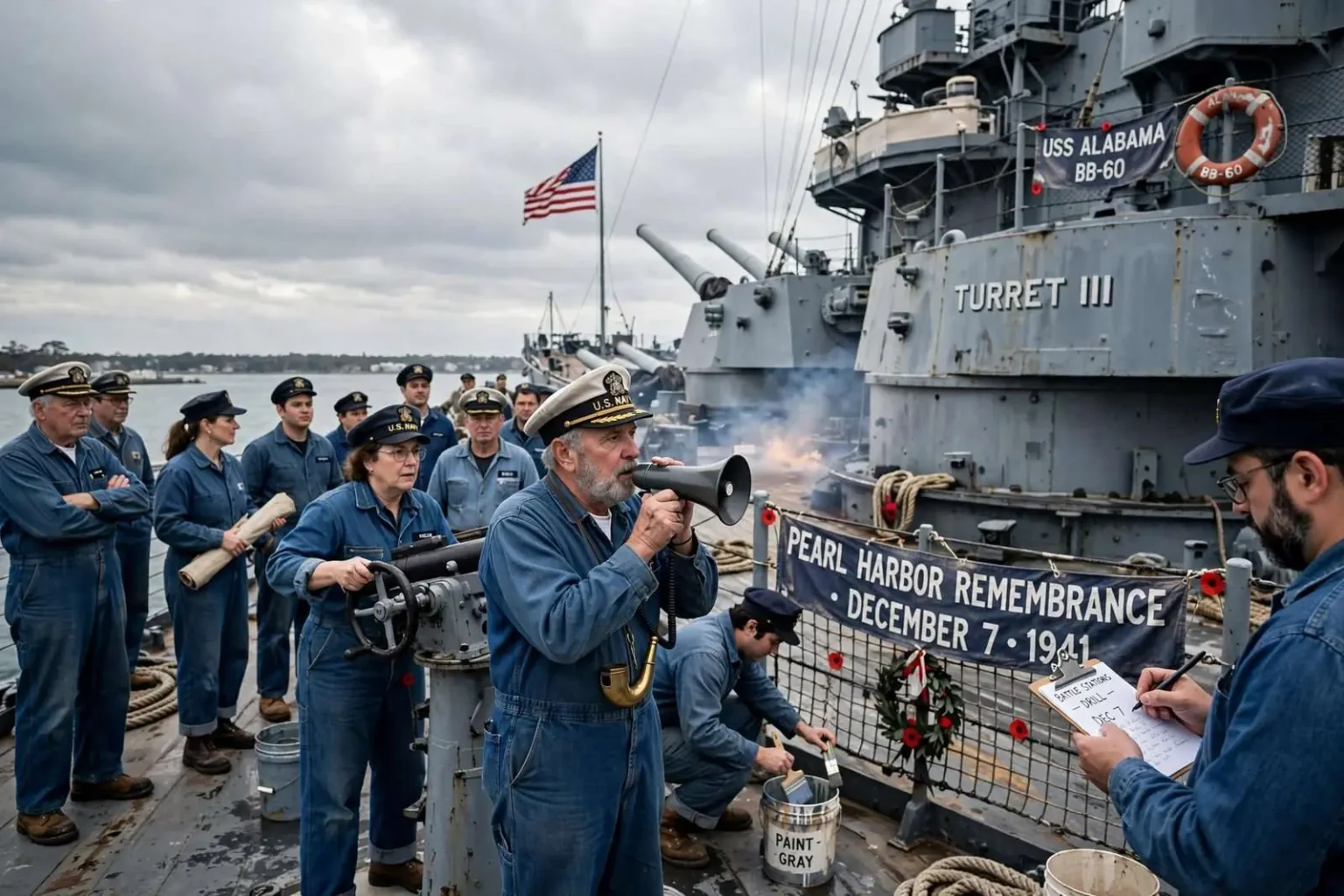
MOBILE, Alabama – Aboard the battleship USS Alabama, a crew of volunteers spent a December weekend re-creating the sights and sounds of a World War II-era gun drill, marking the anniversary of the attack on Pearl Harbor with a living-history demonstration at Battleship Memorial Park.
About 15 volunteers, dressed in blue dungarees, 1940s-style Navy caps and period boots, spent the day painting, cleaning and standing watch as if they were part of the ship’s original crew before staging a simulated fire drill on the fantail.
The event marked the first time the group had organized a demonstration tied specifically to the December 7 anniversary since forming in April 2013.
Pearl Harbor Day carries particular weight at Battleship Memorial Park. The South Dakota-class battleship that bears the state’s name was still under construction when Japanese aircraft struck the Pacific fleet on December 7, 1941, and it entered service the following year to fight through the campaigns that followed. Aboard a preserved warship from that era, the anniversary is not an abstract historical date — it is the reason the vessel exists as a memorial to the sailors of Alabama who served and died in the war, many of them in the Pacific theater.
The choice of a gun drill as the demonstration’s centerpiece was fitting. The battleship’s nine 16-inch guns in three triple turrets, along with its batteries of smaller mounts, defined the ship’s purpose, and gun crews were the heart of its wartime complement. A drill simulated the disciplined choreography of loading, elevating and firing under a gunnery officer’s direction — work performed by crews of teenagers and twenty-somethings in the 1940s, working in confined spaces at the edge of combat.
For visitors on the deck that weekend, the demonstration bridged the gap between the ship as museum and the ship as machine. The Alabama has sat in Mobile Bay since 1965, and its static displays — the turrets, the gun mounts, the tight corridors of the crew spaces — tell their story silently. Watching a crew in period uniform man the fantail mounts, respond to commands and work the equipment restores some of the noise and motion the museum lacks.
The Living History Crew
The volunteers belong to the USS Alabama Living History Crew, an organization that meets aboard the battleship every other month and draws members from across Alabama and neighboring states.
The group’s commanding officer said the crew has room for roughly 2,500 volunteers, matching the number of sailors who once served aboard the vessel, and continues to recruit new members regardless of military background. Participants have ranged in age from teenagers to volunteers in their late 80s.
That ambition — to one day field a reenactment crew as large as the ship’s original complement — gives the group a goal that doubles as a memorial. The USS Alabama earned nine battle stars in World War II and carried its crew through the Atlantic and Pacific without losing a sailor to enemy action, a record the volunteers honor by learning the trades and routines that kept the ship fighting. Every other month, the group’s workdays double as maintenance for the museum itself: the painting, cleaning and upkeep that a 45,000-ton warship requires simply to survive the Gulf Coast climate.
The membership’s breadth is central to the group’s character. Veterans and civilians, teenagers and octogenarians, practicing tradesmen and history teachers — the crew welcomes anyone willing to wear the dungarees and learn the drills, and its ranks have grown through word of mouth among families who visit the park and decide to come back with a purpose.
The membership’s breadth is central to the group’s character. Veterans and civilians, teenagers and octogenarians, practicing tradesmen and history teachers — the crew welcomes anyone willing to wear the dungarees and learn the drills, and its ranks have grown through word of mouth among families who visit the park and decide to come back with a purpose.
Roles drawn from real life
One volunteer serving as boatswain’s mate for the day, a middle school geography and civics teacher and Army veteran who served in Iraq, said he purchased his own boatswain’s pipe and smoking pipe to complete the role. He described the appeal of historical reenactment as a chance to understand firsthand what sailors of the era wore and experienced, calling it “a labor of love.”
Other volunteers said they try to choose roles that connect to their real-world skills or interests. An HVAC technician from Florence noted that some trades, like air conditioning repair, simply did not apply to a 1940s-era warship.
The observation gets at a truth the crew discovers as members dig into their roles: life aboard the Alabama in the 1940s ran on technologies and hardships that modern trades barely recognize. Ventilation below decks meant blowers and open hatches rather than climate control. Communications ran on flags, lamps and voice tubes. Even routine tasks — laundering uniforms, baking for a crew of thousands, storing produce for weeks at sea — required shipboard systems a modern tradesman has to relearn from scratch. That gap is precisely what makes the reenactment educational, for the volunteers as much as the audience.
The teacher’s improvised props illustrate the group’s approach to authenticity. Reenactment at this level is built on details — the boatswain’s pipe’s piercing call that once carried over a working deck, the rituals of watch standing, the dungarees and caps that identified a sailor at a glance. Volunteers research their roles, and many spend their own money on equipment to get them right, a commitment the group’s leadership describes as the difference between a costume and a portrayal.
A flyover canceled, a drill carried on
The demonstration was originally supposed to include a flyover by two vintage aircraft departing from an airport in Bay Minette, but low cloud cover forced organizers to cancel the flight.
The ship’s crew carried on regardless, running through a simulated call to battle stations complete with commands relayed over the ship’s public address system and megaphone, followed by the sound of blank cannon fire from the fantail gun mounts while visitors looked on from the deck.
The weather cancellation deprived the crowd of one of the day’s planned spectacles — period warbirds circling over the bay, a sight the park’s airpower displays usually deliver — but it also pushed the demonstration back to its core: the crew, the ship and the drill itself. Blank cannon fire from the fantail echoes across the water at the park’s entrance, where the battleship sits alongside the causeway, and for visitors that weekend it supplied the soundscape the flyover was meant to complement.
Battleship Memorial Park, home to the USS Alabama and the submarine USS Drum, has long served as one of Mobile’s most visited attractions and a hub for military history education in the region. The park’s collection also includes aircraft and armor spanning the decades since the war, drawing school groups, veterans’ organizations and tourists through Mobile Bay’s year-round visitor traffic.
Battleship Memorial Park, home to the USS Alabama and the submarine USS Drum, has long served as one of Mobile’s most visited attractions and a hub for military history education in the region. The park’s collection also includes aircraft and armor spanning the decades since the war, drawing school groups, veterans’ organizations and tourists through Mobile Bay’s year-round visitor traffic.
Volunteer reenactment groups like the Living History Crew supplement the park’s static displays with hands-on demonstrations meant to give visitors a closer sense of daily shipboard life during the ship’s active service.
The division of labor between museum and volunteers has become a productive one. Park staff manage preservation, operations and the aircraft and memorial exhibits that make up the broader grounds; the living history crew supplies the human element that no placard can — a sailor’s posture at a gun mount, the rhythm of commands on a drill, the details of uniform and equipment that turn a preserved space into a scene. Museums across the country have adopted similar living-history programs as attendance studies consistently show they deepen what visitors retain, particularly among school-age audiences.
The Pearl Harbor anniversary demonstration also placed the crew’s work in the context the ship was built for. The battleship’s wartime service — Atlantic convoy duty, Pacific shore bombardment, presence at the Japanese surrender in Tokyo Bay — is preserved in the ship’s records and the park’s displays, but the drills that made that service possible were performed by crews the age of many of the volunteers’ own children and grandchildren. Demonstrations like the weekend’s turn that abstraction into something a visitor can watch unfold in real time.
Organizers said they plan to continue holding demonstrations throughout the year, with future events likely to focus on other milestones in the battleship’s service history.
The group’s calendar will build on the Pearl Harbor anniversary as the first of its themed events. A ship with the Alabama’s combat record offers no shortage of commemorations to draw on, from Atlantic convoy duty to the Pacific campaigns that carried the war to its end, and each demonstration gives the crew a fresh drill to master and a new story to stage for the public.
For the volunteers themselves, the December weekend ended the way the workdays always do — with a ship better maintained than they found it, and a crew more practiced in the routines of the sailors they portray. The cannon smoke over the fantail and the commands echoing through the public address system were, for an afternoon, the closest Mobile Bay gets to the ship at war.