Airbus Posts New Round of Hourly Jobs for Mobile A320 Assembly Line
Airbus has posted new hourly job openings, including tool shop attendants and flight line technicians, for its growing Mobile A320 assembly line.
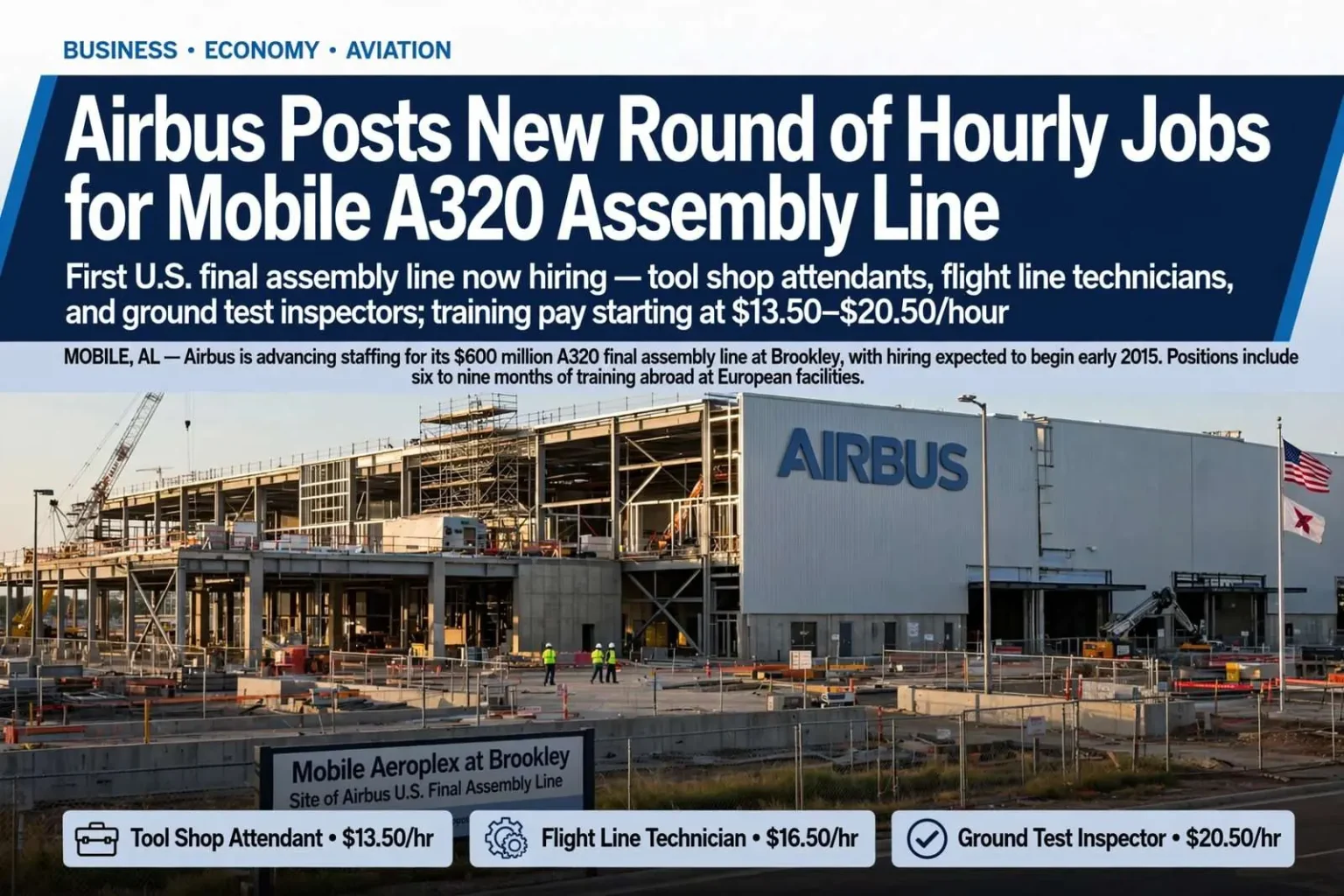
Airbus has posted another round of hourly job openings tied to its A320 final assembly line under construction at Mobile Aeroplex at Brookley, giving South Alabama job seekers a fresh set of positions to apply for even though actual hiring isn’t expected to begin until early 2015.
The postings signal that the European aircraft maker is moving ahead with the staffing pipeline for the first final assembly line it has ever operated on American soil. While the assembly building rises at the Brookley industrial complex south of downtown, the company is laying the groundwork in parallel — defining roles, setting pay scales and building the applicant pool it will draw from when production staffing begins in earnest.
The latest postings include final assembly line tool shop attendants, with starting hourly training pay set at $13.50, and flight line technicians, who start at $16.50 an hour during training. Airbus is also hiring ground test inspectors, a higher-skilled role with training pay set at $20.50 an hour. All three positions require six to nine months of training abroad before employees begin working on the Mobile line — a signature feature of how Airbus staffs new assembly plants, sending its first waves of hires to established facilities in Europe to learn the company’s processes before they ever touch an aircraft in Alabama.
Who Airbus Is Looking For
Tool shop attendants will be responsible for the inventory, inspection and maintenance of manufacturing tools, and candidates need a high school diploma or equivalent along with at least three years of experience in logistics or tool management in a manufacturing setting. The role may be the least glamorous of the three, but it is among the most essential: a modern final assembly line runs on calibrated, specialized tooling, and a missing or out-of-tolerance tool can idle a station and cascade delays through the entire line.
Flight line electrical and avionics technicians will handle installation, testing and maintenance of aircraft electrical and avionics systems, while flight line mechanical technicians will cover mechanical, hydraulic, sheet metal and composite systems. Both technician roles require a high school diploma and at least five years of relevant military or vocational aviation experience, with the electrical role requiring a valid FCC license and the mechanical role requiring an airframe and powerplant license. Those requirements put Mobile’s veteran community squarely in Airbus’s sights — the Gulf Coast is dense with aviation maintainers trained in the military, from naval aviation operations across the region to Army aviation installations within driving distance.
Ground test inspectors, meanwhile, will plan and carry out ground tests to confirm aircraft systems meet design specifications, and Airbus is looking for candidates with at least five years of experience, ideally as an avionics or quality test engineer with an international aviation company. It is the most senior of the posted roles, responsible for certifying that every system on an aircraft performs as designed before it ever leaves the ground.
Training Across the Ocean
The six to nine months of training abroad is more than a formality. Airbus assembles aircraft to exacting, standardized processes, and the company has long staffed new plants by embedding early hires alongside experienced crews at facilities such as its European assembly sites. There, future Mobile workers learn not just the technical steps of final assembly but the documentation discipline, safety culture and quality gates that define the company’s production system.
For the workers chosen, the experience amounts to a paid apprenticeship inside one of the world’s leading aircraft manufacturers — months in Europe learning skills almost no one in Alabama has had the chance to acquire. The training pay rates posted for the Mobile roles are starting rates, with the company’s expectation that compensation grows as workers qualify and production ramps.
The staggered timeline — postings now, hiring in early 2015, months of training abroad — reflects the deliberate pace of aerospace manufacturing. Aircraft assembly cannot scale up the way other industries can; every worker on the line must be qualified before the station they staff goes live, and Airbus’s production targets depend on getting that sequence right.
Brookley’s Second Life
The postings are part of the buildout of Airbus’s first U.S. final assembly line, a $600 million project at Mobile Aeroplex expected to begin production in 2015 and deliver its first Mobile-built aircraft the following year. For the Brookley complex itself, the assembly line marks the culmination of a transformation that began when the Air Force base that once occupied the site closed decades ago, leaving Mobile with a long industrial runway and a plan to build an aerospace economy on it.
The Aeroplex has spent the years since quietly filling with aerospace tenants — maintenance, repair and overhaul operations, parts suppliers and engineering firms — building the ecosystem that helped convince Airbus executives that Mobile could support an assembly plant. The $600 million facility and its associated supplier buildings represent one of the largest single industrial investments in the city’s history, and the hourly positions now being posted are the first of what will become a permanent aerospace workforce of roughly a thousand employees when the line reaches full production.
The economic reach extends well beyond Airbus’s own payrolls. Suppliers who will build aircraft parts in and around Mobile have announced their own facilities and hiring, and the assembly line’s supply chain draws on companies across the region. Aerospace wages circulating through South Alabama’s economy — from the shipbuilders’ overlap in skilled trades to the hospitality businesses that serve the growing Brookley workforce — compound the direct employment.
What the Jobs Mean for Job Seekers
For South Alabama workers, the postings clarify what the opportunity actually looks like. These are skilled positions with real entry requirements, not general labor calls: years of documented experience, specific licenses, and the demonstrated ability to work under aerospace quality standards. Job seekers who meet those requirements — veterans with aviation maintenance backgrounds, experienced manufacturing workers, licensed aircraft mechanics — now have a concrete path into an industry with long-term staying power in the region.
For those who don’t yet qualify, the postings map the gap. The requirements tell the region’s schools, community colleges and training programs exactly what Airbus needs, and workforce development efforts across the Gulf Coast have been aligning with those signals — building aviation maintenance curricula, machining programs and quality certification tracks that prepare the next wave of applicants. The company’s steady cadence of postings, stretching across the construction period, gives educators and workers alike a moving target worth aiming at.
The hiring timeline also matters to applicants’ planning. Because hiring isn’t expected to begin until early 2015, candidates have time to complete licenses, document their experience and prepare applications rather than rushing to meet a deadline. The six to nine months of overseas training that follows selection, however, is a real commitment that applicants and their families should weigh — a sustained stay abroad as part of a new career.
A Regional Milestone
Each round of postings moves the project from announcement to reality. South Alabamians have followed the Airbus story since Mobile won the assembly line over competing sites, watching Brookley’s skyline change as the final assembly building took shape alongside Mobile Bay. The arrival of detailed job specifications — pay rates, license requirements, training obligations — is the point where the project becomes personal: real positions that real neighbors will hold, learning skills no one in the region has taught before, building airplanes that will carry the words “Made in Mobile” to carriers around the world.
The tool shop attendants, flight line technicians and ground test inspectors hired in this round will be among the founders of that story — the first Alabamians to earn a living assembling Airbus aircraft, and the experienced crew that will help train the thousands who follow them onto the line as production scales toward its full strength.
The Assembly Line in Context
Understanding what these workers will join requires a sense of what a final assembly line actually does. Aircraft arrive at such facilities as major sections — fuselage barrels, wings, tail components — manufactured elsewhere and shipped in by air, sea and road. The assembly line joins those sections, routes miles of wiring and hydraulic lines, installs cabin interiors and systems, tests everything on the ground, and rolls out a completed aircraft ready for paint and flight testing. It is manufacturing at one of the largest physical scales in any industry, performed to tolerances measured in fractions of a millimeter.
The A320 family — the aircraft family Mobile will build — is one of the best-selling commercial jets in aviation history, flown by airlines around the world on short- and medium-haul routes. That demand is what justifies a $600 million assembly line on another continent: Airbus needed U.S. production capacity to serve American carriers, and Mobile won the competition that placed it here.
For the workers in the posted roles, the aircraft itself shapes the job. Tool shop attendants will manage the specialized fixtures and drills that hold and fasten fuselage sections; electrical and avionics technicians will trace and test wiring bundles that run the length of the plane; mechanical technicians will install and adjust landing gear, hydraulics and control surfaces; and ground test inspectors will verify that each finished system performs within specification before the aircraft advances.
The Long Game at Brookley
The steady rhythm of job postings will continue as 2015 approaches, with additional roles announced as the production schedule firms up. For the region, each posting is a reminder that the aerospace economy taking shape at Brookley is permanent infrastructure — a base of skilled work, supplier relationships and industrial expertise that outlasts any single hiring wave.
Mobile’s bet on aerospace has been building for years, and the A320 line is its anchor. The workers hired in this round of postings will spend months abroad learning the craft, return to Alabama to build the first Mobile-made jets, and stand at the origin of an industry the region has spent decades working to earn.