First Light Marathon Training Underway, Proceeds Support L’Arche Mobile
Runners training for the First Light Marathon in downtown Mobile are supporting L'Arche Mobile, a community that helps adults with intellectual disabilities thrive.
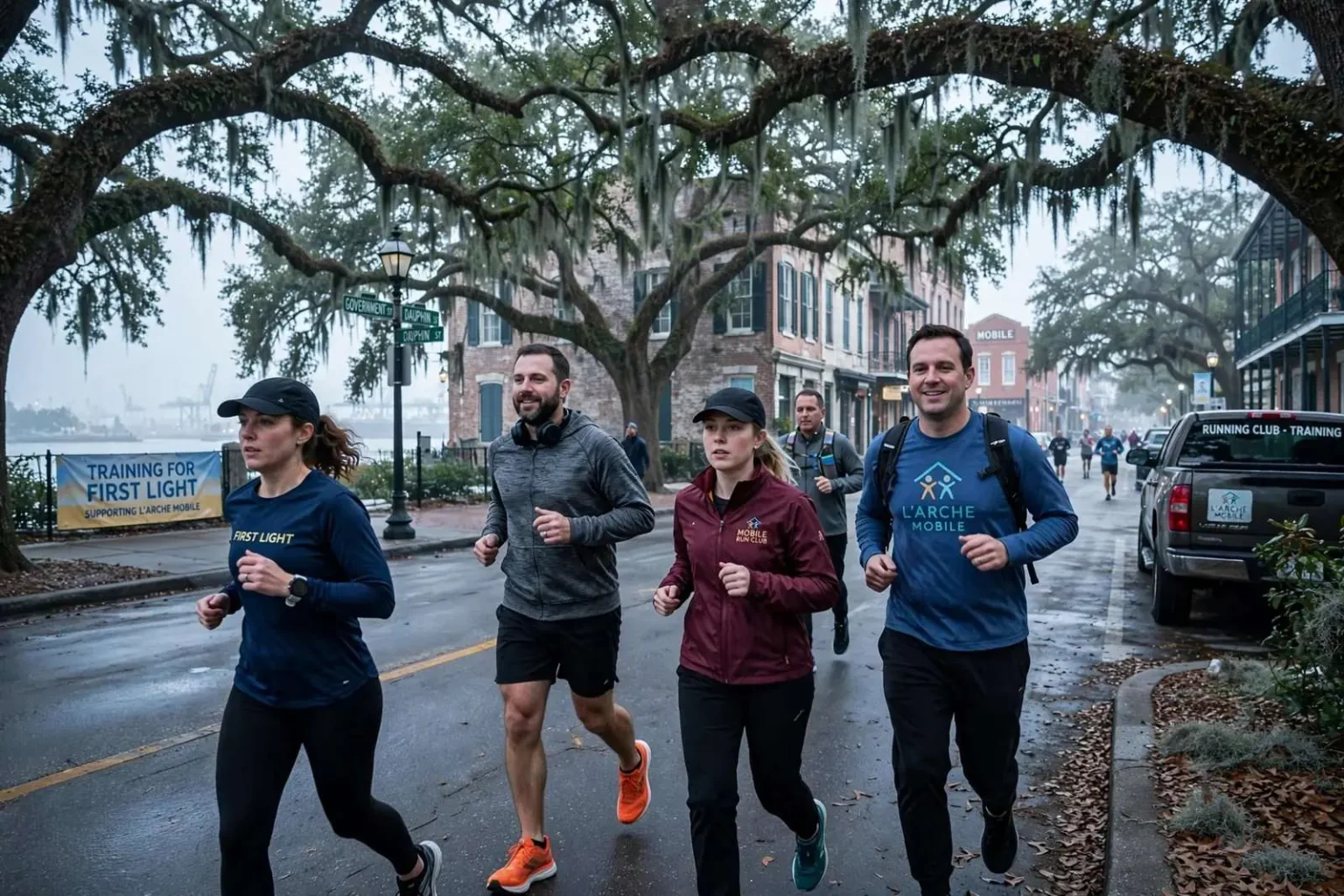
With the First Light Marathon, Half Marathon and Five Person Relay just weeks away, runners across the Mobile area were deep into training for the downtown race, which doubles as a fundraiser for a local nonprofit serving adults with intellectual disabilities. The event, held each January on a course that loops through Mobile’s historic downtown and oak-lined streets, has become a fixture of the city’s winter calendar — a point on the Gulf Coast running schedule that draws seasoned marathoners chasing a fast winter course alongside first-timers content simply to finish.
Proceeds from race entries support L’Arche Mobile, a community that allows adults with intellectual disabilities to live and work alongside team members who assist them daily. The organization includes roughly two dozen core members supported by around fifty team members who help with daily living and community engagement. The distinction between the two roles is the heart of the model: core members are not clients of a service program but full members of a shared life, and the assistants — the team members — are there to support them rather than to manage them.
How L’Arche Mobile Works
Organizers with L’Arche Mobile said the relationships built between core members and team members are central to the program’s mission, with participants working together and discovering one another’s strengths throughout the year. The community is part of the international L’Arche federation, founded in France in 1964, which now operates communities on six continents. The founding insight of the federation — that people with and without intellectual disabilities, living and working together on equal terms, transform one another’s lives — is expressed in Mobile through shared homes, shared workdays in the activity center, and the ordinary rhythm of meals, celebrations and chores that make up any household.
In practice, that means a core member’s week includes meaningful work, social life and the responsibilities of communal living, with support calibrated to each person rather than dictated by a schedule. The roughly fifty team members who assist them include live-in assistants and day staff, and their continuity matters: the model depends on relationships deep enough that strengths and struggles are known personally, not clinically. It is a slower, more relational kind of care than most social service programs offer, and its proponents argue that the results — in confidence, in skills, in belonging — justify the labor intensity.
The Craft Operation Behind the Medals
Those relationships extend into the group’s craft work, including handmade medals and award plaques given to First Light finishers each January. Every marathon, half marathon and relay participant who crosses the finish line downtown receives a medal made in the L’Arche Mobile activity center — which means the race’s signature artifact is produced by the community it supports, in a cycle that has become one of the most tangible connections between a Southern road race and a disability services organization anywhere in the country.
Core members begin creating the race medals for the following year’s event as early as July, according to the group’s activity center coordinator. The timeline is longer than an outsider might expect. Each medal is assembled and finished by hand, and production of the thousands of awards a race weekend requires has to be paced across months, with the work itself structured so that every core member who wants to participate can hold a role suited to their abilities — pouring, painting, assembling, packaging. The craft work is simultaneously a fundraiser, a vocational program and a point of pride: finishers wear a medal that members of their own community made.
This year, L’Arche Mobile’s craft operation expanded beyond the local race, filling medal and plaque orders for events not only around Alabama but also in Pennsylvania, Nevada, Southern California and Kansas after other race organizers admired the handcrafted awards used at First Light. The out-of-state orders transformed what had been a local tradition into a small export business, and they gave the activity center’s workers a customer base that stretches across the map — a validation of the work that goes well beyond charity.
Handmade Cards and the Holiday Season
Beyond athletic medals, the L’Arche Mobile activity center stayed busy during the holiday season with a longstanding tradition of handmade Christmas card production. One volunteer leading the effort said the group had already completed more than a thousand cards for the season and welcomed additional orders for any holiday occasion in exchange for a donation. The card operation runs on the same principles as the medal work: genuine craftsmanship, personal effort from core members, and a product good enough that customers return and order more.
A thousand handmade cards in a season represents an enormous amount of coordinated labor — design, stamping, assembly, signing and packaging, all divided among members with different capabilities and attention spans. The finished cards go out to families, businesses and churches across the Mobile area, and each one doubles as an ambassador for the community that made it. For many locals, an order of L’Arche cards has become part of the rhythm of the holidays, the way the First Light medal has become part of the rhythm of January.
Training Through a Mobile Winter
The weeks before the race are the hardest and most rewarding of the training cycle. Mobile’s summer heat makes serious distance training nearly impossible for much of the year, and the January race date gives Gulf Coast runners a season of cool-weather mileage — the long runs of November and December, when the city’s mornings finally drop to comfortable temperatures. Local running groups build their calendars around it, and the downtown course, with its stretches along the waterfront and through historic neighborhoods, is considered one of the more scenic winter marathons in the region.
For first-time marathoners, the half marathon and the five-person relay serve as on-ramps: the relay splits the 26.2-mile distance among teammates, allowing runners who cannot yet cover the full course to take part in race morning anyway. That design is deliberate and entirely appropriate for a race whose purpose is inclusion — the relay has introduced thousands of runners to the event over the years, and many of them return in later years for the half or the full marathon.
Race organizers encouraged participants to track their weekly mileage goals leading up to race day, with the event remaining one of downtown Mobile’s most anticipated winter traditions. The training advice is standard and sound: consistent weekly mileage matters more than any single heroic long run, and runners arriving at the start line with a measured twelve-week buildup finish happier and healthier than those who cram their training into the final month.
Why the Partnership Endures
The First Light–L’Arche partnership works because each side gives the other something it could not easily produce alone. The race gives L’Arche Mobile its signature annual visibility: thousands of runners and their families learn about the community each January, many of them by wearing its handiwork home around their necks. L’Arche gives the race a soul that the average road race lacks — a reason for being beyond the clock and the course, and a story that volunteers and sponsors can connect to year after year.
L’Arche Mobile continues to welcome volunteers throughout the year to support both its craft programs and daily community activities. The needs range from assistance in the activity center to sharing meals and evening companionship in the community’s homes, and the barrier to entry is deliberately low: organizers encouraged residents interested in getting involved, whether through race participation, card orders or volunteering, to reach out directly to the organization. A city that shows up in January to run through its own downtown, wearing medals made by its neighbors with disabilities, has already made the argument the community exists to make — that contribution flows in every direction, and that the line between helping and receiving help is thinner than most people assume.
A January Morning Downtown
Race morning in downtown Mobile carries a texture few other events replicate. Streets that sit empty on a Sunday in January fill before dawn with runners warming up under the live oaks, port-a-john lines stretching down Government Street, and the amplified voice of an announcer counting down a start that sends the marathoners out first, then the half, then the relay teams in their waves. Residents along the course set up chairs on their sidewalks, and church and neighborhood groups staff water stops that double as some of the loudest mile markers on the Gulf Coast running circuit.
Where the Money Goes
Race entries, sponsorships and associated fundraising flow to L’Arche Mobile, and the scale of the annual contribution matters for an organization of its size. A community of roughly two dozen core members and fifty team members carries the permanent costs of homes, staffing and programming — costs that a small nonprofit must piece together from private donations, grants and enterprises like the craft operation. The marathon functions as both the largest annual fundraiser and the largest annual public-relations event, recruiting donors and volunteers in a single morning.
The structure also insulates the community from a dependency that affects many disability service organizations: state contract funding, which arrives with paperwork, rate caps and eligibility rules that can shift with each budget cycle in Montgomery. A funding base anchored by an event the city has embraced gives L’Arche Mobile room to make decisions based on the needs of its members rather than the terms of a contract — including the decision to keep paying for handcrafted production methods that a contract-funded workshop might have to abandon as inefficient.
The Value of Handmade in a Mass-Produced World
There is a quiet irony in the fact that thousands of technically proficient athletes, many of them obsessive about their gear and their splits, treasure a medal cut and finished by hand by adults with intellectual disabilities. Race directors across the country have moved toward generic online-ordered medals that arrive in bulk from overseas; First Light’s awards are the opposite of that — slightly irregular, unmistakably human, and made within a few miles of the finish line. Runners who have earned one tend to know exactly where it came from, which is more than can be said for most race swag.
The out-of-state orders from race organizers in Pennsylvania, Nevada, Southern California and Kansas suggest that other events have reached the same conclusion. A handcrafted award communicates something about the event that a standard medal cannot: that the race values the process as much as the product, and that its economic footprint reaches into its own community. For L’Arche Mobile’s activity center, each new order means more work at meaningful wages or stipends for core members, more variety in the tasks members can learn, and a customer relationship that often turns into a visit or a donation.
Looking Toward Race Day
As the final weeks of training wound down, the pieces were all in motion on both sides of the partnership. Runners logged their last long runs and tapered; the activity center finished its medal production run and kept its card tables busy through the holidays; and race organizers finalized the logistics of closing downtown streets on a winter morning for a crowd that grows with every edition. The First Light Marathon, Half Marathon and Five Person Relay have grown into one of the region’s signature running events not by accident but by design — a fast, scenic course, a welcoming relay for newcomers, and a purpose that makes crossing the finish line feel like participation in something larger than a race.
That is the quiet genius of the arrangement: a runner’s achievement and a core member’s craftsmanship meet in a single object at the finish line, and both are better for it. The medals being made in July for the following January are the calendar’s own evidence that the cycle continues — work beginning almost as soon as the last finisher’s medal has been handed out, in a workshop where the meaning of the race is understood long before the starting gun fires.