Mobile Navy Veteran Recalls Surviving Pearl Harbor 73 Years Later
A 94-year-old Mobile man and Pearl Harbor survivor shares his memories of the 1941 attack that changed his life and pulled America into World War II.
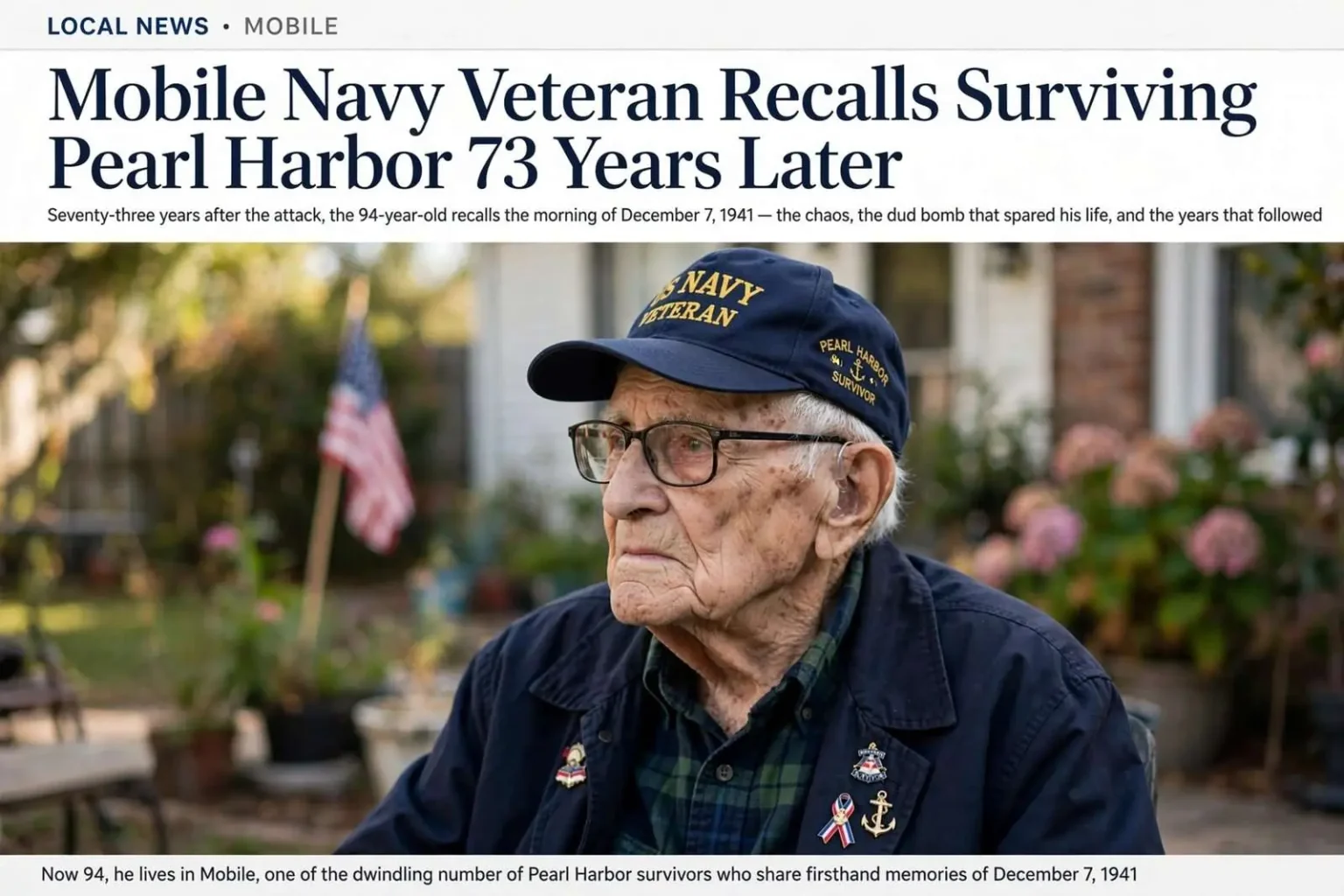
Seventy-three years after Japanese warplanes attacked the U.S. naval base at Pearl Harbor, a 94-year-old Mobile resident is still telling the story of how he survived it. His account spans the moments that defined the greatest generation — the confusion of the first wave, the casualties, the luck that separated the living from the dead — and it remains vivid enough that his family has made a point of preserving every detail while they can.
The veteran, a longtime Mobile-area man who grew up in Pass Christian, Mississippi, before moving to Mobile as a child, joined the U.S. Navy as a young man and arrived at Ford Island in Hawaii in October 1941, just weeks before the attack. He was assigned to kitchen duty in the base’s mess hall, a posting that placed him in the geographic center of the devastation that would follow.
Ford Island sat at the heart of the harbor, surrounded by the battleship row that Japanese planners targeted first. Servicemen stationed there lived within sight of the Pacific Fleet’s most powerful ships, and the island’s runways and hangars made it a priority objective for the attacking aircraft. Whoever was stationed at Ford Island on December 7, 1941, was going to experience the attack at close range; there was no corner of the island far from it.
The Morning of the Attack
On the morning of December 7, 1941, he had planned to attend church services but never made it there. Japanese fighter planes descended on the naval base, and from his position near the barracks he recognized the insignia beneath the wings of the incoming aircraft. Bombs fell across the base, striking ships and buildings, while his own unit’s photographic reconnaissance planes were spared and able to get airborne to document the attack.
The first moments of any surprise attack are defined by disbelief, and accounts from Pearl Harbor survivors consistently describe the same sequence: the sound mistaken for routine work, then the markings seen clearly, then the sirens and the reality that the United States was under attack. This sailor’s recognition of the insignia placed him among those who understood immediately what they were witnessing, minutes before official word spread across the base.
In the chaos that followed, he worked to help wounded sailors reach medical care, moving through debris and carrying the injured on stretchers alongside a fellow serviceman. As he carried a stretcher out of a dispensary, he heard a bomb whistling toward the building. He shouted for his partner to jump clear seconds before the bomb struck — but it failed to detonate. Family members later credited that stroke of luck with saving both of their lives.
Unexploded ordnance was a persistent feature of that morning. Bombs that struck buildings but failed to detonate spared some targets entirely while others nearby took direct hits, and the randomness of survival became one of the defining memories of everyone who lived through the attack. A dud bomb on a dispensary where wounded men were being treated could just as easily have added to the casualty list; on this day, it did not.
What the survivors did in the hours after the attack became part of the Navy’s own account of that day. Regular sailors and kitchen workers became stretcher bearers, fire crews and orderlies within minutes, because no base plans for a disaster of that scale with enough hands. The medic and mess-cook distinction dissolved in the first hour; what remained was whoever was standing, carrying whoever was not.
Knocked unconscious by the blast, he came to amid wreckage and made his way to the base’s mess hall, which had been converted into a makeshift morgue. The sight of the dead overwhelmed him, and he blacked out again, waking later in his own bunk. The memory stayed with him for the rest of his life, one of those images from the war that survivors carried without ever quite setting it down.
A Twist of Fate Aboard the Lexington
Family members who have heard the story recount that he and another sailor, both ill at the time, had been transported to Ford Island earlier than planned aboard the aircraft carrier Lexington. Because the two men needed to reach the island in October rather than December, the Lexington missed what would have been a scheduled stop at Pearl Harbor on the morning of the attack, sparing the carrier from the bombing that sank or damaged much of the Pacific fleet.
The near-miss was remarkable in the full context of that morning. The Japanese strike force targeted the carriers above all — American carriers were the Pacific Fleet’s most valuable assets — and by luck alone, none were in the harbor when the first bombs fell. The Lexington was at sea, delivered to safety in part by a routine transport run that carried two seasick sailors a few weeks ahead of schedule. A change of a few weeks had placed this Mobile-area man at the center of the attack instead of aboard a ship steaming toward it, and had kept one of the Navy’s capital ships out of Japanese gun sights on the worst morning of the war.
The attack killed more than 2,000 Americans and thrust the United States into World War II. Battleship row burned, the Arizona sank with more than a thousand of her crew aboard, and the next day the nation declared war on Japan. For the men who were there, the war’s meaning was settled that morning in a way no speech could match; they had seen the fleet on fire from the barracks and the flight lines, and everything that followed — island campaigns, fleet actions, the long road to Tokyo — grew from what they witnessed on December 7.
Two Decades in the Navy
The Mobile veteran remained stationed in Hawaii for roughly three more years before serving in various posts around the world during a Navy career that spanned about two decades. A man who arrived at Ford Island as a kitchen worker in the fall of 1941 went on to spend the length of an ordinary civilian career in the service, moving through assignments that carried him across the globe as the Navy grew into the world’s dominant fleet.
Staying in for two decades placed him among the career servicemen who carried the institutional memory of the wartime Navy into the Cold War era. Sailors of his generation trained the men who fought at Midway and the Philippine Sea, and the survivors of Pearl Harbor occupied a particular place in that culture: they were living proof of both the cost of unpreparedness and the resilience required to recover from it.
A Life After the War in Mobile
Now in his 90s, he lives in Mobile, where he recently celebrated another birthday. He spends his time on gardening and housework, and family say he remains proud of his service. The habits of a Navy man — order, routine, self-reliance — show in a household maintained by a veteran entering his mid-90s, and they are part of why his family finds his story so worth preserving.
Decades after the attack that nearly killed him, he still describes his gratitude simply: that America remains, in his words, the greatest country in the world, and that he is glad to have been part of defending it. That sentiment, common among his generation, carries particular weight coming from a man who carried stretchers past a dud bomb and woke up near a makeshift morgue on the day the war began for America.
Stories like his are becoming rarer each year as the generation that lived through Pearl Harbor and World War II grows smaller. Seventy-three years after the attack, survivors who could describe the morning from personal memory were passing the age of 90, and each passing removes a primary source that no archive can replace. National Pearl Harbor Remembrance Day observances have become as much about listening as commemorating for exactly that reason.
The growth of the remembrance itself tracks the shrinking of the generation. What began as official ceremonies has expanded into school programs, museum exhibits and recorded interviews, as institutions realize that the window for firsthand testimony is closing. For families, the work is more personal: gathering the small details — a transport run that departed weeks ahead of schedule, a dud bomb on a dispensary, a blacked-out sailor waking in his bunk — that make the history real to grandchildren who will never meet a Pearl Harbor survivor in person.
Local historians and veterans’ organizations in the Mobile area continue to document these firsthand accounts before they are lost to time. The effort has taken on urgency across the country, with oral history projects recording veterans’ recollections on video and families gathering details — like the ill-fated transport aboard the Lexington, or the bomb that failed to detonate outside a dispensary — that exist nowhere in official records. In Mobile, a city whose connection to the Navy runs through the Battleship Memorial Park and its shipyard history, the project of remembering has strong local roots, and this 94-year-old’s story stands among the accounts worth keeping.