Baldwin County Weighs Road-Funding Options as $30 Tag Fee Stalls
With a proposed $30 vehicle tag fee shelved for now, Baldwin County officials explored other ways to pay for about $150 million in needed road projects.
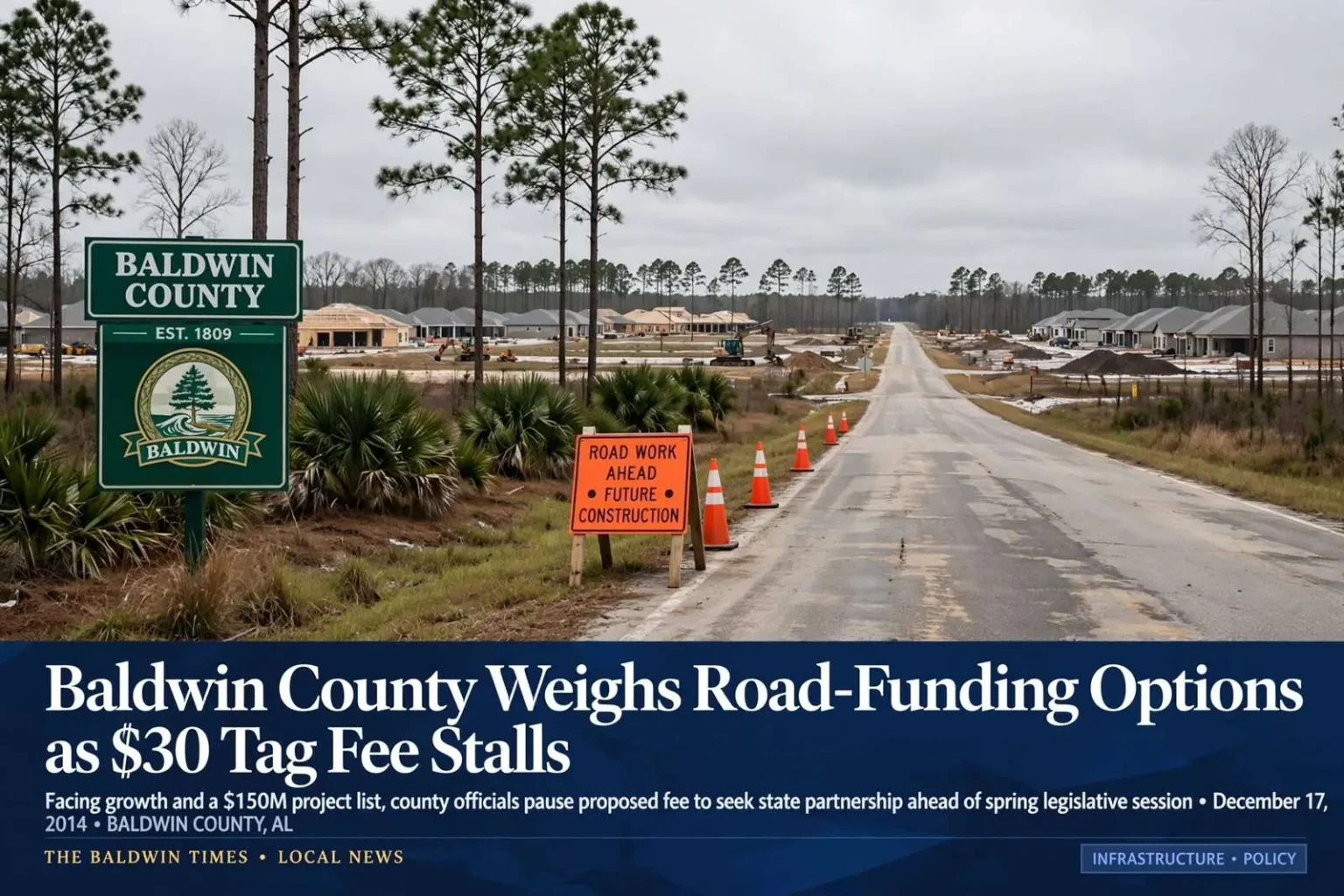
Facing steady population growth and mounting demand for better roads, Baldwin County officials in December 2014 stepped back from a proposed $30 vehicle tag fee and began weighing other ways to pay for roughly $150 million in planned construction. County Commissioner Tucker Dorsey, who first floated the tag fee in October, said there was no immediate pressure to settle on a funding source before the spring legislative session in Montgomery.
“We are backing up a little bit and thinking of other ideas,” he said, adding that the county wanted a firm agreement with the state transportation department on project goals before moving ahead.
The retreat from the tag fee was not a retreat from the problem. Baldwin County had spent years absorbing growth that outpaced its road network, and the $150 million list of planned projects represented the commission’s attempt to catch up. What Dorsey’s comments signaled was sequencing: before the county asked taxpayers for a specific fee, it wanted the state transportation department locked into agreement on which projects would actually be built — so that any new money raised would flow into defined work rather than a moving target.
The Options All Run Through Montgomery
Both the tag fee and a possible gasoline-tax increase, another option on the table, would require approval from state lawmakers. That structural reality shapes every county funding conversation in Alabama: local governments cannot impose such levies on their own authority, and any Baldwin-specific measure would need a local bill passed in the legislature — and, in the case of the tag fee, a statewide or local constitutional amendment ratified by voters as well.
The December pause, then, was aimed at the calendar. The legislative session each spring is when local delegations carry home-county bills, and commissioners knew that going to Montgomery with a divided proposal would accomplish less than arriving with a unified plan backed by the state transportation department. Waiting meant delaying any new revenue by months, but it also meant avoiding the fate of half-built funding plans that die in committee.
Commissioner Chris Elliott, elected earlier that year, said road conditions dominated his campaign. “During the campaign, that’s all I heard about were roads, roads, roads,” he said, arguing that the county and legislature needed to confront “inadequate revenue sources for roads.”
Elliott’s suggestion that the county position itself to tap state discretionary money offered a third path between the tag fee and a gas tax. The state transportation department administers discretionary programs from time to time, and counties that arrive with engineered, shovel-ready projects and matching plans stand the best chance of winning a share. Positioning Baldwin for that money meant committing local planning resources now in hopes of leveraged state dollars later.
The Tag Office Behind the Debate
The discussion came a day before Probate Judge Tim Russell was set to assure the commission that the county’s tag operation was running efficiently. Russell contrasted Baldwin’s program with Jefferson County, where long lines had prompted officials to ask city governments for help selling tags. He said his office could administer an added $30 fee if lawmakers supported it and voters approved a state constitutional amendment, but that his office would not take a position on the proposal.
The contrast with Jefferson County was pointed. The state’s most populous county had struggled with a vehicle registration backlog so severe that motorists waited in lines for hours, and city halls were drafted into service as auxiliary tag offices. Baldwin’s probate office, by contrast, was processing the county’s heavy volume without comparable strain — a fact that mattered to the debate, because a new fee is only as administrable as the office collecting it. Russell’s message was capability without advocacy: his office could run the fee, but whether the county should adopt it was a question for elected policymakers and, ultimately, voters.
The fee, if adopted, would be charged on top of the existing value-based annual tag fee. Baldwin drivers already pay an ad valorem charge scaled to their vehicle’s worth, so a flat $30 add-on would have been a uniform increase regardless of what a resident drove — an old truck and a new SUV paying the same. That flat structure is simpler to administer and easier to explain, which is precisely why it drew support as a funding concept even as its political prospects remained unsettled.
The Arithmetic of a $30 Fee
The numbers underscored the stakes. Baldwin County issued 250,652 tags in 2013; a $30 charge on each would have raised more than $7.5 million a year. That figure framed both the appeal and the limits of the proposal: $7.5 million annually is substantial money for a county commission, but set against a $150 million construction program, it represents a down payment — a revenue stream large enough to bond against, perhaps, but not one that builds the list on its own.
The gap between the fee’s yield and the project list’s cost is why commissioners were also discussing the gasoline tax and state discretionary funds. Infrastructure financing of this scale typically stacks sources: a local recurring revenue stream to anchor bonds, state dollars to match, and periodic discretionary grants to close specific gaps. No single mechanism was going to carry the program, and the December deliberations were effectively an exercise in designing that stack before committing to any one piece of it.
What the Money Would Build
The project list officials floated in October reflected the county’s fast-growing corridors. It included widening Alabama 181 from near Daphne to Fairhope, building a third bridge over the Intracoastal Waterway, extending 20th Street toward Canal Road near Orange Beach, constructing an interchange at Interstate 10 and County Road 13 near Spanish Fort, and widening U.S. 31 through Spanish Fort.
Each project mapped onto a growth pattern residents live with daily. Alabama 181 has become the eastern county’s principal north-south route as subdivisions have filled the land between Daphne and Fairhope, and its two lanes carry commuter traffic that grows with every new roof. The Intracoastal Waterway bridge question is the perennial one for the peninsula — a third crossing would relieve the pressure on the existing routes to the beaches, where summer traffic tests the infrastructure beyond its design. The 20th Street extension toward Canal Road addresses the Orange Beach side of the same equation, offering a parallel path through one of the coast’s most congested segments.
The Spanish Fort items — a new interchange at Interstate 10 and County Road 13, and widening U.S. 31 through the city — respond to the commercial boom along the Interstate 10 corridor at the foot of the Eastern Shore, where retail growth has transformed traffic patterns in a decade. Every one of the five projects sits in the county’s fastest-developing areas, which is both why the need is urgent and why the county struggled to fund the work from its existing revenues: growth generates the demand for roads years before it generates the tax base to build them.
The search for new revenue came at a time when both state transportation dollars and the county’s own budget remained tight, leaving commissioners to balance rising infrastructure needs against limited resources. That was the context for the December pause — not indecision about whether Baldwin needed the projects, but a deliberate effort to line up the money, the state agreements and the legislative pathway before committing to a funding mechanism that would have to last for decades.
Why County Road Money Is Complicated in Alabama
Alabama’s county governments operate under some of the tightest fiscal constraints in the country. Counties depend heavily on state-shared revenues and local levies whose structure is dictated in Montgomery, and any new source — a tag fee, a fuel tax, even an updated franchise arrangement — must be authorized through legislation aimed specifically at the county. That is why Dorsey spoke of the spring legislative session as the natural deadline, and why the commission’s deliberations were as much about legislative strategy as fiscal policy.
The constitutional amendment layer adds another hurdle unique to the tag-fee proposal. Because vehicle registration fees touch on state constitutional territory, a Baldwin County $30 fee would require not only a local bill but voter ratification, adding an election cycle to any implementation timeline. Commissioners weighing the option had to account for the full path: legislative passage, an amendment vote, then collection through the probate office — a sequence of a year or more before the first dollar arrived.
The gasoline tax alternative carried its own complications. Fuel taxes flow with consumption and spread the burden across everyone who drives the county’s roads, including the summer’s beach-bound visitors who fill Baldwin’s highways but never register a vehicle there. That feature makes a fuel tax attractive to county officials whose road wear is driven partly by tourist traffic — but the same state-law approval requirement applies, and fuel tax bills have historically faced steep resistance in the legislature, making it a heavier political lift than a county tag fee.
Growth Now, Revenue Later
The timing tension at the heart of the December discussion is a familiar one for fast-growing Sun Belt counties. Roads are needed in the same years the growth is happening, but the property and sales tax growth that follows development arrives gradually and is largely spoken for by schools, public safety and operations. Capital construction of $150 million in scale typically requires either bonds backed by a dedicated revenue stream or phased pay-as-you-go construction stretched over a decade — and commissioners were effectively choosing which discipline to adopt.
Bonding against a $7.5 million annual fee stream could have produced the full program in a fraction of the time, at the cost of decades of interest, which is why the fee remained attractive even after the December pause. Pay-as-you-go funding avoids the interest but means the Alabama 181 widening and the third Intracoastal bridge wait in line behind whatever the county can scrape together each budget year — while traffic on those corridors grows another year worse.
What the commissioners agreed on, whatever mechanism they ultimately chose, was the sequence Dorsey articulated: settle the project list with the state transportation department, present a unified front to the local legislative delegation, and only then ask Baldwin County voters — or their legislators — to approve the money. The tag fee had served its purpose even in retreat: it put a concrete number on the county’s needs and started the conversation the $150 million list required. By spring, when the legislature convened in Montgomery, Baldwin County’s road debate would be the most fully developed funding conversation of any county on the Gulf Coast — stalled, perhaps, but no longer hypothetical.