
Memorial Day Ceremony at Mobile National Cemetery to Honor the Fallen
The South Alabama Veterans' Council held its annual Memorial Day ceremony at the National Cemetery on Virginia Street in Mobile, with a World War II Marine featured in two acclaimed war histories as keynote speaker.
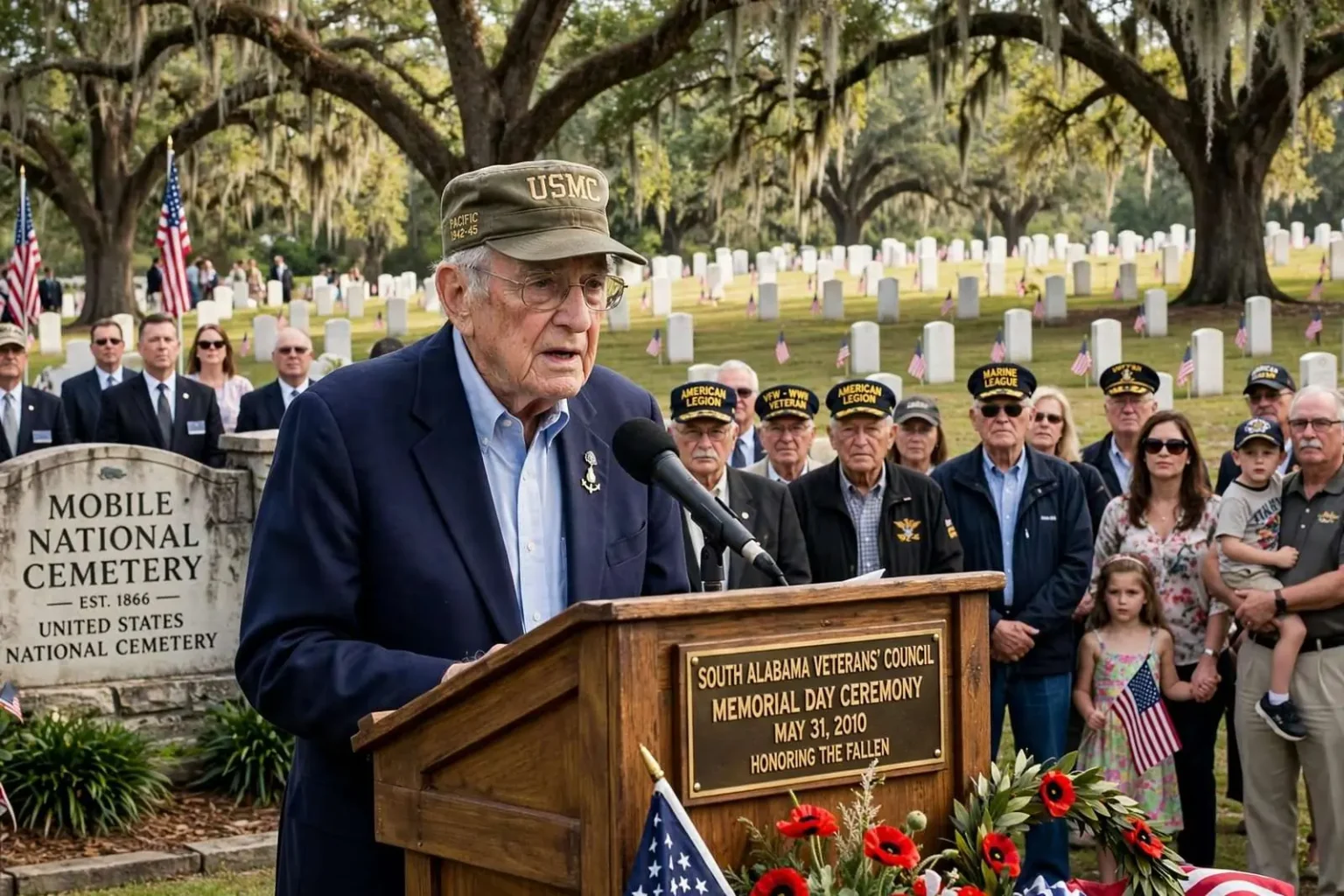
The South Alabama Veterans’ Council held its annual Memorial Day ceremony Monday morning at the National Cemetery on Virginia Street in Mobile, gathering veterans, elected officials and families for a service the council has long treated as one of its central obligations. The ceremony began at 9 a.m. and was scheduled to run about 40 minutes. It was open to the public, and the council encouraged residents to bring their families.
The hour was deliberate. Memorial Day services in Mobile traditionally end before the coast’s mid-morning heat settles in, and the short program — a speech, the laying of wreaths, and a moment of silence — is built to be attended, not endured. Families with children stood alongside rows of men wearing the caps of the ships, divisions and wars they served in, a combination the council considers the whole point of the morning.
A keynote speaker who lived the history
The keynote address was delivered by Dr. Sidney Phillips, a Mobile physician who served as a Marine in the Pacific during World War II. Phillips became widely known to a national audience through his appearances in Ken Burns’ documentary The War and through the HBO miniseries The Pacific, in which his wartime experience formed part of the narrative.
Phillips had left Mobile as a teenager to join the Marines and served through the early island campaigns of the Pacific war, coming home to a medical career and decades of quiet standing in the city’s civic life. His boyhood friend Eugene Sledge, who fought beside him in the Pacific, later wrote one of the most respected memoirs of the war, and it was that shared Mobile story — two local boys carried into history by the events of 1941 — that the documentary and miniseries brought to a national audience.
His wartime record had made him a sought-after speaker in the years after the documentaries aired, and audiences who heard him found the same quality that made him compelling on film: no speeches about glory, only precise, unsentimental memory of what happened to the boys he shipped out with. For a Memorial Day crowd, that mattered. The men the ceremony honored were not symbols to him but specific people — friends from Mobile who never came home — and he said so plainly, in the city where most of their names still had families attached.
His presence gave the observance an immediacy that few Memorial Day programs can offer. By 2010, the ranks of World War II veterans were thinning quickly, and events like this one were among the last opportunities for younger residents to hear directly from the men who fought that war.
Mobile Mayor Sam Jones welcomed those attending. Local veterans organizations and military groups were represented, and a number of elected officials were expected to be on hand. The council has long drawn its membership and its leadership from the city’s American Legion, Veterans of Foreign Wars and Marine Corps League posts, and its ceremonies serve as the one morning a year when all of those organizations stand in the same place.
Why the council holds the service
The South Alabama Veterans’ Council described the ceremony as both a memorial and a reminder — an acknowledgment that the rights and freedoms Americans exercise daily rest on the sacrifices of the men and women of the armed services. The council urged residents to treat the observance as a tradition worth passing to the next generation. Service and sacrifice, in the council’s framing, are not abstractions but habits of citizenship that have to be taught, modeled and renewed.
“Please bring your family and join us Memorial Day to honor those who made liberty possible,” the council said in its invitation to the public. The emphasis on families is a standing theme of the council’s work: ceremonies without children in the crowd, its members argue, are rehearsals rather than inheritance, and the veterans who attend in uniform are modeling for the youngest spectators what service looks like after the uniform comes off.
The council coordinates the region’s major veterans observances through the year, and its members treat the Memorial Day program as the anchor of the calendar. For the organizations involved — posts that also run color guards, funerals honors details and school programs — the ceremony is where their separate work becomes a single public act. The morning’s short list of speakers and dignitaries belies the amount of volunteer labor behind it: flags placed at graves in the days before, sound systems hauled onto the lawn, water set out for the crowd, and the coordination with the cemetery’s federal caretakers that keeps the grounds ready for company.
About the cemetery
Mobile National Cemetery on Virginia Street is one of the oldest national cemeteries in the country and holds the graves of service members from generations of American conflicts. Its rows of white headstones make it a natural gathering point on the last Monday in May, and the annual ceremony there has become a fixture of the city’s civic calendar.
The cemetery’s ground was established in the closing year of the Civil War, when Union forces occupied the city, and it has taken in the dead of every American war since — from the 19th-century conflicts that founded it through the world wars, Korea, Vietnam and the modern Middle East. Administered as a national shrine, its grounds are maintained by the federal government, and burials of eligible veterans and their families continue there today, which gives the Memorial Day crowd a literal connection between the city’s past wars and its current military families.
Memorial Day, distinct from Veterans Day, is set aside specifically for those who died in military service. The distinction is one that veterans’ organizations across South Alabama take care to preserve each year, resisting the drift of the holiday into a simple marker for the start of summer. Veterans Day in November thanks the living; the last Monday in May belongs to the dead, and the council’s program is arranged around that difference.
The holiday itself carries that history. What began after the Civil War as Decoration Day — when families decorated the graves of soldiers with flowers in late May — grew into the national observance now set on the last Monday of the month, and the South’s early Decoration traditions are part of why graveside ceremonies like Mobile’s have remained central to the holiday here rather than incidental to it.
A somber note in a difficult season
The 2010 observance came at a hard moment for coastal Alabama. Six weeks earlier, the Deepwater Horizon rig had exploded in the Gulf of Mexico, killing 11 workers and beginning an oil spill that was still uncontained as the holiday arrived. Beaches from Dauphin Island to Gulf Shores were bracing for oil, and thousands of families along the coast faced an uncertain summer.
The spill had remade the rhythm of the coast’s year. Communities that measure their summers by tourists, fishing seasons and church beach trips were watching weathered containment booms instead of swimmers, and boat owners whose livelihoods were tied to the water had been pressed into the cleanup effort. The economic anxiety ran through every town on the coast, and it gave the usual holiday weekend a muted quality from Dauphin Island’s west end to the beaches east of Perdido Pass.
The coincidence of the holiday with the crisis was not lost on those who planned the ceremony. A community watching its shoreline threatened was gathered on a hillside of graves maintained by people who served it, and several speakers drew the connection directly: coastal Alabama’s resilience had always been a joint project between its citizens and its veterans, and the oil on the horizon was simply the latest test of it.
Against that backdrop, the gathering at the National Cemetery carried extra weight. It was, for many who attended, a reminder that South Alabama has weathered hard seasons before — wars, hurricanes and economic blows among them — and that the community’s habit of coming together to honor its dead is one of the things that has carried it through.
For more information
Details about the ceremony and the South Alabama Veterans’ Council were available from Pete Riehm, who served as a contact for the event and could be reached at 251-442-4349. The council’s programs through the year, from the Memorial Day morning at the cemetery to the Veterans Day observances in November, are open to the public, and the organizations behind them depend on the families who show up.
The ceremony ended, as it does each year, with the crowd dispersing into a holiday weekend that has never quite lost its double meaning on the Gulf Coast — a day off, and a debt — with the white rows of the Virginia Street cemetery standing behind them in the morning heat.


