Mayor Sam Jones Liked Mobile’s Hand as the ThyssenKrupp Decision Neared
With a $2.9 billion steel mill decision expected within days, Mobile Mayor Sam Jones told a civic club he would not trade places with Louisiana, and laid out where the city stood on the bridge, the port and downtown.
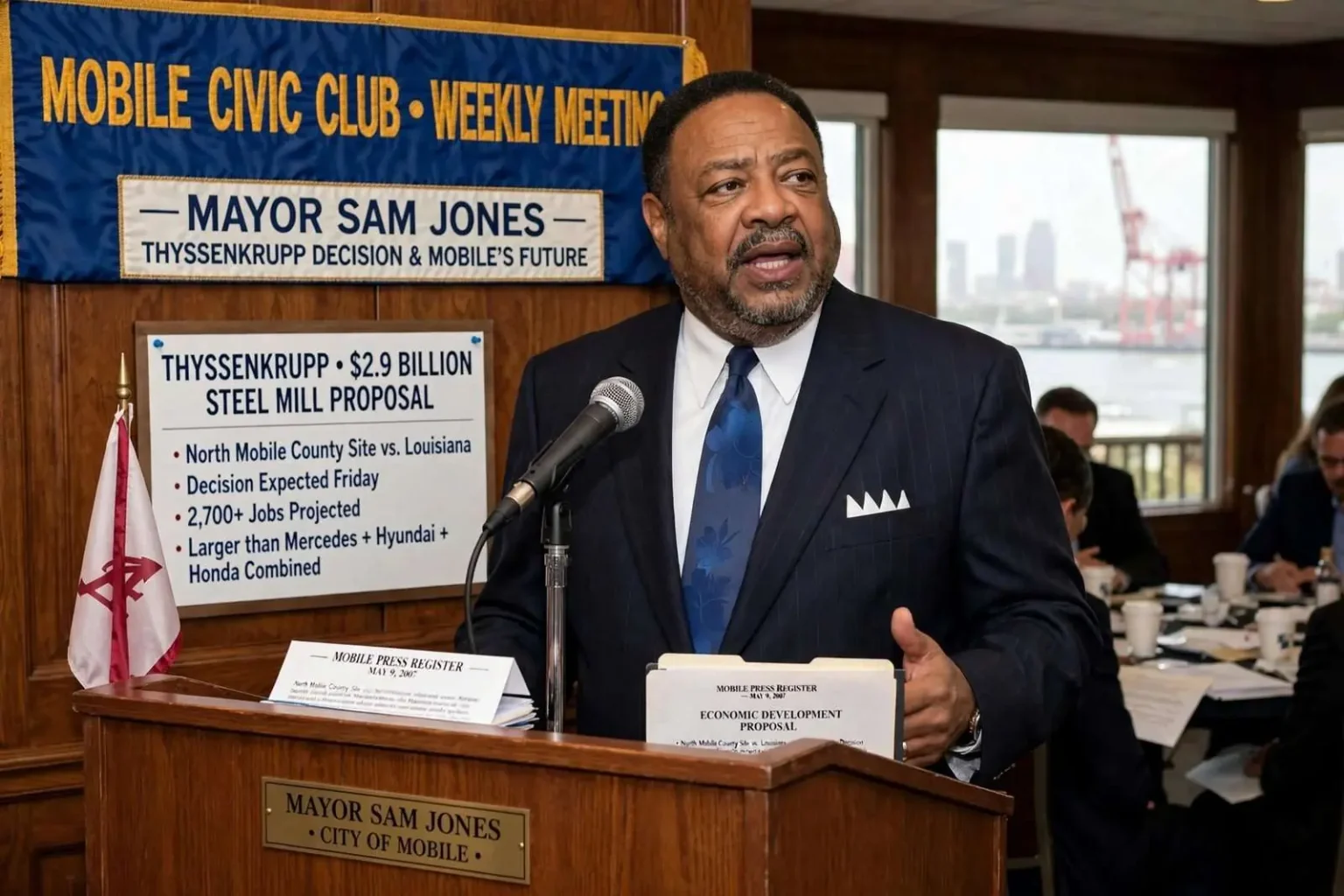
With the largest industrial prize in Alabama history expected to be awarded within days, Mayor Sam Jones told a local civic club Wednesday morning that he would not trade hands with Louisiana. The German steelmaker ThyssenKrupp was expected to announce Friday whether it would build a $2.9 billion carbon and stainless steel mill in north Mobile County or on a competing site in Louisiana.
Jones, a former Mobile County commissioner who had been elected mayor in 2005, told the audience that Alabama’s public and private partners had assembled what he called an amazing proposal, and that he would have no regrets regardless of the outcome. “I would not change hands with Louisiana,” the mayor said, adding that if the state lost, it would be because of some factor beyond the control of Alabama’s economic development team.
A project bigger than Mercedes, Honda and Hyundai combined
Jones stressed the scale of what was at stake. The steel plant, he said, was not merely larger than any of the state’s recent industrial recruitments — Mercedes, Hyundai, Honda, Boeing — but larger than any three of them combined.
He pointed to the Mercedes plant landed near Tuscaloosa roughly 15 years earlier as an instructive case: widely criticized as a bad deal at the time, it had since become, in his words, the envy of the economic development world. Mobile, he noted, draws on a regional labor pool that would be the immediate beneficiary of a mill of that size.
The flip side, he said, was the obligation to prepare Mobile County’s young people to compete for the jobs. And the steel plant was not the only iron in the fire.
Jones said the aerospace firm EADS/CASA was also weighing plans for Mobile, and that “we have several others” in the pipeline. “From today until Monday should be very, very important” to the future of the city, he said.
A downtown bridge, and second thoughts
The mayor devoted a portion of his remarks to the proposed new Interstate 10 crossing of the Mobile River, a project he said had already been 12 years in the planning. Transportation planners had narrowed 14 possible routes to three, all of them crossing at mid-river, near downtown.
That prospect had alarmed a broad coalition — maritime interests, the cruise business, downtown developers and historic preservationists — who feared the effect of a large elevated span on the heart of the city. Jones said officials had now signaled a willingness to reconsider a northern alignment using the existing Cochrane-Africatown Bridge.
When the community pulls together to communicate, he said, the odds of resolving an issue improve considerably.
The waterfront, the railroad and the cruise terminal
Jones said the Water Street Landing condominium project on the former CSX property remained “on track,” though air rights questions with the railroad were unresolved.
Local officials and developers were scheduled to meet with the CSX chief executive within two weeks, and the mayor was blunt about his frustration with the company’s chain of command. “It has been very difficult to get a response,” he said.
“We’ve been told to talk to someone in Jacksonville and he says ‘no, the guy you need is in Atlanta,’ and that guy says ‘no, no, the man you need is right there in Mobile.’” The city would work to accommodate the railroad’s needs, Jones said, but would not let CSX dictate the development of the waterfront. He expected to bring the matter to a head within the month.
At the Alabama Cruise Terminal, Jones said an announcement about a larger ship was “very, very close.” Carnival’s Holiday, he said, had never sailed from Mobile at less than full capacity, and he did not expect the vessel to remain in the following year. A ship carrying roughly 2,500 passengers would likely be homeported here first, he said, with a second to follow.
Parking would be expanded, possibly with valet service staged on the site set aside for a proposed maritime museum. Recovery of the New Orleans cruise market after Hurricane Katrina, he added, had been slower than the industry expected — a fact that worked in Mobile’s favor.
Airport, airfares and the ‘good old days’
Jones said he could not understand the opposition to annexing Mobile Regional Airport, a move that would bring in no residents. The city’s motives, he said, were economic development and public safety: growth was pushing westward, response times in the western service areas were roughly double the six-minute goal, and the city needed the ability to station crews accordingly.
On airfares, the mayor blamed a lack of sustained competition. Delta’s long-held share of the Mobile market, he said, discouraged rivals from entering; when a carrier such as AirTran did try, Delta matched the fares, kept its passengers and raised prices again once the challenger withdrew.
He closed on a note of civic impatience. A Mobile native who had lived nowhere else except for a decade in the Navy, Jones said he had little use for talk of the good old days.
“We’re living in the good days right now,” he said. “It is the best it’s ever been here. But we must take advantage of this opportunity. We will not see another opportunity like ThyssenKrupp in our lifetime.”
The Outcome
Two days later, on May 11, 2007, ThyssenKrupp announced that it had chosen the Alabama site. The mill near Calvert in north Mobile County began operating in 2010. ThyssenKrupp sold it in 2014 to a joint venture of ArcelorMittal and Nippon Steel, which runs it as AM/NS Calvert.