Poker Run in Lillian to Raise Money for Honor Flight South Alabama’s WWII Veterans
Honor Flight South Alabama announced an all-day fundraiser at H&D Cycles in Lillian, featuring a poker run, raffle and silent auction, capped by a ceremony honoring local World War II veterans.
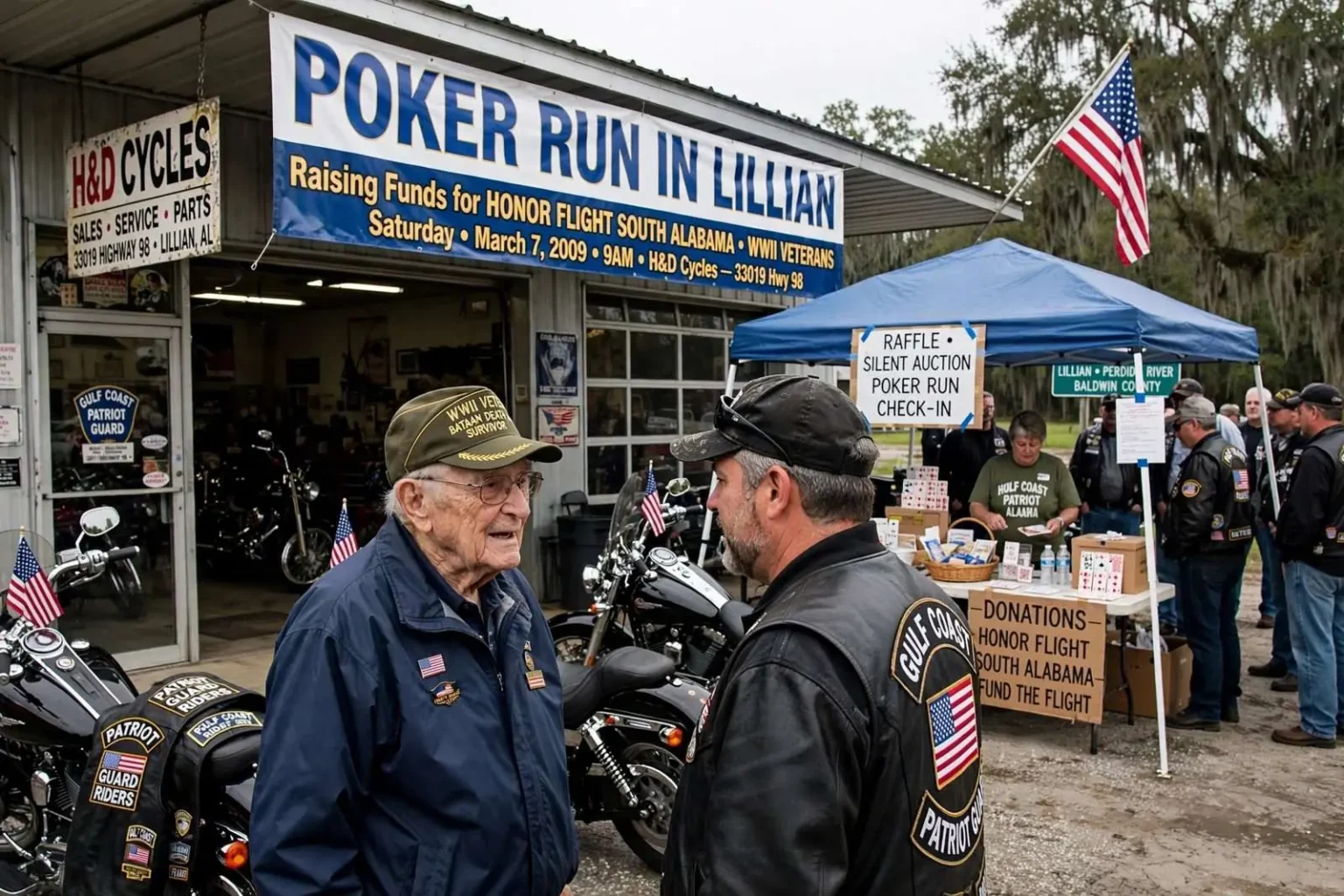
Honor Flight South Alabama announced on Friday, March 6, 2009, that it would hold an all-day fundraising event the following day in Lillian, with motorcycles, an auction and a closing ceremony for the men the whole effort exists to serve. The turnaround — an announcement the day before the event — said something about the urgency that drove the organization’s work in those years: the veterans it existed to honor were running out of time, and the flights could not wait for long planning cycles.
The event was sponsored by the Gulf Coast Patriot Guard and H&D Cycles of Lillian, and was set to begin at 9 a.m. Saturday at the cycle shop at 33019 Highway 98. Lillian sits on the Perdido River at the southern tip of Baldwin County, a small crossroads community within an easy ride of Pensacola Bay, and the highway shop drew riders from both sides of the state line.
The day’s schedule
The program was built around a poker run, the familiar motorcycle fundraiser in which riders travel a set route, collecting a playing card at each stop and competing for the best hand at the end. Alongside it, organizers planned a raffle, a silent auction and an awards ceremony. The format is a proven one for small organizations: the run itself is the attraction, the cards give every stop a destination, and the auctions and raffle pull in the spouses, friends and neighborhood businesses who never mount a bike at all.
The last motorcycle was to leave at 11 a.m. All participants were asked to return to H&D Cycles by 2 p.m. for the afternoon’s festivities, which would include food and entertainment. The day was to close at 3 p.m. with a short ceremony featuring local World War II veterans.
Among them was Glen Frazier, a survivor of the Bataan Death March whose account of the war reached a national audience through Ken Burns’s documentary series “The War.” Frazier was by then one of the region’s best-known voices of the Pacific war — a man who had endured the fall of the Philippines, the march itself and years of captivity, and who spent his later years telling the story to audiences that had no other way to hear it firsthand.
That a Bataan survivor would close the day made the purpose of the fundraiser impossible to miss. The riders would spend the morning raising money so that men like him could fly to Washington, and the ceremony would put the men themselves in front of the crowd to make the case better than any brochure could.
What Honor Flight does
Honor Flight South Alabama belongs to the national Honor Flight network, which arranges for World War II veterans to travel to Washington, D.C., to visit the National World War II Memorial — a monument that was not dedicated until 2004, nearly six decades after the war ended. The memorial stands on the National Mall between the Washington Monument and the Lincoln Memorial Reflecting Pool, and for the generation it honors, seeing it is not tourism. It is recognition, delivered by a grateful government sixty years late.
The timing explains the urgency behind an event like the one in Lillian. Veterans of that war were, by 2009, well into their eighties. The memorial built in their honor had existed for less than five years. Many had never seen it and, absent an organized effort, never would. The arithmetic drove everything the network did: every year of delay cost the mission thousands of the men it was created for.
Flights are provided at no cost to the veteran. Each traveler is typically accompanied by a guardian who pays their own way and assists throughout the trip — pushing wheelchairs, keeping track of medications, and standing between the veteran and the logistics of a long travel day. That model is precisely why the fundraising matters: every dollar raised at a cycle shop on Highway 98 translates fairly directly into seats on an airplane.
The date itself carried meaning. March 2009 sat in the stretch when the Honor Flight movement was expanding fastest, as local hubs organized across the country to meet a deadline no one could extend. The national network’s growth in those years came largely from exactly this kind of community effort — a hub formed in a region, a roster of veterans compiled through churches and veterans’ posts, and a calendar of small fundraisers strung together until the cost of a charter flight was covered.
A charter trip to Washington is a logistical undertaking for any group; for a planeload of travelers in their eighties, many with limited mobility, it requires months of coordination, medical planning and volunteer recruitment. The fundraising covers the air charter, the motorcoaches that meet the plane, the meals and the wheelchairs, and the small costs that make the day manageable for men who once thought nothing of a forced march. Guardians, who pay their own way, multiply the workforce without adding to the bill the organization must raise.
The day of travel is organized down to the minute, and the emotional weight of it is the reason volunteers return trip after trip. Veterans arrive at the airport before dawn, are welcomed with water arches and cheers, and spend the day moving between the memorial, Arlington National Cemetery and the war memorials that followed their service. For many of the men, it was the first time anyone had thanked them for the war — a war that, unlike the ones that came after, ended with a homecoming the country spent decades largely quiet about.
That quiet is part of what the memorial finally corrected. The World War II generation came home, built careers and families, and by and large did not talk about the war; the country, absorbed in the decades that followed, did not build them a monument for nearly sixty years. The Honor Flight network grew out of the simple observation that the men who were owed that recognition were dying faster than the recognition was being delivered. A poker run in a small Baldwin County town was one answer to that arithmetic — imperfect, small-scale, and exactly the kind of answer the moment required.
How to take part
Organizers directed questions about the poker run to Aaron Daniels of the Gulf Coast Patriot Guard, by email at [email protected], or to Don Rogers or Reese Herrington at H&D Cycles, at 251-961-2259. For a one-day event announced a day out, those contacts were the whole publicity apparatus — a handful of names in a shop on Highway 98, working the phone lists of two organizations that knew their riders.
Information about Honor Flight South Alabama, including applications for veterans and for guardians and instructions for donating, was available at the organization’s website. Applications could also be obtained at any Springhill Medical facility and at the Mobile Area Chamber of Commerce. Veterans were invited to call the chamber at 251-431-8621 to have a package mailed to them. General inquiries were directed to Pete Riehm at 251-442-4349.
The application channels tell their own story about how the program worked. Applications in hand at a hospital system and the chamber of commerce meant the pipeline to potential travelers ran through the institutions where aging veterans were already customers and members — a doctor’s waiting room or a chamber mailing list rather than a recruiting office. Guardians, meanwhile, were recruited the same way: from the families, churches and civic groups surrounding each veteran.
An unlikely but fitting partnership
There is a certain rightness to the pairing behind the event. The Patriot Guard Riders, formed in 2005, are best known for attending the funerals of fallen service members at the invitation of their families, standing as a shield against protesters. The organization’s work has always been about presence — showing up, in numbers, for people who served. A poker run on a Saturday in Baldwin County is a different expression of the same idea.
The riders who set out from Lillian that morning were raising money so that a man in his late eighties, who once marched out of Bataan, could fly to Washington and stand in front of a memorial with his name’s generation carved into it. The Patriot Guard’s membership, heavy with veterans and the families of veterans, made the cause a natural fit; H&D Cycles put the building, the parking lot and the local motorcycle community behind it.
The ceremony at 3 p.m. was scheduled to last only a few minutes. For the veterans in attendance, and for the riders who came back to hear it, that was rather the point. The day was never about the speeches. It was about the cards collected at the stops, the auction items under the tent, and the trip to Washington that all of it made possible — while the men it honored could still make the trip themselves.
Events like this one became a fixture of the Honor Flight model across the country in those years: local organizations, local businesses and local riders converting a Saturday into a plane full of veterans. The Lillian version carried an added weight that early-spring Saturday — a Bataan survivor’s closing words, and a highway shop full of people who understood exactly what the day was for.