Battleship Memorial Park Stages Pearl Harbor Attack Reenactment
Mobile's Battleship Memorial Park marked the Pearl Harbor anniversary with a first-of-its-kind reenactment and flyover aboard the USS Alabama.
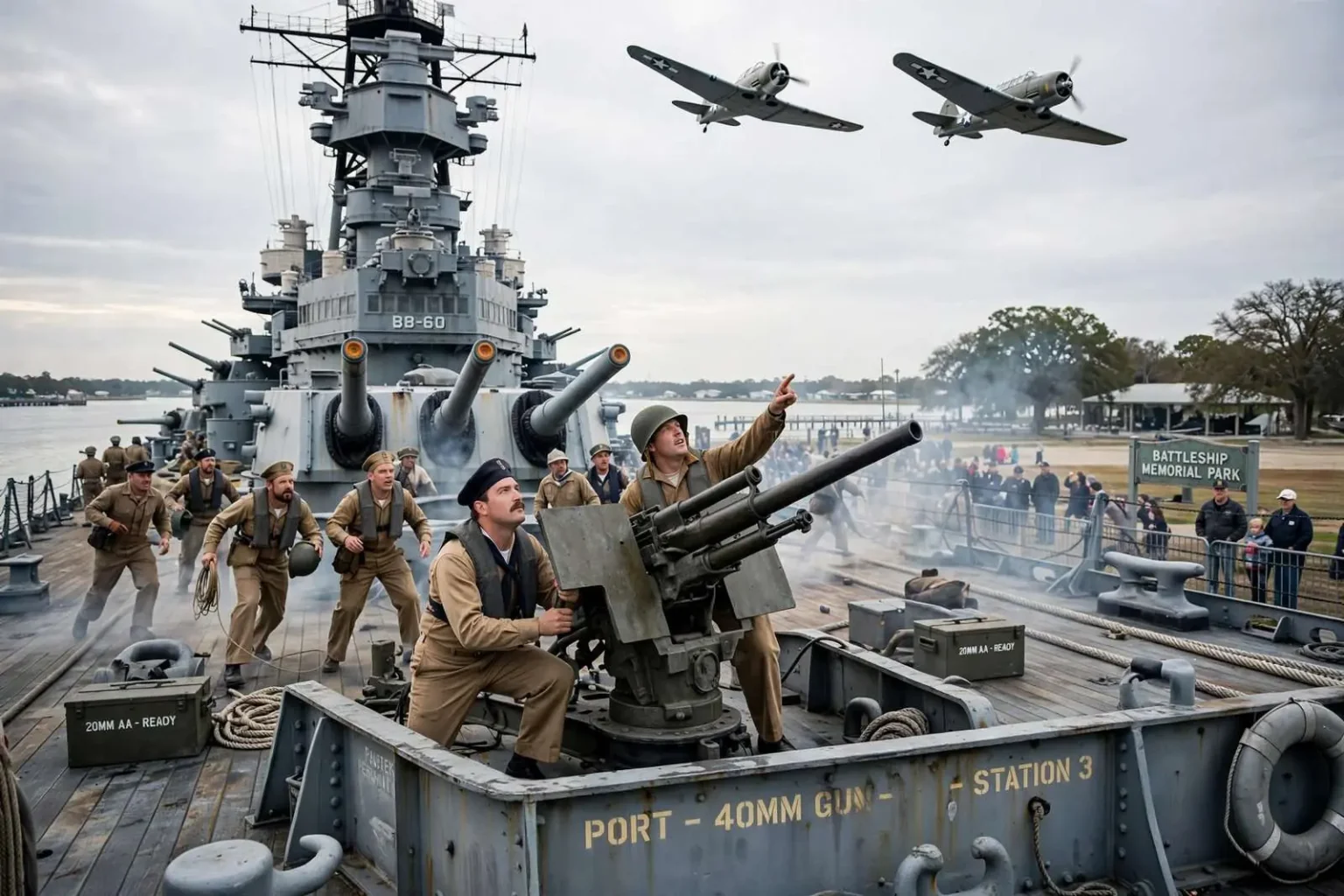
Battleship Memorial Park in Mobile hosted a special living-history event in December 2014, staging a reenactment of the attack on Pearl Harbor to mark the anniversary of the December 7, 1941 assault that pulled the United States into World War II. The program brought together costumed performers dressed in period 1940s military uniforms alongside local aviators, who flew a commemorative flyover meant to echo the formation that appeared over Oahu, Hawaii, seven decades earlier.
Park executive director Bill Tunnell said the reenactment was the first of its kind staged at the site, calling it a rare opportunity for visitors to experience a realistic simulation of the historic attack. For a park whose exhibits are by necessity static, a ship at anchor and aircraft on display, the event offered something the grounds had never before attempted: the sights and sounds of the attack itself, replayed on a vessel that served in the very war it commemorates.
As part of the presentation, volunteers dressed as sailors took positions on the deck of the USS Alabama, the World War II-era battleship that anchors the park and gives it its name, manning the ship’s guns during the mock assault to give onlookers a sense of what crews faced in 1941. The reenactors worked through the motions of a crew under surprise attack, from manning anti-aircraft positions to scrambling across the deck, compressing hours of chaos into a staged performance visitors could follow from the shore.
The event was scheduled for a Saturday morning at 11 a.m. and was designed to be both an educational exercise and a tribute to the sailors, airmen and Marines who served during the war. Organizers timed the program so that families, veterans groups and school audiences could attend together, making the anniversary a teaching moment rather than a ceremony observed only by those who remember the original day.
Remembering the Attack That Drew America Into War
Tunnell noted that organizers hoped the demonstration would help visitors better understand the scale and suddenness of the surprise attack that sank or damaged a large portion of the Pacific Fleet and killed more than 2,400 Americans. On the morning of December 7, 1941, Japanese carrier aircraft struck the U.S. fleet at anchor at Pearl Harbor, Hawaii, catching the base largely unprepared and pushing a nation still divided over intervention into World War II within hours.
The Alabama itself tells the story of what came after. The battleship, one of the fast battleships built for the Pacific war, earned nine battle stars serving in both the Atlantic and the Pacific, protecting carrier task forces and shelling enemy positions before the war’s end. Decommissioned after the war and saved from the scrapyard by Alabama schoolchildren’s penny drives and a statewide campaign, the ship has rested on Mobile Bay since the 1960s, one of the few surviving battleships of its generation anywhere in the world.
That history gives a Pearl Harbor reenactment at the site a particular weight. Visitors watching reenactors race across the deck are standing on a ship that faced the real dangers of the Pacific war, from kamikaze attacks to the typhoons that stalked the fleet, and the connection between the staged event and the real service recorded in the ship’s log is part of what organizers hoped visitors would take away.
For the Mobile area, the anniversary has long carried personal significance. The Gulf Coast’s ties to the Navy run deep through shipbuilding, shipyard work and generations of families whose members served in the Pacific theater, and the park’s December ceremonies have traditionally drawn veterans of the war itself, their numbers fewer with each passing year.
A Park That Anchors Gulf Coast Memory
Battleship Memorial Park has long served as one of the Gulf Coast’s most visited historic sites, drawing school groups, veterans and tourists to tour the USS Alabama and the submarine USS Drum, along with an aircraft pavilion featuring historic military planes. The park sits on Mobile Bay along the causeway that links Mobile to the Eastern Shore, its white superstructure visible for miles across the water and serving as one of the region’s most recognizable landmarks.
The submarine USS Drum, moored beside the battleship, is among the oldest American submarines on public display anywhere, a veteran of the Pacific submarine campaign that sank scores of Japanese vessels during the war. Visitors who climb through the Drum’s hatches see how cramped and relentless that service was, and the submarine’s survival into the present makes the park a rare place where two major warship types from the same war can be toured on the same afternoon.
The aircraft pavilion rounds out the collection with historic military planes spanning the decades, from World War II-era fighters and bombers to jets of the Cold War. For the Pearl Harbor reenactment, the pavilion’s connection to the flyover was direct: the aviators who took to the sky over the bay were performing, in miniature, the role aircraft played in the war’s opening act.
The park’s programming regularly ties into national commemorations, and the Pearl Harbor anniversary has become one of the more solemn dates on its calendar, offering a chance for South Alabama residents to connect with the nation’s military history without leaving Mobile. Memorial Day, Veterans Day and the battleship’s own commissioning anniversary each bring their own ceremonies, drawing crowds of veterans and families to the deck and the memorial areas along the shore.
For many attendees, the reenactment offered a hands-on complement to the park’s static exhibits, letting visitors watch history come alive rather than simply reading placards. Museum professionals have increasingly turned to living-history programming as a way of reaching younger audiences raised on interactive media, and the park’s first attempt at a staged battle scenario placed it alongside institutions nationwide experimenting with the same approach.
The flyover component, coordinated with area pilots, added a multisensory layer to the tribute, with the sound of vintage-style aircraft passing overhead intended to evoke the chaos and noise reported by eyewitnesses to the original attack. Survivors’ accounts from Pearl Harbor describe the roar of low-flying aircraft and the concussions of bombs and torpedoes as among the most disorienting elements of the morning, details no placard can convey but a flyover can approximate.
Teaching the Next Generation
Organizers indicated an interest in continuing similar commemorative programming in future years, using the battleship as a backdrop for teaching new generations about a pivotal moment in American history. The 2014 event served as a test of what the site could support, from the logistics of coordinating reenactors and aircraft to the question of whether visitors would respond to a staged reenactment of an event more often observed through solemn ceremony.
Education has always been central to the park’s mission. Thousands of schoolchildren from across Alabama and the Gulf Coast pass through the ship’s compartments every year, many of them encountering the scale of a battleship, the reality of a submarine’s cramped quarters, or the story of the war in the Pacific for the first time. A reenactment builds on that mission by giving those same students a dynamic memory to attach to the facts, the image of sailors racing to their guns on a Saturday morning.
The timing of the 2014 event also mattered for the veterans still able to attend. Each December brings fewer survivors of the Pearl Harbor attack, and the park’s ceremonies have increasingly doubled as opportunities for the region to honor them while they remain present. Living-history events extend that work to audiences who never knew the veterans personally, converting memory into experience before the last eyewitnesses are gone.
The morning timing also worked in the event’s favor, placing the reenactment and flyover in the same hours when Pearl Harbor itself came under attack in 1941. Organizers encouraged visitors to arrive early, both to find parking along the popular causeway site and to position themselves for the full view of the deck performance and the flyover together, a combination that unfolded in under an hour but drew on months of preparation.
The park remains a cornerstone of Mobile’s tourism economy and a touchstone for the region’s deep ties to the U.S. Navy and Gulf Coast shipbuilding heritage. Visitors from across the country tour the ship each year, cruise ships calling at Mobile send passengers to the causeway, and the park’s presence along the bay connects the city’s present, still shaped by shipbuilding and the port, to the naval history that helped build it.
For one December Saturday, at least, the visitors who came to see a museum instead watched a battle. The guns of the USS Alabama, silent since the war, once again echoed over Mobile Bay in a tribute to the 2,400 Americans lost on the morning the war came to Pearl Harbor, and to the ship and crew that helped finish what that morning began.