Mobile Weighs ‘Ban the Box’ Measure for City Hiring
A proposed Mobile ordinance would remove criminal history questions from initial city job applications to help formerly incarcerated residents.
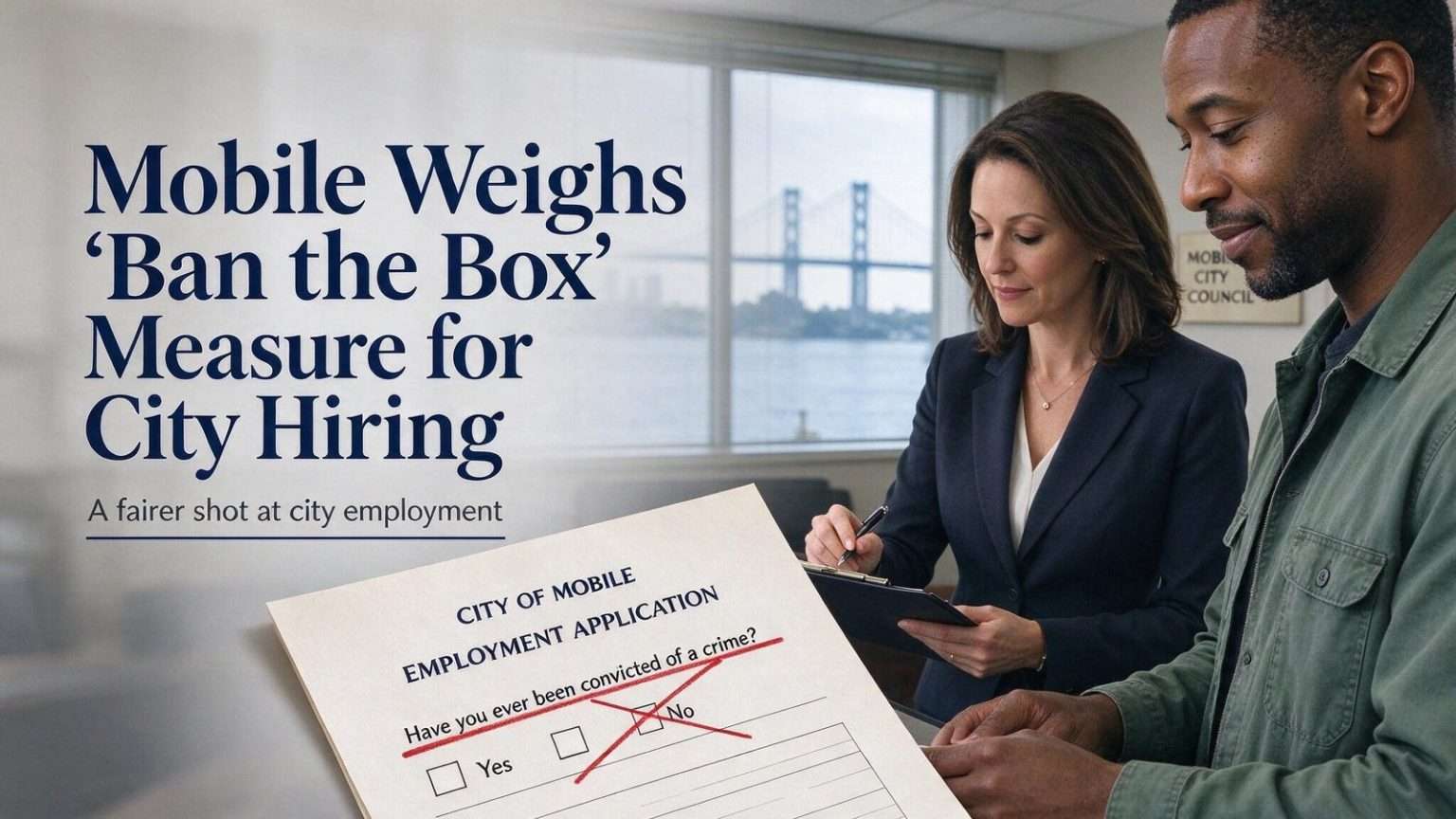
A proposed “Ban the Box” measure aimed at giving formerly incarcerated Mobile residents a fairer shot at city employment is expected to move forward after a Mobile City Council committee weighed the legality and impact of the policy this week. The proposal would remove questions about criminal history from initial city job applications, delaying background checks until later in the hiring process so that applicants with criminal records are not automatically screened out before their qualifications are considered.
The name comes from the checkbox that has long appeared on standard job applications asking whether an applicant has ever been convicted of a crime — a single box that, for the hundreds of Alabamians released from prison each year, can end an application before a hiring manager reads a single qualification. Removing the box does not erase the background check; it moves it later in the process, so an applicant’s skills, work history and interview performance are evaluated first and the record is weighed when it is actually relevant to a hiring decision.
Testimony From Those Affected
The Rules Committee heard emotional testimony from residents affected by the policy debate, including a mother who described the lasting barriers her adult son has faced finding steady work since serving time for a robbery conviction more than a decade ago. She told committee members she was not excusing her son’s past actions but believed people who have served their sentences and stayed out of trouble deserve a genuine opportunity to rebuild their lives.
Her son, now in his mid-30s, was convicted of armed robbery as a teenager and served seven years of a 20-year sentence before his release. He has been nearing the end of his probation period, according to testimony given to the committee, but said his criminal history continues to follow him during job searches years after his release. His experience mirrors the pattern reentry researchers describe across the country: the sentence ends, but the conviction continues to impose its own consequences in every application pile, long after the debt to society has formally been paid.
Stories like his are why the policy has found advocates beyond the civil rights community. Employers who conduct credit and background screens at the application stage often discard otherwise qualified candidates by the hundreds, and the people who appear before city committees in support of Ban the Box measures are frequently parents, pastors and employers who have watched capable workers stuck in cycles of rejection. The Mobile testimony followed that pattern — personal, specific and aimed at a practical question: what does the city gain by discarding a qualified applicant before reading the application?
The National Movement
Ban the Box policies have gained traction in cities across the country as part of a broader movement toward criminal justice reform, driven by research suggesting that stable employment significantly reduces the likelihood that formerly incarcerated individuals will reoffend. Advocates argue that removing the criminal history question from initial applications gives qualified candidates a fair chance to be evaluated on their skills and experience first. What began as a grassroots effort in a handful of cities has spread to hundreds of municipalities and a growing list of states, along with large private employers that adopted similar fair-chance hiring standards voluntarily.
Federal policy has pushed in the same direction. The U.S. Equal Employment Opportunity Commission has issued guidance encouraging employers to delay criminal history inquiries until later in hiring, on the theory that blanket early screening can disproportionately screen out minority applicants and run afoul of civil rights law. That guidance does not bind city councils, but it gives municipal attorneys a framework for evaluating the proposals that keep arriving in council chambers from coast to coast — including Mobile’s.
Critics of such measures have raised concerns in other cities about liability and workplace safety, though many Ban the Box ordinances still allow employers to conduct background checks later in the hiring process, typically after a conditional job offer has been extended. That structure preserves an employer’s ability to disqualify candidates whose records genuinely conflict with the duties of the job — positions involving cash handling, vulnerable populations or law enforcement powers — while preventing the record from functioning as an automatic gate at the application stage. How Mobile’s version treats sensitive positions is among the questions the city’s attorneys were asked to address.
What the Ordinance Would Cover
Supporters say the policy would apply specifically to city government hiring practices rather than private employers, though some advocates hope it could eventually influence hiring practices more broadly across the Mobile business community. That scope is typical of first-generation Ban the Box ordinances: the city controls its own application forms, so the reform can be enacted cleanly for municipal jobs, while private employers remain governed by state and federal law. The hope among advocates is that city government, as one of the area’s largest employers, can model the practice well enough that local businesses adopt it without being required to.
Mobile’s city government employs workers across an unusually wide range of occupations — police and fire, public works, the port-adjacent infrastructure enterprises, parks and administrative staff — which makes the design details matter. An ordinance that removes the conviction question from applications for a clerk position may need different timing rules than one covering a position with access to cash, equipment or vulnerable residents. Committee members weighing the proposal this week were navigating exactly that line: a fair-chance standard that opens doors without creating liability the city cannot manage.
The Road Through City Hall
Mobile City Council members did not take a final vote on the measure this week, but committee members indicated the proposal is likely to advance for broader council consideration in the coming weeks. The committee stage is where the practical objections get aired — the cost of changed application procedures, the legality questions, the concerns of department heads who administer hiring — and where the emotional testimony of residents like the mother who spoke this week meets the administrative machinery of a city workforce.
If adopted, Mobile would join a growing number of Alabama municipalities examining similar hiring reforms aimed at reducing employment barriers for residents with criminal records. The movement’s growth in Alabama is notable in a state where reentry services are thin and where a felony conviction carries lifelong collateral consequences — restrictions on voting, licensing and housing that compound the employment problem the ordinance targets. For a city whose population includes thousands of residents with records, the question the council will take up is not whether formerly incarcerated Mobilians are looking for work, but whether the city’s own application process will let their qualifications be seen before their past is counted against them.
The coming weeks will show whether the committee’s direction holds through a full council vote. Whatever the outcome, the hearing itself marked a shift in the local conversation: the policy that began elsewhere as an advocacy slogan is being debated in Mobile on the concrete terms of who gets a job interview, when a background check happens, and what a second chance actually looks like in practice for the families who testified this week.
The Economics of a Second Chance
The employment question at the center of the ordinance is not simply a matter of fairness; it is a measurable economic issue for the city. A resident who cannot clear the application stage cannot build the steady work history that leads to better wages, and the costs of that exclusion — in public assistance, in family instability, in the far higher cost of returning someone to prison — land on the same taxpayers the city serves. Reentry researchers have documented for years that people who find stable employment in their first years after release reoffend at sharply lower rates than those who do not, which is why workforce access has become a cornerstone of criminal justice reform nationwide.
Alabama’s particular circumstances sharpen the stakes. The state’s prison system has been under sustained scrutiny for overcrowding, and releases into the community happen every month across Mobile County. Each person walking out faces a job market where the conviction question sits at the top of most applications, and each rejection that follows costs the community one of two ways — either the person finds footing and becomes a taxpayer, or the cycle resumes at vastly greater public expense. The mother who testified this week put a face on that arithmetic, but the numbers behind it are the city’s own.
How Other Cities Have Handled It
The experiences of the cities that adopted Ban the Box ordinances first offer Mobile a practical preview. The common design elements are well established by now: the conviction question comes off the initial application, background checks occur after a conditional offer or at the interview stage, and positions with legal disqualifications — law enforcement, jobs working with children, positions bound by state licensing rules — are carved out. Cities that followed that template have generally reported steady hiring operations; cities that skipped the carve-outs have sometimes faced litigation or administrative confusion, which is why the legality review Mobile’s committee requested matters.
The week’s committee discussion did not produce a vote, but it produced the record a city needs before enacting a reform of this kind: testimony from affected residents, questions to staff about implementation, and a legal review of how the ordinance would interact with state law and federal guidance. If the measure advances to the full council on that footing, Mobile will adopt it as a tested model rather than an experiment — one more Gulf Coast city deciding that an applicant’s qualifications deserve to be read before a checkbox answers for them.