Vandals Damage Holiday Gift Drive for Mobile Families Facing HIV
A break-in at a Mobile church storage site damaged or stole donations meant for 120 holiday gift boxes destined for AIDS Alabama South clients and families.
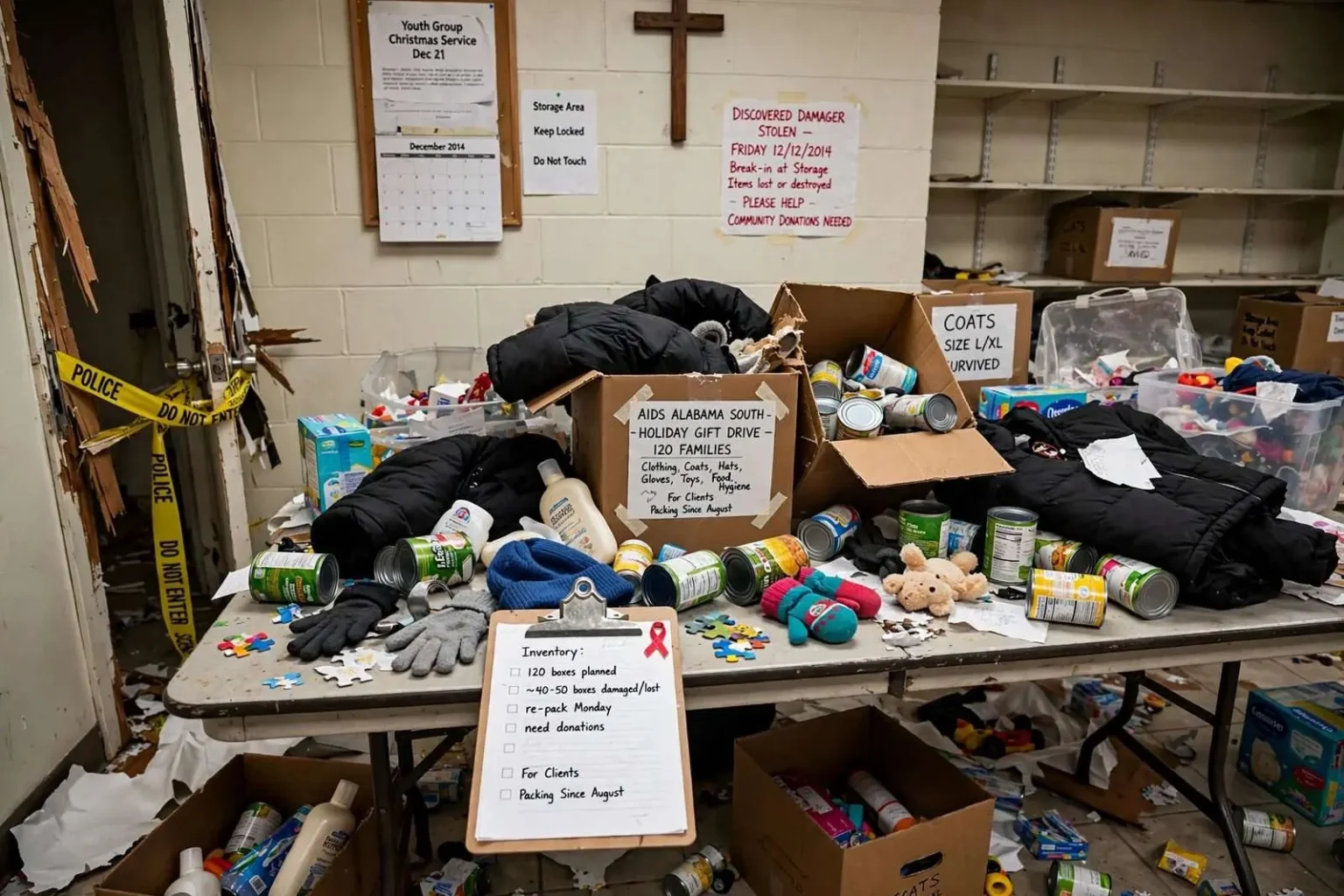
A long-running holiday tradition in Mobile suffered a setback in mid-December 2014 after donations gathered for families served by AIDS Alabama South were stolen or destroyed in a break-in at a church storage site. The nonprofit had been assembling 120 gift boxes for clients and their families, all of whom live below the poverty level. Development specialist Erika Corey Turner said the boxes were being filled with clothing, coats, hats, gloves, toys, non-perishable food and personal hygiene items. Much of that inventory was lost when vandals struck the building where the donations were being kept.
“Items generously donated by the community were either stolen or damaged,” Turner said. The damage was discovered on a Friday, according to the organization, which notified police and began assessing the scope of the loss. Officials at the church where the donations were stored asked to remain anonymous while police investigated, a request that underscored the sensitive nature of the incident and the relationship between the nonprofit and its host site.
A Quarter-Century Holiday Tradition
The gift-box project has been an annual effort for AIDS Alabama South for about a quarter of a century, and volunteers had been working on it since August. Months of collection drives, sorting sessions and packing work went into the effort each year, with community members, congregations and local businesses contributing items for the boxes. For many of the organization’s clients, the December delivery has been one of the few guaranteed moments of celebration in a year otherwise defined by tight budgets and difficult health circumstances.
Turner said the group was heartbroken but determined to recover in time for the holidays. “We are all just speechless and heartsick that anyone would inflict destruction to those in need, yet we are determined to push forward and create a happy ending,” she said. Her comments captured the mood among staff and volunteers, who described the break-in as a betrayal of both the organization and the donors whose gifts were targeted.
AIDS Alabama South provides services and support to people living with HIV and AIDS across the Mobile region. The organization operates as part of a network of Alabama AIDS service organizations that have, over the decades, taken on housing assistance, case management, prevention education and client support in communities where the disease has carried a heavy toll. In the Mobile area, the group’s client base includes individuals and families who rely on the nonprofit not only for direct services but for practical help — food, clothing and seasonal support — that stretches limited household budgets further.
Regrouping After the Break-In
The organization planned to regroup the following Monday, sorting through what survived and beginning to repackage the undamaged gifts. “The joy that our clients and their families deserve is what will motivate us to turn this event around and make it the celebration it is intended to be,” Turner said. “We will reassess this situation and begin reassembling and packaging the gifts that survived without damage.”
That triage work, officials said, would determine how much of the original plan could be salvaged. Donations that escaped the vandalism would be cleaned, re-sorted and repacked, while the gaps left by stolen or destroyed items would need to be filled quickly if the boxes were to reach families before Christmas. Staff members acknowledged the timeline was unforgiving, but they pointed to the organization’s long experience with the drive as a reason for confidence.
An Appeal to the Community
The setback prompted a fresh appeal to the community for donations of any of the items lost in the break-in, with the organization asking individuals, churches and businesses to step forward in the final days before distribution. Nonprofit leaders noted that the drive’s survival had always depended on volunteer labor and in-kind giving rather than large institutional funding, which meant the community itself held the power to restore what had been taken.
Local gift drives of this kind occupy an important place in Mobile’s charitable landscape. Each December, churches, schools and service organizations across the city collect toys, coats and food for families in need, and the loss of one organization’s inventory reverberates through the network of agencies that often refer clients to one another. AIDS Alabama South’s clients, living below the poverty level, frequently qualify for multiple assistance programs, and a lost gift box cannot easily be replaced by another agency that already has its own committed recipients.
Why the Drive Matters to Clients
For the families the boxes are intended for, the drive represents more than charity. Many clients of AIDS Alabama South manage chronic illness on fixed or limited incomes, and the holiday season brings added expenses — travel to family, extra meals, gifts for children — that strain household resources. The organization has structured its annual drive to deliver a complete package of seasonal needs: warm clothing for Gulf Coast winters that can still turn cold, toys that allow parents to give their children a normal Christmas morning, and shelf-stable food that carries a household through school breaks.
Volunteers, some of whom have worked the drive for years, describe the packing days as a highlight of the organizational calendar, a moment when the wider community’s generosity becomes tangible. The August start date for collection reflects the scale of the undertaking: sourcing donations item by item, tracking inventory and coordinating storage space requires months of lead time, which is precisely what the vandals’ actions threatened to erase.
Turner and other organization leaders emphasized that the response to the break-in would define the season for the 120 families on the list. The group’s message to the community in the days after the vandalism was direct: the tradition would continue, the boxes would be delivered, and the generosity that had sustained the drive for roughly twenty-five years would be called upon once more to carry it through.
The Role of Faith Partners in the Drive
The reliance on donated church storage space is common among Mobile-area nonprofits, which often operate with lean administrative budgets and depend on congregations, schools and civic clubs for warehouse capacity as much as for funding. Hosting a gift drive places a congregation at the center of a citywide charitable effort, but it also means the host site assumes responsibility for security during the weeks when inventory accumulates. The decision by church officials at the storage site to remain anonymous while police investigated reflected the delicate position such hosts occupy — cooperative with the inquiry, yet wary of drawing further attention to a facility that had already been targeted.
Police in Mobile handle burglary and criminal mischief reports across hundreds of churches and nonprofit sites each year, and cases involving stolen charitable donations tend to draw particular public attention because the harm extends beyond the property owner to unseen recipients. Investigators in such cases typically review entry points, security measures and the timeline of when the donations were last seen intact. The organization did not disclose what, if anything, was recovered, and police had not announced arrests in the days after the damage was discovered.
How AIDS Alabama South Serves the Region
Beyond the holiday drive, AIDS Alabama South functions as a year-round support system for people living with HIV and AIDS in the Mobile region. Organizations of this type emerged across the South in the late 1980s and early 1990s, a period when the epidemic’s impact on Gulf Coast communities outpaced public services and grassroots groups filled the gap. Over time their missions broadened from emergency assistance to comprehensive support — connecting clients to medical care, helping with housing stability, offering testing and prevention outreach, and advocating for the people they serve in a region where stigma surrounding the disease has historically complicated both fundraising and service delivery.
That history gives the annual gift drive its particular weight within the organization. Clients served by the group often face circumstances — illness, loss of income, family estrangement — that make the holidays harder rather than easier, and the gift boxes are designed as a practical expression of the community’s continued support. Losing a portion of the inventory days before distribution therefore struck staff not merely as a property crime but as an injury to people already carrying significant burdens, a framing Turner’s remarks made explicit.
Looking Toward Distribution
With the Monday regrouping planned, the organization’s immediate priorities were clear: catalogue what remained, repair what could be repaired, and rebuild the boxes in time for their scheduled delivery. Volunteers were expected to return to packing duties alongside staff, and the organization signaled that it would accept replacement donations through the final stretch before the holidays. Whether the full complement of 120 boxes could be restored depended on the community’s response in the days that followed, but leaders committed to delivering a celebration to their clients regardless of the final count. In a season defined for many of those families by scarcity, the organization’s insistence on pressing forward — “create a happy ending,” in Turner’s words — became the story’s defining note for supporters across Mobile.