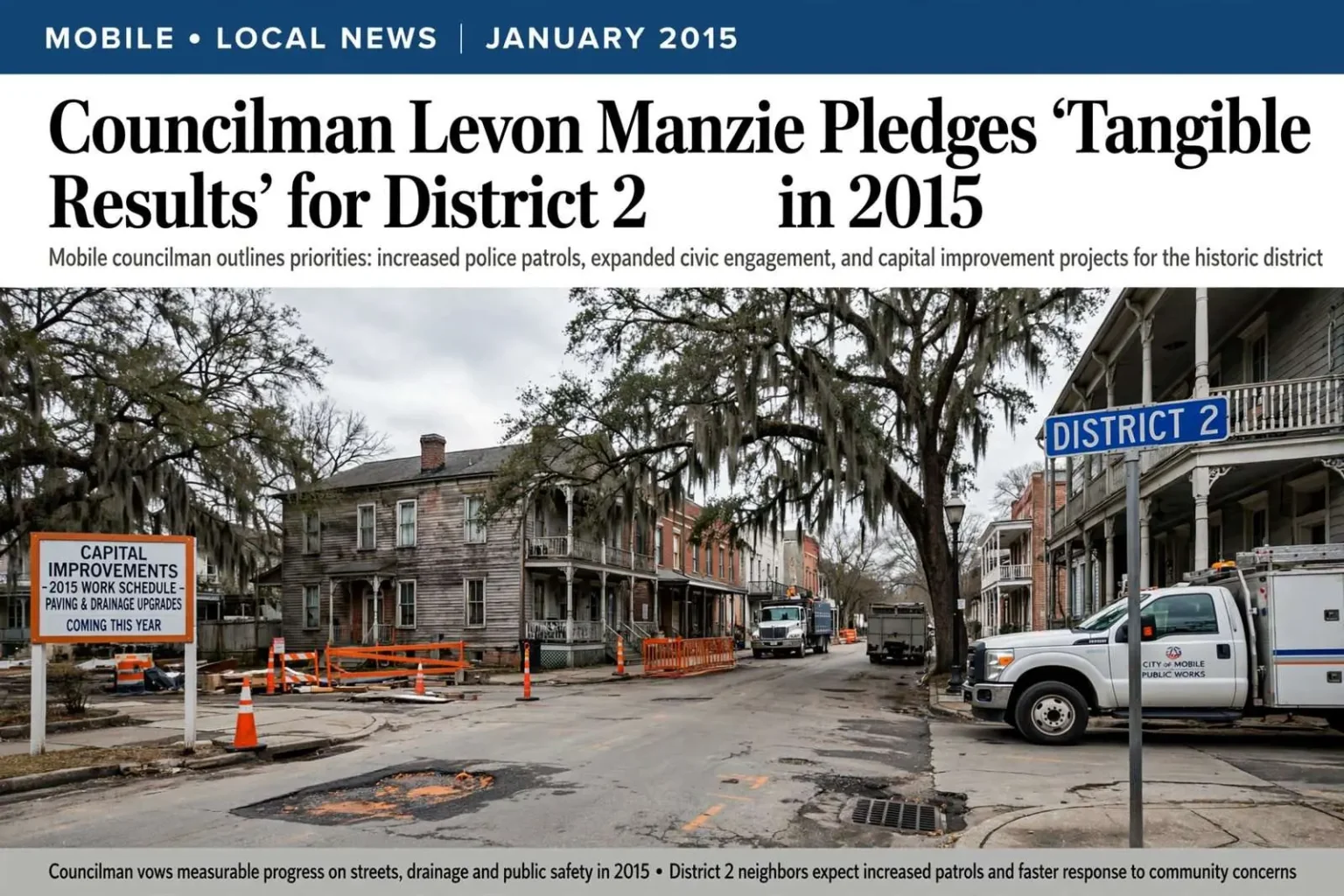
Councilman Levon Manzie Pledges ‘Tangible Results’ for District 2 in 2015
Mobile City Councilman Levon Manzie outlined plans for more police patrols, capital projects and community engagement in District 2 for 2015.
Mobile City Councilman Levon Manzie says residents of District 2 should see more than just talk from City Hall in the coming year, promising increased police patrols, expanded civic engagement and a renewed focus on capital improvement projects across the city’s oldest district. The pledges come as Mobile’s elected leaders prepare for a new year of budget decisions and project planning, and they amount to a challenge to his own office to show measurable outcomes.
In outlining his priorities for 2015, Manzie emphasized that his office takes constituent outreach seriously, telling residents that their phone calls and emails to his office are not going unanswered. He described his approach to representing the district as rooted in listening first, saying his goal is to make sure “we understand the heartbeat and that we understand the needs and concerns of all citizens and all communities in District 2.”
That framing matters in a district as varied as District 2, which stretches across some of the most historic — and in places most demanding — terrain in the city. Manzie’s pledge on responsiveness reflects a common frustration at the neighborhood level, where residents often judge their representation not by speeches or votes but by whether a pothole gets filled, a streetlight gets fixed or a drainage complaint gets answered.
The district and its backlog of needs
Much of Manzie’s focus centered on the physical condition of District 2, which encompasses some of Mobile’s oldest neighborhoods. Age shows up in infrastructure first: streets that predate modern engineering standards, drainage systems built for a smaller city, sidewalks and public buildings that have absorbed decades of Gulf Coast weather. He pointed to a backlog of capital improvement needs that have accumulated over years in the historic district and pledged that 2015 would bring measurable progress rather than continued planning without follow-through.
Capital improvement projects — the roads, drainage upgrades, sidewalks, parks and public facilities that cities build and rebuild — are funded through the city’s annual budget and its capital program, and they are typically the most visible promises a council member can make. They are also among the slowest to deliver, since projects must be scoped, designed, bid and constructed before residents see results. A pledge of “measurable progress” in a single calendar year is therefore a pledge about momentum: projects moving from the planning column to the construction column, rather than waiting yet another year on a list.
For the older neighborhoods at the heart of District 2, the stakes are concrete. Drainage capacity is a perennial concern in a city that measures its summer rainfall in feet, and aging streets in historic districts face maintenance demands that newer subdivisions do not. When deferred maintenance accumulates across decades, as Manzie described, the cost of catching up grows each year that projects slip.
“Tangible results” became something of a rallying phrase for his priorities heading into the new year. The phrase is a deliberate contrast to the planning documents and studies that often mark municipal government’s response to longstanding needs. Manzie’s argument, in effect, is that District 2 has been studied enough — what its neighborhoods need now are crews, contracts and completed work.
The promise also sets a standard by which his office can be judged. Residents who hear “tangible results” in January will reasonably look for them by summer: project signs in the ground, contracts awarded, patrol cars in the neighborhood. Council members in Mobile serve four-year terms and face reelection on that record, and district representatives have historically been held closely accountable for the condition of streets and the visibility of city services close to home.
Public safety at the top of the list
Public safety also featured prominently in Manzie’s remarks, with the councilman committing to push for increased police presence throughout District 2 neighborhoods. Residents in older, denser parts of the city have often raised concerns about response times and visible patrol coverage, issues Manzie said he intends to address directly with city public safety officials in the coming months.
The concerns he cited are familiar ones in urban cores across the Gulf South. Denser neighborhoods with older housing stock, commercial corridors and nightlife districts generate more service calls per block than quieter residential areas, and residents frequently equate safety with visibility — officers they see, not just officers who arrive when called. A pledge of increased patrols is a pledge about deployment, and deployment decisions rest with the police department’s command staff rather than the council. What a council member can do is advocate, push staffing and resource questions into budget talks, and serve as a conduit between neighborhoods and the department.
That is the role Manzie described for himself. By committing to raise the issue “directly with city public safety officials,” he framed patrol coverage as a subject for ongoing negotiation between the district and the department rather than a one-time request. Mobile’s police force, like departments across the region, balances patrol staffing against investigative and administrative demands, and council members who make public safety a headline priority typically press for their districts in the annual budget process where officer positions and equipment are funded.
Expanded civic engagement rounded out his three stated priorities. In practice, that points toward the neighborhood meetings, community walk-throughs and direct communication channels that district offices use to keep pressure on city departments — and to keep constituents informed about when and where promised work will actually happen.
Manzie’s comments were part of a broader series of interviews Mobile’s seven City Council members gave heading into the new year, each outlining district-specific priorities for constituents. The series gave residents across the city a chance to hear directly from their council representatives about what to expect from municipal government in the months ahead, from infrastructure spending to public safety staffing decisions.
Mobile’s council-government structure gives each of the seven members a distinct constituency: every district elects its own representative, and the mayor and council together set the budget that funds the work. Because the council must approve the city’s spending plan, district priorities voiced in January tend to reappear in public budget discussions later in the year, where they either attract the votes and funding to move or do not. The interview series functions as an early declaration of each member’s bargaining position heading into those talks.
It also gives residents a basis for comparison. A homeowner in District 2 hearing Manzie promise patrols and capital projects can look at the pledges of the other six members and see whether similar needs in their own districts are being prioritized — useful context in a city where tax revenue is finite and every district has a list of deferred needs.
Balancing preservation and progress in the historic core
District 2 covers a significant swath of Mobile’s historic core, and Manzie’s emphasis on both capital investment and public safety reflects ongoing efforts to balance preservation of older neighborhoods with modern service demands. That balance is a defining tension in historic districts everywhere: the same old-growth character that makes a neighborhood desirable makes its infrastructure expensive to maintain, and repairs often must respect historic materials and layouts that complicate standard municipal work.
Mobile’s historic districts are among the most significant in the Deep South, with blocks of antebellum and turn-of-the-century architecture that anchor the city’s tourism economy and its identity. Maintaining them requires investment that goes beyond function to appearance — streetscapes, lighting and drainage work that fit the character of the neighborhoods. Projects in these areas tend to cost more and take longer than equivalent work in newer parts of the city, which is one reason backlogs form and why residents are quick to notice when promises of maintenance go unmet.
At the same time, the historic core is a living part of the city — home to thousands of residents who need functioning streets, adequate policing and responsive city services, not just a well-preserved backdrop. Manzie’s dual emphasis on capital investment and police presence speaks to both halves of that reality.
As the council moves into budget discussions for the new fiscal year, residents will be watching to see whether the projects and patrol increases Manzie outlined translate into the concrete progress he promised. The annual budget is where pledges meet line items, and it is the document that will show whether District 2’s backlog moves toward the front of the queue or waits another cycle.
What tangible results would look like
For residents trying to hold the pledge accountable, the markers are straightforward. On capital improvements, the test is whether projects in the district advance through design and bidding into actual construction during 2015 — the point at which years of planning become visible work. On public safety, the test is whether patrol presence in District 2 neighborhoods increases in practice, something residents gauge by how often they see officers on their blocks and how quickly calls are answered.
On civic engagement, the measure is simpler still: whether the phone calls and emails Manzie pledged to answer keep being answered, and whether neighborhood concerns raised at the start of the year resurface as funded projects or departmental commitments by the end of it. Constituent service rarely makes headlines, but it is the day-to-day currency of a district office, and it is often what residents remember at election time.
Manzie enters the year with the advantage — and the burden — of having named his standard himself. “Tangible results” is a phrase that invites measurement, and District 2’s neighborhoods, some of which have waited years on deferred maintenance and uneven police coverage, are positioned to apply it. The coming budget cycle will show whether the councilman’s rallies phrase becomes a record of completed work or another entry on the city’s long list of good intentions.
For now, the commitments are on the record: more patrols in District 2 neighborhoods, a district office that answers its residents, and a capital improvement backlog that its councilman says has waited long enough. Whether 2015 delivers on all three will be visible in the only place that matters to the people who live there — in the streets, drains and neighborhoods of Mobile’s oldest district.