Prichard Council Fails to Introduce Budget Amid Revenue Dispute
A Prichard City Council member blocked introduction of the city's budget, saying the revenue projections need review by an outside accountant.
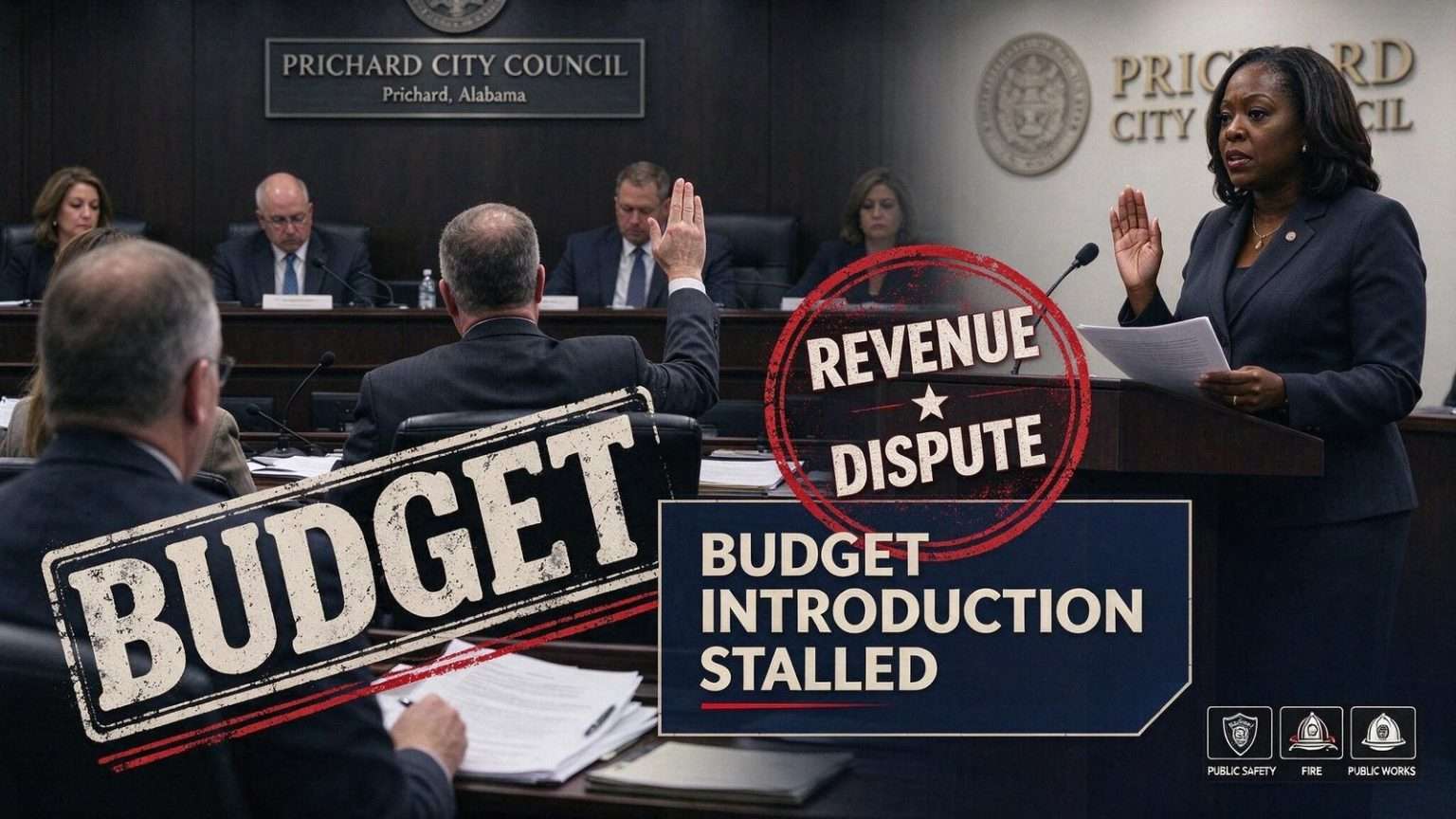
An attempt to introduce a balanced budget for Prichard’s current fiscal year stalled Thursday night when a City Council member voted against the measure, citing concerns about the accuracy of its revenue projections. Councilwoman Severia Campbell-Morris said she could not support the proposed budget without an independent review from a certified public accountant, arguing that no one with formal expertise in municipal budgeting had verified the figures compiled by council members.
“I am not in agreement with the projected revenue,” Campbell-Morris said during Thursday’s meeting, adding that she considered the numbers too optimistic given the city’s financial track record. Her objection was enough to block the introduction of the spending plan, leaving the council without the votes it needed to move the document forward even after weeks of preparation by council members who assembled the proposal themselves.
A City Familiar With Financial Strain
The failure to introduce the budget leaves Prichard, a small city in Mobile County with a long history of financial strain, without a formally adopted spending plan for the fiscal year already underway. City officials have grappled for years with tight finances, and the city spent time in state oversight during a prior financial emergency, making budget accuracy a particularly sensitive issue for council members and residents alike.
Prichard’s fiscal history is among the most difficult of any municipality in Alabama. The city of roughly 22,000 residents north of Mobile has struggled for decades with a shrinking tax base, legacy pension obligations and recurring shortfalls that at one point pushed it into municipal bankruptcy — an episode that made Prichard a statewide cautionary tale about municipal finance. State examiners have periodically scrutinized the city’s books, and the memory of that oversight continues to shape how officials and residents judge any proposal that rests on projected revenue.
What the Delay Means for City Services
Other council members expressed frustration with the delay, noting that the city needs an approved budget to plan spending on core services, including public safety, public works and administrative operations. Without an adopted budget, city departments typically continue operating under interim spending authority until council members can reach agreement — a mechanism that keeps the lights on and paychecks flowing, but which limits the city’s ability to commit to new spending, plan maintenance schedules or enter into contracts with confidence.
Interim budgeting also complicates matters for department heads. Police and fire commanders, public works supervisors and administrative staff generally prefer a fixed spending plan they can build hiring, equipment purchases and project schedules around. When a budget stalls, decisions large and small get deferred, and the uncertainty can stretch for weeks or months depending on how quickly the council resolves its differences.
The Case for an Outside Review
Campbell-Morris’s request for an outside accountant to examine the numbers reflects broader concerns among some council members about the reliability of internal financial reporting in a city that has struggled with budget shortfalls in the past. Supporters of an independent review argue that outside verification could help avoid mid-year shortfalls that have plagued the city’s finances previously — situations in which revenue came in below projections and officials were forced to cut spending or delay obligations partway through the fiscal year.
In Alabama municipalities, budget adoption follows a defined rhythm: the council and mayor’s office draft a spending plan, hold public sessions, and vote before the fiscal year begins on October 1. When the process slips, as it has in Prichard, the council must either pass a temporary appropriation or rely on routine expenditure authority while negotiations continue. An independent CPA review, while it adds time and cost up front, is sometimes seen as a worthwhile safeguard in cities with troubled fiscal histories, because a professionally verified revenue forecast carries more credibility with bondholders, state examiners and residents.
Divisions on the Council
The Thursday-night standoff exposed a familiar tension in small-city governance: the desire to move quickly versus the desire to get the numbers right. Council members who supported immediate introduction argued that the budget, balanced as presented, gave the city a working framework it badly needed, and that lingering over projections would only extend the period of improvised spending. Campbell-Morris and those sympathetic to her position countered that adopting an optimistic budget without professional verification would repeat mistakes the city could not afford to make again.
The disagreement is unlikely to be the last word. Council budget disputes in cities Prichard’s size are typically resolved through additional work sessions, where departmental requests are trimmed, projections are adjusted and holdout members are brought along — or overruled. Whether the council would commission the independent review Campbell-Morris sought, or simply revise its revenue assumptions, remained to be seen as the meeting ended.
Prichard’s Broader Fiscal Context
Prichard’s revenue base depends heavily on sales taxes, business licenses and shared state distributions, all of which fluctuate with economic conditions in the Mobile metropolitan area. The city’s industrial corridor along U.S. Highway 45 and its proximity to Mobile’s port economy provide some stability, but population loss over recent decades has eroded the household base that supports municipal revenue. Cities in that position often face a structural gap between the cost of providing basic services and the revenue available to pay for them, which makes conservative revenue projection a matter of survival rather than preference.
That arithmetic explains why a single council member’s demand for a CPA review could command such weight. A budget that projects revenue the city fails to collect forces disruptive mid-year corrections — hiring freezes, deferred maintenance, withheld payments to vendors — while a budget that projects conservatively may leave room for modest year-end reserves. For a city that has already endured state intervention, the difference between the two approaches is not abstract; it is the difference between managing its own affairs and surrendering that authority to outside oversight.
What Comes Next
City leaders have not announced a specific timeline for when the budget might be reintroduced, though officials indicated the council would continue working toward an agreement in the coming weeks. The options on the table — commissioning an independent review, revising revenue projections internally, or assembling the votes to proceed over Campbell-Morris’s objection — each carry their own implications for cost, credibility and the council’s working relationships.
For residents, the immediate effect is a period of continued uncertainty about city services and spending priorities. Prichard’s government has historically been closely watched by its citizens precisely because of its fiscal history, and council meetings on the budget have drawn attention from residents who want assurances that the city’s recovery from past emergencies will hold. The council’s next steps on the budget will be watched with the same scrutiny, as the city works to adopt a spending plan it can actually keep — a task that, in Prichard’s circumstances, is easier demanded than done.
Interim Authority in Practice
Under Alabama law, municipalities must operate within the limits of their most recent adopted budget or lawful appropriation, and when none exists, cities rely on interim mechanisms that allow routine obligations to be paid while a new plan is negotiated. Those mechanisms are not designed for extended use. Payroll, utility bills and insurance premiums can continue, but discretionary spending — new equipment, program expansions, facility repairs — generally waits for adoption. The longer the gap stretches, the more the deferred decisions pile up on the far side of whatever budget finally passes, creating pressure to spend hurriedly once authority is restored.
Prichard’s council members know this dynamic from experience. The city has navigated late budgets before, and departments have learned to plan conservatively during the interim period. Still, officials on both sides of Thursday’s dispute agreed on the underlying point: the city needs a real budget, and the question dividing them was not whether to adopt one but how much verification the revenue figures require before adoption.
The episode also illustrates the check each individual council member holds in a city’s legislative process. Budgets are ordinance-level acts that require majority support, and a single dissenter with procedural footing can slow — or in this case, halt — a document’s introduction. That leverage is most effective when an argument carries substantive weight, and Campbell-Morris’s appeal to professional verification resonated in a city where revenue assumptions have repeatedly proven to be the budget’s weakest link.
Thursday’s vote also served as a reminder of how municipal budgeting differs from the budgeting residents do in their own households. A city’s revenue arrives from many sources on different schedules — sales tax remittances, license renewals, state-shared funds — and each carries its own forecasting error. Professional accountants who specialize in municipal finance bring benchmarks from comparable cities, historical collection rates and an understanding of Alabama’s local tax structure that volunteer drafters, however diligent, rarely possess. In communities with stable finances, that gap in expertise is tolerable; in Prichard, where the margin between balanced and deficit is thin, it has repeatedly proven decisive.