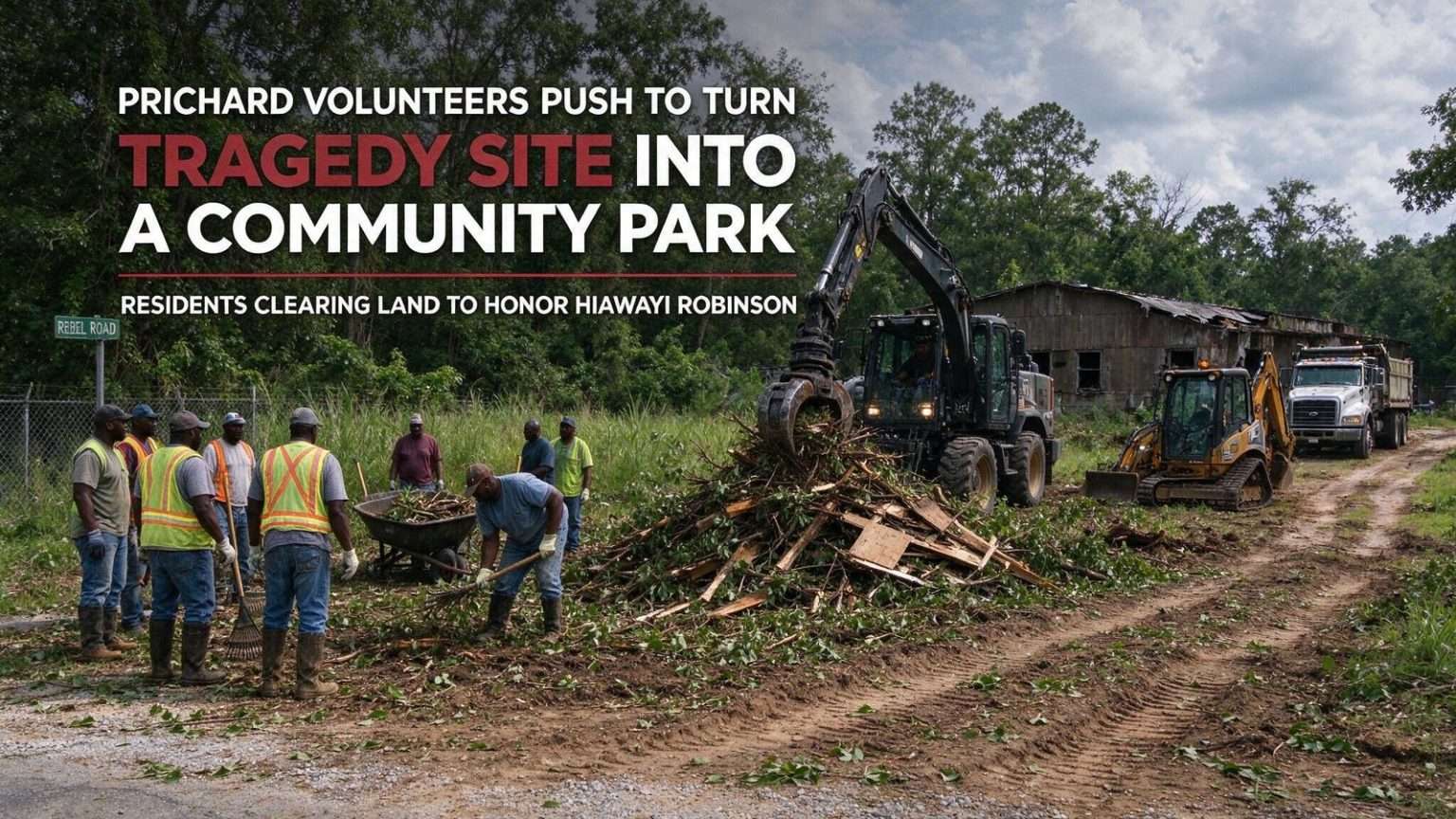
Volunteers clearing land in Prichard for a memorial parkPrichard volunteers are clearing land to build a park in memory of Hiawayi Robinson.

PRICHARD, Ala. — A group of Prichard community members has spent recent weeks hauling debris off a patch of overgrown land near Rebel Road, hoping to transform the site into a park or playground in memory of Hiawayi Robinson, the 8-year-old whose death devastated the community last month.

The land belongs to Pilgrim Rest A.M.E. Zion Church, and organizers say church representatives are expected to meet soon to decide whether the project can move forward on their property. “We are clearing the land and hoping and praying that we are able to bring a park to that location, particularly for that area where this tragic situation took place,” said Jimmie Gardner, a former Prichard police chief who is leading the effort.

Gardner is working alongside former Prichard Mayor Ron Davis and My Father’s House of Prayer pastor Lilly Mancarella, with additional help from community members Lee Witherspoon, Marshell Phillips, George Cooke and Vincent Smith. The group has been meeting at the site most days between 10 a.m. and 4 p.m., piling up brush and debris by hand before bringing in heavier equipment.

Remedial Services Inc., a Saraland-based hauling company, volunteered to help move the cleared debris, sending four trucks and a track hoe to the site on a recent Monday. Company representative Darin Smith said crews expected to haul away roughly eight full loads that day alone, a sign of how much work has gone into preparing the land for a different purpose.

Gardner said he’s optimistic the church will give its blessing to let the project continue, and he’s asking Prichard residents to pitch in with volunteer hours, equipment or other donations as the effort moves into its next phase. “As the project moves forward, I would ask the community to continue to come out and support the effort of creating a park at that location,” Gardner said.

Hiawayi Robinson, a Prichard third-grader, was reported missing on the night of Sept. 16. Her body was found two days later behind an abandoned building on Rebel Road, a discovery that shook the small Mobile County community. Funeral services for the child were held Sept. 27, and in the weeks since, neighbors and former city leaders have looked for a way to reclaim the site and honor her memory with something lasting.
Organizers say a completed park would give area children a safe, supervised place to play — transforming a site associated with grief into one focused on the community’s youngest residents moving forward.

See also  Mobile's Teen Curfew Law Could Guide Pensacola's Debate

Mobile is the county seat of Mobile County in southwest Alabama and the state’s only saltwater port. Situated where the Mobile River meets Mobile Bay near the northern Gulf of Mexico, the city has long served as a commercial and cultural gateway between Alabama and the wider Gulf Coast. Founded in 1702 as Fort Louis de la Louisiane and ruled in turn by France, Britain, and Spain before joining the United States in 1813, Mobile carries a layered heritage distinct from the rest of the state.

Today Mobile anchors a metropolitan area spanning Mobile County and neighboring Baldwin County, and it remains a center for shipping, aerospace, healthcare, and higher education in the region. Its downtown and waterfront have seen sustained revitalization, while historic neighborhoods preserve architecture from its colonial and antebellum past. The city’s identity is shaped as much by its working port and industrial base as by its festivals and food culture, making it a frequent focal point for news about growth and change in southern Alabama.

Charitable and nonprofit organizations form a vital safety net across South Alabama, addressing needs from hunger and homelessness to disaster relief and holiday assistance. Groups such as The Salvation Army operate local corps that provide shelter, food, and seasonal programs funded largely by community donations.

The generosity of Gulf Coast residents, often mobilized after hurricanes and economic hardship, underscores how tightly knit many of these communities are. Local philanthropy also relies on volunteers and corporate partners, and the progress of fundraising efforts is a recurring subject of regional news because it reflects the community’s capacity to care for its most vulnerable members.

Holiday campaigns in particular reveal the scale of need and the reach of volunteer networks. The rhythm of annual giving, from food drives to toy distributions, is woven into the regional calendar and into the coverage that keeps residents informed about how to help and where support is most needed.

The economy of the Mobile region is diversified across shipping and logistics, aerospace and shipbuilding, healthcare, tourism, and manufacturing. The Port of Mobile is one of the nation’s busiest seaports and a cornerstone of the local and state economy.

Major employers in aviation and defense contribute to a skilled workforce, while economic-development organizations aim to attract investment and jobs through incentives and infrastructure improvements. Small businesses, from restaurants to professional services, form the backbone of neighborhood commerce.

See also  Mobile Police Arrest Robbery Suspect in Downtown Package Store Holdup

The health of the regional economy is a frequent subject of public discussion and reporting. Workforce development, recruitment of industry, and the fortunes of local retailers all feed into a broader picture of how the Gulf Coast competes and adapts in a changing national economy.

Local government in the Mobile area operates through a combination of mayor-council or commission structures at the municipal level and a county commission in Mobile County, with elected officials handling budgets, public safety, infrastructure, and zoning. Baldwin County has its own commission and a collection of incorporated municipalities.

Decisions made in council chambers and commission meetings affect roads, school funding, economic development, and quality of life, which is why coverage of local government is a staple of regional journalism. The interplay between city, county, and state authorities often determines how effectively the area can address shared challenges.

Because many services residents rely on are delivered at the local level, the choices of elected officials have direct, everyday consequences. Budget priorities, in particular, reveal a community’s values and shape the trajectory of growth and public welfare for years to come.

Local law enforcement across South Alabama is carried out by municipal police departments, county sheriff’s offices, and state agencies that together cover a mix of urban, suburban, and rural territory. City departments handle policing within municipal limits, while sheriff’s offices provide courthouse security, jail operations, and patrol in unincorporated areas.

Cooperation among these agencies, and with federal partners, is central to tackling problems that cross jurisdictional lines, from drug trafficking to violent crime. Joint task forces that pair federal agents with local officers have become a standard mechanism for sharing information and concentrating resources on threats that no single agency could address alone.

Public-safety agencies in the region also contend with staffing, training, and community-relations challenges common to departments nationwide. How they allocate patrols, respond to calls, and engage neighborhoods is a regular subject of local oversight and news coverage, particularly where residents expect both accountability and visible protection.

Local journalism serves as the connective tissue of communities like those across South Alabama, informing residents about government, schools, public safety, and the events that shape daily life. Outlets covering Mobile and Baldwin County help hold institutions accountable and give voice to neighborhood concerns larger media may overlook.

See also  Riley Moved to Ban Double Dipping Across All of State Government

In an era of shifting advertising revenue and the rise of digital platforms, community news organizations have had to adapt how they gather and deliver information. The persistence of regional reporting remains important for civic engagement, particularly on issues such as coastal development, education, and local governance that directly affect residents.

The relationship between a local newsroom and its community is reciprocal: readers supply tips, context, and a sense of what matters, while the reporting provides a shared record of decisions and events. That loop is essential to a well-informed public.

Baldwin County sits directly east of Mobile County across Mobile Bay and is the largest county in Alabama by land area. It encompasses the Eastern Shore communities of Daphne, Fairhope, Spanish Fort, and Foley and stretches south to the beaches of Gulf Shores and Orange Beach along the Gulf of Mexico.

Long among the fastest-growing counties in the state, Baldwin blends suburban development near the bay with tourism-driven coastal economies. Its proximity to Mobile and its position on the Eastern Shore make it a recurring subject of regional news covering growth, infrastructure, schools, and the balance between development and coastal preservation.

Mobile Bay is a shallow estuary in southern Alabama where freshwater from the Mobile, Tensaw, and other rivers mixes with saltwater from the Gulf of Mexico. It is among the largest estuarine systems in the United States and supports commercial and recreational fishing, shipping through the Port of Mobile, and wetlands that buffer the coastline from storms.

The bay’s Eastern Shore, in Baldwin County, includes Daphne, Fairhope, and Spanish Fort, while the Western Shore lies in Mobile County. Its ecology and economy have guided settlement for centuries, and the bay figures in regional debates over development, navigation, and conservation. Events on either shore are routinely covered as part of the interconnected life of the Mobile metro area.