MAWSS Faces Sept. 3 Deadline on Prichard Water System Takeover
The Mobile Area Water and Sewer System has one meeting left before a Sept. 3 deadline to decide on taking over Prichard's water system for good.
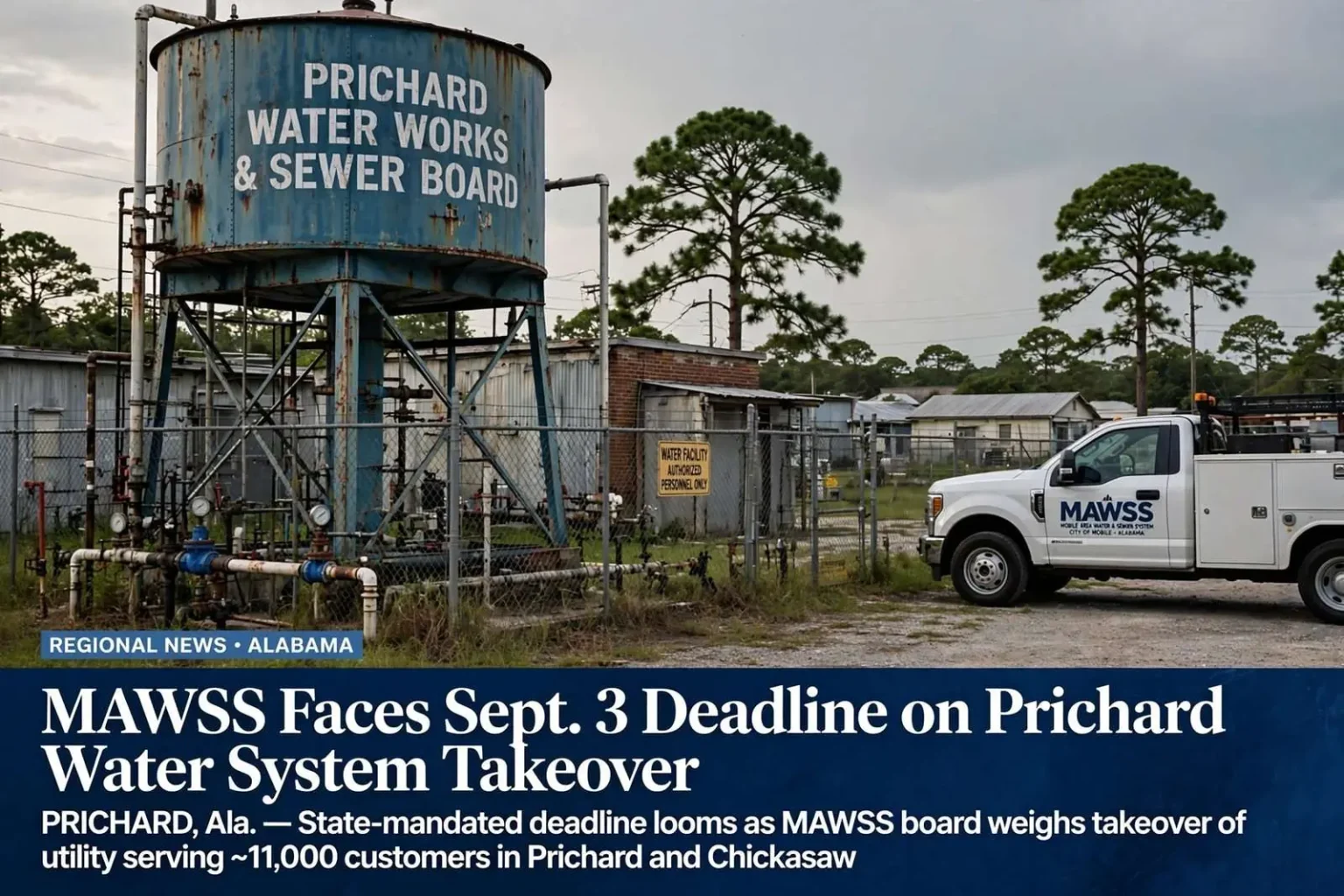
PRICHARD, Ala. — A state-mandated deadline is bearing down on the Mobile Area Water and Sewer System board, which must decide within days whether to take over the water utility serving thousands of customers in Prichard and Chickasaw.
State lawmakers approved legislation earlier this year laying out a timeline for MAWSS to absorb the Prichard Water Works and Sewer Board following a June referendum in which voters endorsed dissolving the Prichard board in favor of a MAWSS takeover. Under that law, the transfer of assets and liabilities must happen within 90 days of the election, putting the effective deadline in early September for a system serving roughly 11,000 customers across the two cities.
The referendum capped years of financial turbulence at the Prichard utility, which has struggled for more than a decade with debt, aging infrastructure and rate pressure on a customer base that is among the poorest in metropolitan Mobile. Prichard, a city of roughly 22,000 residents just north of Mobile, has faced its own fiscal crises — including a municipal bankruptcy — and its water board’s troubles have been a recurring subject of legislative attention in Montgomery.
Despite the voter mandate, the ultimate call rests with the seven-member MAWSS board, which has only one regular meeting scheduled before the deadline arrives. As of this week, there was no public indication that board members intend to bring the takeover to a vote at that session, and the board’s chairman did not respond to requests for comment on the timeline.
One MAWSS board member confirmed the matter would come up again at the upcoming meeting but said he could not predict whether it would actually reach a vote. A spokeswoman for the utility said the board continues to request records and operational details from the Prichard system, noting that only some of the requested information has been provided so far.
The Last-Minute Management Contract
Much of the holdup appears tied to a management contract the Prichard board approved in the days just before the June referendum. Under that agreement, an outside firm would handle day-to-day management and operations of the Prichard system at a cost of roughly $6.5 million a year over five years, with room for the price to rise further.
A state lawmaker who championed the MAWSS takeover argues the contract is unnecessary, saying MAWSS has the internal capacity to run the system itself and suggesting the last-minute vote by the outgoing Prichard board was designed to complicate or slow the transition. A five-year, $6.5-million-a-year management layer would, on the lawmaker’s reading, saddle the combined system with a cost it does not need just as ratepayers in Mobile are being asked to absorb a new service area.
The objection goes to the heart of the takeover debate. MAWSS operates the water and sewer system for the city of Mobile and surrounding areas at a scale several times larger than Prichard’s, with its own engineering staff, billing operation, maintenance crews and financing relationships. Proponents of consolidation argue those existing functions could absorb Prichard’s operations at modest marginal cost, while a contract that hires an outside firm to do what MAWSS can already do internally adds roughly $32 million over the contract’s life without adding a single mile of pipe.
For its part, the Prichard board’s defenders would note that the utility needed management help long before the referendum, and that an interim operations agreement is not an unreasonable step for a board still responsible for the system until the day of transfer. But the timing — approved in the final days before voters decided to dissolve the board — has made the contract the most contested artifact of the transition, and MAWSS’s unanswered records requests have kept questions about its terms and its selection process alive.
What the Deadline Means
The 90-day clock in the legislation is not advisory. If the transfer does not occur within the statutory window, lawmakers will face a choice between extending the deadline, forcing the transfer through further legislation, or watching the Prichard system continue operating under the structure voters just rejected. None of those outcomes reflects the orderly process the bill’s sponsors described when they carried the measure through the session.
Practical questions also complicate the transfer in ways a vote of the MAWSS board cannot resolve on its own. The two systems’ infrastructure interconnects in places but does not match entirely; Prichard’s debt obligations, pension liabilities and ongoing litigation must be inventoried and assumed under the statute; and customers in both cities will eventually want to know what happens to rates, billing cycles and service standards when the systems merge. Chickasaw, which shares the Prichard system under its own arrangements, adds another layer to the negotiation.
MAWSS itself is a creature of the Legislature, governed by a board whose members are appointed through city and county processes, and its leadership has been cautious about absorbing assets and liabilities it has not fully inspected. The utility’s request for records and operational details is standard due diligence for a merger of utilities, but the incomplete responses from the Prichard side have become the board’s stated reason for hesitation — and, to skeptics, a convenient one.
What Customers Should Expect
For the roughly 11,000 customers in Prichard and Chickasaw, a MAWSS takeover would mean, in time, a new bill, new customer-service channels and access to MAWSS’s capital improvement capacity. Supporters point to MAWSS’s deeper balance sheet and its ability to finance system upgrades at better rates as the core promise of consolidation: pipes repaired faster, water pressure stabilized and long-deferred maintenance finally scheduled.
Critics of consolidation have warned about rate equalization — the possibility that merging a financially distressed system into a healthier one could put upward pressure on Mobile customers’ bills, or that Prichard’s rates could rise toward MAWSS levels. Those questions have no public answers yet, because the transfer itself remains in limbo.
The coming MAWSS meeting is the last scheduled session before the statutory deadline, which makes it the moment the board either acts or forces the question back to Montgomery. Board members, the sponsoring legislators and the customers of two cities will all be watching whether the takeover that Prichard’s voters endorsed in June actually happens on the timeline the Legislature wrote — or whether the last-minute management contract and the unanswered records requests push the story into September and beyond.
A Decade of Troubles Behind the Referendum
The push to dissolve the Prichard Water Works and Sewer Board did not emerge from nowhere. The utility has spent years under financial strain, carrying debt accumulated through past borrowing, weathering collection problems in a service area where poverty runs high, and drawing repeated scrutiny over its governance. Previous state legislative sessions produced various interventions, none of which fully stabilized the system, and by the time this year’s referendum reached the ballot, supporters of dissolution argued that the board structure itself was the problem — that no management fix could succeed while the same governance model that produced the troubles remained in place.
The June vote gave supporters a decisive mandate. Voters in the affected service area, the people with the most direct stake in the outcome, endorsed dissolving the board and handing the system to MAWSS, which operates the largest water and sewer utility in the region. Under Alabama’s framework for utility governance, the Legislature then wrote the transfer timeline into law, effectively converting the referendum’s outcome into a statutory obligation with a fixed deadline.
That construction is what makes the current standoff unusual. The Legislature did not leave the transfer to negotiation between the two boards; it set a 90-day fuse from the election and directed that assets and liabilities move within the window. The MAWSS board’s discretion to vote — or not vote — before the deadline sits in tension with the statute’s design, and the sponsoring lawmakers have made clear they did not intend for the takeover to die of delay in a boardroom after surviving a public vote.
Stakes for the Region
The outcome matters well beyond the two cities directly involved. Mobile County’s water future increasingly runs through consolidation questions: small systems with shrinking rate bases and aging infrastructure struggle to fund repairs, while larger systems can borrow more cheaply and spread fixed costs across more customers. How the Prichard transfer plays out — smoothly on schedule, or stalled by contract disputes and incomplete records — will shape how legislators approach the next distressed system that asks for rescue.
For now, the customers of Prichard and Chickasaw remain in the same position they have occupied through years of uncertainty: paying bills to a system whose long-term owner is unresolved. The water still flows, the bills still arrive, and the deadline keeps moving closer. Within days, either the MAWSS board will vote to absorb the Prichard system, or the story will return to the Legislature that created the deadline — with a summer of public votes, statutes and referendums hanging on a single meeting agenda item that, as of this week, was not yet guaranteed a vote at all.