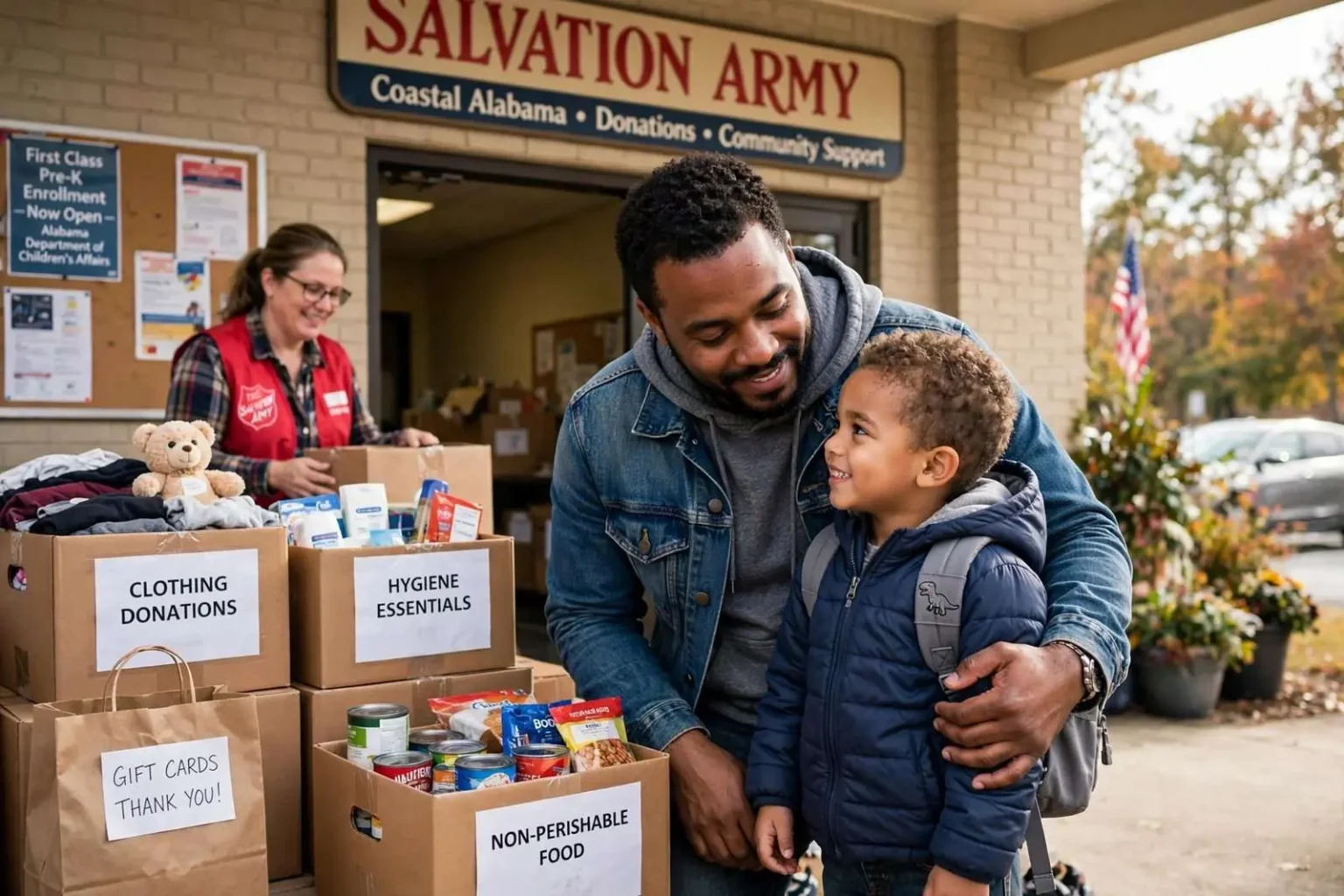
Volunteers assisting a family in the Mobile, Alabama areaLocal charities and residents rallied to help a father and son find stable housing.

MOBILE, Ala. — A father and his 4-year-old son who found themselves sleeping in their car after arriving in Mobile last month are now surrounded by an outpouring of community support, according to local relief workers who have been coordinating donations on the family’s behalf.

The father, previously living in Birmingham, drove into Mobile in late September with his young son and few other options. With shelters for homeless fathers and children scarce in the region, the Salvation Army of Coastal Alabama stepped in first, putting the pair up for several nights before arranging an extended hotel stay in early October.

Once word of the family’s situation spread, a local couple came forward and offered the use of a guest house, giving the father and son a stable place to live while he searches for steady work. Salvation Army representatives say the two are expected to move in within days.

Donations have followed just as quickly. Boxes of clothing, gift cards and other essentials have arrived at the Salvation Army’s Coastal Alabama offices, and a separate online fundraiser organized by a sympathetic local resident had already collected close to $1,500 toward a $2,000 goal.

The child has also found a soft landing. Thanks to a referral from Alabama’s Department of Children’s Affairs, he was enrolled in a First Class Pre-K classroom at a Mobile-area child development center, where staff say he has quickly made friends and settled into the routine of drop-off and pickup with his father each morning.

Salvation Army staff say the family’s story struck a chord locally because it highlighted a gap in services: shelters and transitional housing built for single mothers or individuals often are not equipped to handle fathers raising young children on their own. Organizers say they hope the response helps push for more flexible emergency housing options in Mobile and Baldwin counties.

In the meantime, the Salvation Army is working with the father on practical next steps, including replacing lost identification documents and connecting him with local employers who have reached out with job offers since hearing about the family’s situation.

Community organizers involved in the case say they hope to use the momentum from this outpouring of support to help other Mobile-area families facing similar circumstances, noting that a background check on the father turned up no concerns and that the response so far has been overwhelmingly positive.

Mobile is the county seat of Mobile County in southwest Alabama and the state’s only saltwater port. Situated where the Mobile River meets Mobile Bay near the northern Gulf of Mexico, the city has long served as a commercial and cultural gateway between Alabama and the wider Gulf Coast. Founded in 1702 as Fort Louis de la Louisiane and ruled in turn by France, Britain, and Spain before joining the United States in 1813, Mobile carries a layered heritage distinct from the rest of the state.

See also  Chunchula Man Accused of Attacking Family, Setting Home on Fire

Today Mobile anchors a metropolitan area spanning Mobile County and neighboring Baldwin County, and it remains a center for shipping, aerospace, healthcare, and higher education in the region. Its downtown and waterfront have seen sustained revitalization, while historic neighborhoods preserve architecture from its colonial and antebellum past. The city’s identity is shaped as much by its working port and industrial base as by its festivals and food culture, making it a frequent focal point for news about growth and change in southern Alabama.

Alabama is a state in the southeastern United States bordered by Tennessee, Georgia, Florida, the Gulf of Mexico, and Mississippi. Often called the Heart of Dixie, it spans Appalachian foothills in the north and flat coastal plains in the south. Its largest cities include Birmingham, Montgomery, Huntsville, and Mobile.

Alabama’s history encompasses Indigenous roots, Spanish and French colonial settlement, a cotton-plantation economy, the Civil War and Reconstruction, and the Civil Rights Movement of the 1950s and 1960s, followed by a shift toward manufacturing, aerospace, and technology. Local news across the state frequently reflects this mix of tradition and change.

Baldwin County sits directly east of Mobile County across Mobile Bay and is the largest county in Alabama by land area. It encompasses the Eastern Shore communities of Daphne, Fairhope, Spanish Fort, and Foley and stretches south to the beaches of Gulf Shores and Orange Beach along the Gulf of Mexico.

Long among the fastest-growing counties in the state, Baldwin blends suburban development near the bay with tourism-driven coastal economies. Its proximity to Mobile and its position on the Eastern Shore make it a recurring subject of regional news covering growth, infrastructure, schools, and the balance between development and coastal preservation.

Charitable and nonprofit organizations form a vital safety net across South Alabama, addressing needs from hunger and homelessness to disaster relief and holiday assistance. Groups such as The Salvation Army operate local corps that provide shelter, food, and seasonal programs funded largely by community donations.

See also  Cold Shelters Open Across Mobile and Northwest Florida as Temperatures Plummet

The generosity of Gulf Coast residents, often mobilized after hurricanes and economic hardship, underscores how tightly knit many of these communities are. Local philanthropy also relies on volunteers and corporate partners, and the progress of fundraising efforts is a recurring subject of regional news because it reflects the community’s capacity to care for its most vulnerable members.

Holiday campaigns in particular reveal the scale of need and the reach of volunteer networks. The rhythm of annual giving, from food drives to toy distributions, is woven into the regional calendar and into the coverage that keeps residents informed about how to help and where support is most needed.

The economy of the Mobile region is diversified across shipping and logistics, aerospace and shipbuilding, healthcare, tourism, and manufacturing. The Port of Mobile is one of the nation’s busiest seaports and a cornerstone of the local and state economy.

Major employers in aviation and defense contribute to a skilled workforce, while economic-development organizations aim to attract investment and jobs through incentives and infrastructure improvements. Small businesses, from restaurants to professional services, form the backbone of neighborhood commerce.

The health of the regional economy is a frequent subject of public discussion and reporting. Workforce development, recruitment of industry, and the fortunes of local retailers all feed into a broader picture of how the Gulf Coast competes and adapts in a changing national economy.

The natural environment is central to life on the Gulf Coast, where barrier islands, bays, rivers, and wetlands support fisheries, recreation, and storm protection. Coastal Alabama faces challenges common to low-lying regions, including hurricane exposure, erosion, and the management of fragile ecosystems.

The Mobile-Tensaw Delta, one of the largest river deltas in the country, is a particularly significant natural asset. Conservation efforts, fisheries regulation, and shoreline restoration are frequent points of collaboration among state agencies, federal bodies like the Army Corps of Engineers, and environmental groups.

How the region plans for growth while protecting its natural assets is a recurring theme in local reporting. The tension between development pressure and ecological stewardship plays out in zoning fights, infrastructure projects, and disaster-recovery decisions that shape the coast for generations.

Probate courts in Alabama handle matters distinct from the trial courts that hear criminal and civil cases, including wills, estates, guardianships, and involuntary commitments for mental-health treatment. In Mobile County the probate judge is an elected official with broad administrative and judicial duties.

See also  Deputy Superintendent Hired a Lawyer as Scrutiny of 200 Phone Calls Intensified

Cases involving involuntary psychiatric commitment require the court to balance an individual’s liberty interests against concerns for their safety and the safety of others, a sensitive legal threshold that has drawn scrutiny in many jurisdictions. The procedures governing such hearings, including who must appear and testify, are set by state law and local rule.

Disputes over those procedures often surface tensions between healthcare providers, the court, and advocates for patients. Because the stakes involve both liberty and wellbeing, courts and clinicians alike face pressure to honor the law while ensuring that people in crisis receive timely and appropriate care.

Mobile Bay is a shallow estuary in southern Alabama where freshwater from the Mobile, Tensaw, and other rivers mixes with saltwater from the Gulf of Mexico. It is among the largest estuarine systems in the United States and supports commercial and recreational fishing, shipping through the Port of Mobile, and wetlands that buffer the coastline from storms.

The bay’s Eastern Shore, in Baldwin County, includes Daphne, Fairhope, and Spanish Fort, while the Western Shore lies in Mobile County. Its ecology and economy have guided settlement for centuries, and the bay figures in regional debates over development, navigation, and conservation. Events on either shore are routinely covered as part of the interconnected life of the Mobile metro area.

The Gulf of Mexico borders Alabama’s southern edge and defines much of the state’s coastal identity. Alabama’s Gulf coastline, centered on Dauphin Island, Gulf Shores, and Orange Beach, supports a tourism industry built around beaches, charter fishing, and marine recreation, while offshore waters host shipping lanes and energy interests.

The Gulf’s warm, shallow shelf and exposure to hurricanes make weather and disaster preparedness recurring concerns for communities from Mobile to Baldwin County. The marine environment also underpins commercial seafood harvests that have sustained Gulf Coast families for generations, tying the region’s economy and culture closely to the water.