Mobile County Just Created Alabama’s First Court Docket Built Entirely Around Repeat Violent Offenders
Mobile County District Attorney Keith Blackwood has launched Alabama's first Repeat Violent Offender Docket, aiming to bring qualifying cases to trial within 12 months starting Aug. 1.
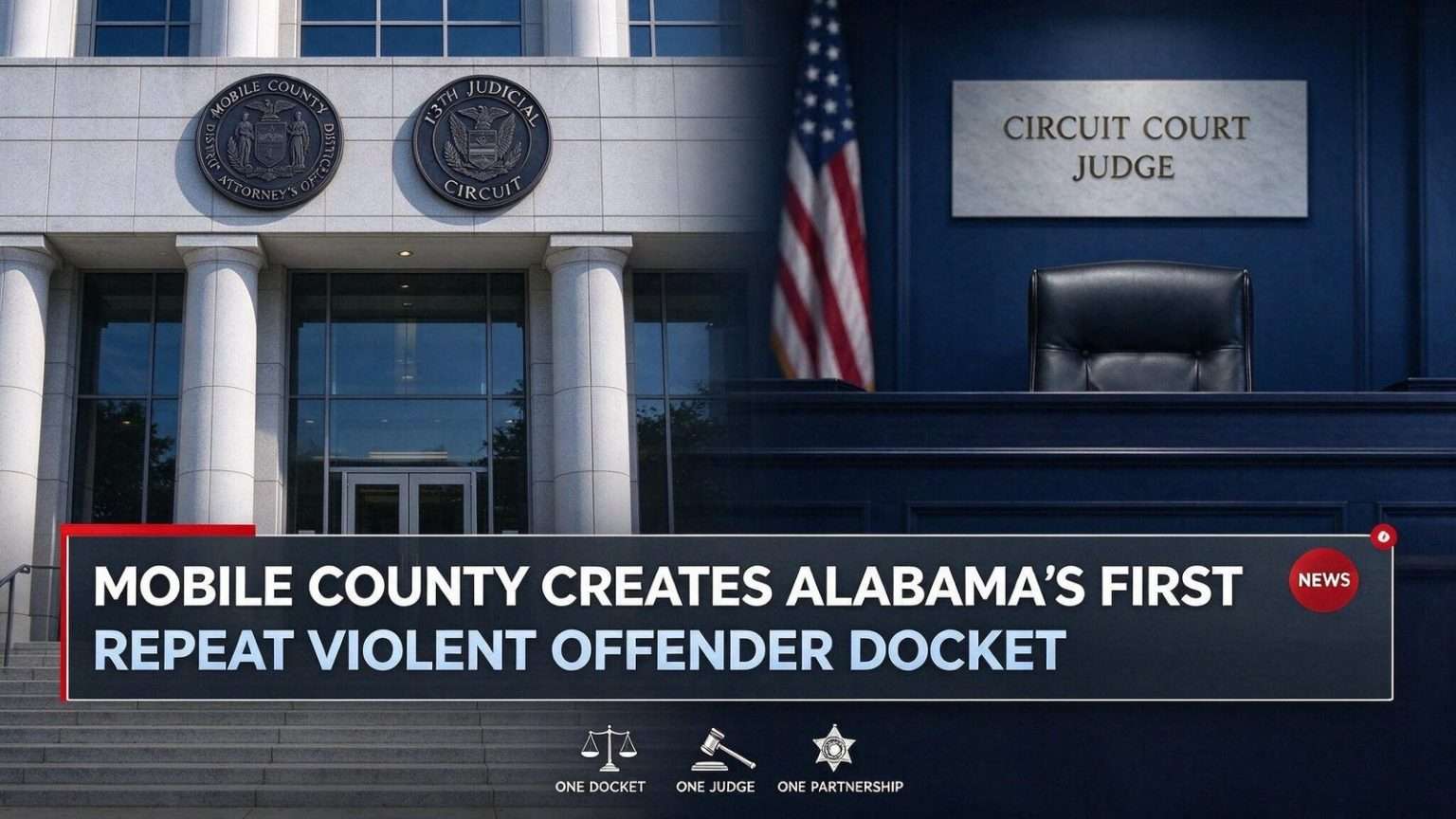
The Mobile County District Attorney’s Office has launched Alabama’s first Repeat Violent Offender Docket, a specialized court track designed to identify, prioritize and speed up the prosecution of defendants with a history of violent felony convictions. The docket took effect Aug. 1 and was created in partnership with the 13th Judicial Circuit, which handles all of the county’s circuit court business. Officials describe it as the first docket of its kind anywhere in the state, and it signals a deliberate shift in how Mobile County manages its most serious caseload.
The concept behind the docket is straightforward. When a defendant who has already been convicted of a violent felony is charged with a new qualifying violent offense, that case is flagged for the specialized track rather than worked into the general criminal docket. The qualifying window applies in two situations: when the new charge comes while the defendant is on supervised release, or when it comes within five years of the defendant’s release from incarceration. Prosecutors say those two categories capture the offenders most likely to continue cycles of violence and the cases most in need of close attention.
By concentrating those cases before a single judge, the court system can apply consistent scheduling, consistent handling and a level of institutional memory that is difficult to achieve when repeat offenders are scattered across the calendars of many different judges. The structure also makes it easier for prosecutors, defense attorneys and court staff to anticipate what a case will require and to resolve scheduling conflicts before they turn into months of delay.
One judge, one calendar, faster trials
Circuit Court Judge Vicki Davis will oversee the specialized proceedings. The stated goal of the docket is to bring qualifying cases to trial within 12 months of arrest, a timeline that officials consider aggressive by the standards of felony prosecution. Cases involving violent charges can ordinarily stretch far longer as attorneys file motions, experts are scheduled and witnesses are located, and each month of delay carries costs: memories fade, witnesses move or lose interest, and victims and their families are left waiting for resolution.
The docket also allows related matters to be consolidated so they move through the system faster. Probation revocations tied to a defendant’s new arrest can be handled alongside the new criminal charges, and cases involving co-defendants can be managed together rather than proceeding on separate, uncoordinated schedules. Consolidation reduces duplicate hearings, keeps the various parts of a case from working at cross purposes, and gives everyone involved a clearer picture of where a defendant stands with the court at any given moment.
Speed is not the only aim. Prosecutors emphasize that prioritizing these cases also changes how resources are deployed. Assistant district attorneys assigned to the docket can build expertise in the specific challenges these prosecutions present, from presenting prior conviction evidence to managing supervision records, and investigators can coordinate with probation and parole officials earlier in the process. For a county that handles one of the largest criminal caseloads in Alabama, that kind of focused capacity is intended to make every stage of a prosecution more deliberate.
Blackwood: standing still is not an option
District Attorney Keith Blackwood said the idea for the docket grew out of conversations that revealed a recurring pattern among repeat violent offenders moving through the county’s court system. Rather than treating each new case as an isolated event, prosecutors began looking at how often the same names reappeared, and how the system might respond if those cases were recognized for what they were: part of a pattern that demanded a different approach.
“I’m grateful to Presiding Judge Pipes and Sheriff Burch for embracing this vision and working alongside us to make it a reality,” Blackwood said. “This initiative represents more than a new court docket. It represents a shared commitment to continually improving the administration of justice because standing still is not an option. As crime evolves, the justice system must continue to evolve with it.”
That collaboration across agencies is central to how the docket will function. The District Attorney’s Office brings the prosecutorial authority, the 13th Judicial Circuit brings the judicial structure and calendar control, and the sheriff’s office brings the detention and enforcement side. Getting all three to agree on a shared approach for a defined category of cases is what made a dedicated track possible in the first place.
Due process protections remain unchanged
Blackwood emphasized that the new docket does not change anyone’s legal rights. Defendants on the track face the same constitutional standards as any other felony defendant in Alabama, and the docket changes management, not the underlying law.
“This initiative isn’t about creating new crimes or changing anyone’s constitutional rights,” he said. “Every defendant remains presumed innocent and is entitled to due process and a fair trial. What this changes is how these cases are managed.”
The distinction matters, because specialized dockets sometimes draw questions about whether expedited schedules shortchange the defense. Officials point out that a 12-month goal is a scheduling target, not a deadline imposed on a defendant’s right to prepare, and that consolidation of related matters is a long-accepted case-management tool. Defense attorneys retain the same motion practice, the same discovery rights and the same trial protections they would have in any other felony case.
Blackwood added that the challenges facing prosecutors today are far different than they were even a decade ago. Crime evolves, technology evolves, and the way violent crime is investigated and prosecuted continues to evolve along with it. In his view, a prosecution office that keeps using the same structures year after year will fall behind the problems those structures were built to address, and the docket is one answer to that reality.
Prosecutors also expect the docket to produce better data. When repeat violent cases are tracked together, the office can measure how long each stage actually takes, identify where delays concentrate and adjust accordingly. That feedback loop is difficult to build when cases are dispersed across a dozen calendars, and officials see it as part of the broader modernization effort Blackwood has described.
Local criminal justice observers note that the docket arrives at a time when Alabama courts everywhere are rethinking case management, from electronic filing to remote hearings. Mobile County’s approach ties that modernization directly to public safety rather than convenience alone, giving the idea a clear constituency among prosecutors, judges and deputies who deal with the consequences of delay every day.
What the docket means for Mobile County
For residents of Mobile County, the practical effect is intended to show up in two places: in how quickly violent cases reach resolution, and in how the system handles offenders who have already demonstrated a pattern of violence. Victims’ families often describe long felony timelines as a second burden stacked on top of the original crime, and prosecutors hope the 12-month target gives those families a realistic expectation of when their day in court will arrive.
Specialized dockets are not new to Alabama courts in general. Jurisdictions across the state have long operated problem-solving courts, including drug courts, mental health courts and veterans courts, each of which routes a defined category of cases into a dedicated track with dedicated oversight. What distinguishes the Mobile County model is its focus: instead of steering cases toward treatment or diversion, the Repeat Violent Offender Docket steers the county’s most serious repeat cases toward faster, more focused prosecution.
The 13th Judicial Circuit, which serves all of Mobile County, is among the busiest circuit courts in Alabama, and its judges routinely manage thousands of criminal filings alongside civil dockets. Concentrating a subset of violent felony cases before one judge is a way of acknowledging that not all cases impose the same demands on the system, and that a minority of offenders accounts for a disproportionate share of the harm.
Sheriff department officials have pointed to the revolving nature of the offenders the docket targets: people charged with new violent offenses while still under supervision, or soon after release. Those cases sit at the intersection of the courts, the jail and the state’s supervision apparatus, and coordination failures at that intersection are a familiar frustration for everyone involved. A single docket with a single judge is designed to reduce the handoffs where cases traditionally stall.
Whether the docket meets its 12-month trial goal will become clear as qualifying cases work through the system in the coming months. Prosecutors say the measure of success will be found not just in the calendar, but in whether faster, better-managed prosecutions produce more consistent outcomes in the cases that matter most to public safety. For now, Mobile County has staked out a claim as the first in Alabama to organize its response to repeat violent offenders this way, and other jurisdictions in the state will be watching how the experiment performs.