St. Paul’s Students Raise $1,717 for the Heart Association on Wear Red Day
An out-of-uniform day and a bake sale at St. Paul's Episcopal School turned National Wear Red Day into $1,717 for the American Heart Association, all of it raised by the school's Interact Club and service leadership class.
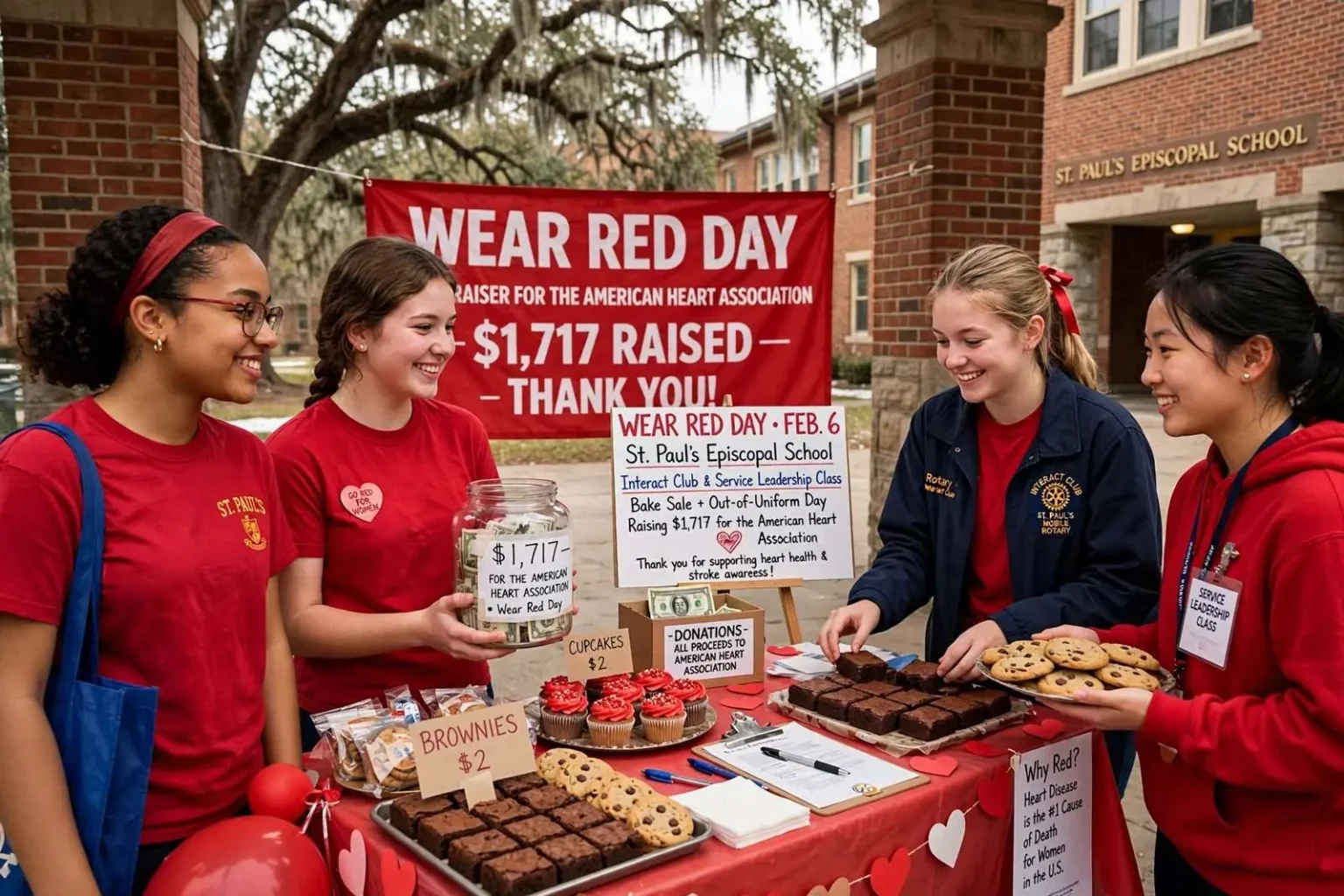
MOBILE – Two student service groups at St. Paul’s Episcopal School turned a red T-shirt and a table of baked goods into $1,717 for the American Heart Association, marking National Wear Red Day with a fundraiser that outperformed most efforts of its size.
At St. Paul’s, the school’s Interact Club and its service leadership class marked the day by holding an out-of-uniform day and a bake sale. Proceeds from the day totaled $1,717, and the money was donated to the American Heart Association for its work against heart disease and stroke.
An Out-of-Uniform Day With a Purpose
National Wear Red Day was observed on Friday, Feb. 6, with companies, organizations and cities across the country wearing red to raise awareness of heart disease and to raise money to fight it. Office towers from New York to Houston put employees in red for the day, landmarks across the country were lit in red, and social media filled with photos of workplaces, school faculties and municipal departments standing together in matching shirts.
The campaign asks a simple thing — wear red — and attaches to it a harder question: do you know your risk? For the American Heart Association, the answer it hopes to provoke is the beginning of a public health conversation about the disease that kills more Americans than any other, and more women than any other cause.
At St. Paul’s, the mechanics of the fundraiser were deliberately small. Students who wanted to shed the uniform for a day paid for the privilege; bakers among them contributed brownies, cookies and other goods that were sold through the day. The two revenue streams were simple enough for a student committee to run entirely on its own, with no outside vendor and no significant overhead — every dollar collected could pass through to the charity.
In a school where uniforms are the rule, the chance to wear something else is a currency students will pay for, and they did. School administrators have long understood that a relaxed dress code is among the most reliable fundraising levers available on a private school campus. It costs the school nothing, requires no logistics beyond an announced date, and converts a coveted privilege into a contribution — a lesson in micro-fundraising that the students who organized this one will carry into whatever causes they run next.
The out-of-uniform format also gave the campaign visibility far beyond the tables of baked goods. Every student in a red shirt was, for a day, a walking reminder of the cause, and the sea of red across campus made the fundraiser’s purpose a topic of conversation in hallways where a poster alone might never have registered.
Why These Students Chose This Cause
The Interact Club and the service leadership class are both service organizations at St. Paul’s, committed to projects that serve and support the community. Both consist of female students – and that fact shaped the choice of cause.
Heart disease is the leading cause of death among women in the United States, a statistic that remains poorly understood by the public and that the Wear Red campaign was created to confront. For decades the public image of a heart attack patient was a middle-aged man clutching his chest, and research, clinical trials and public messaging long skewed accordingly. The Go Red for Women campaign was built to correct that picture, and National Wear Red Day became its most visible annual expression.
Members of the two organizations concluded, on those grounds, that this was a cause worth their effort. The reasoning is worth pausing over. The students did not select a cause because it was fashionable or because it had been assigned to them. They selected it because the risk it describes was, statistically, their own.
That calculation is not abstract. Women’s symptoms of heart disease often present differently from men’s, which has historically contributed to delayed recognition and treatment, and the awareness gap the Wear Red campaign targets is most pronounced among younger women — precisely the population that service-minded students can reach with the message that cardiovascular risk builds over a lifetime and that habits formed young matter.
The students’ choice also reflected the way the American Heart Association’s work is organized. The association funds cardiovascular and stroke research, publishes the treatment guidelines that hospitals and emergency medical services follow, and runs public education campaigns that reach communities long before a patient ever reaches a hospital. A donation to the association supports the entire chain, from laboratory research to the CPR training that has equipped generations of students and first responders.
The $1,717 total will not underwrite a research wing on its own. But the association’s model depends on precisely this kind of grassroots giving — thousands of small events across the country, each modest in isolation, that together sustain an operation with a national research footprint. For the students who ran the fundraiser, the arithmetic was simple: a table of brownies and a day out of uniform had converted into real money for a cause that touches nearly every family, eventually.
Rotary’s Interact Program
Interact is Rotary International’s service club program for young people, sponsored by local Rotary clubs. The St. Paul’s club is sponsored by the Sunrise Rotary Club of Mobile, and its members regularly appear in the club’s proceedings – as candidates for the Rotary Youth Leadership Awards conference, held that spring at Camp ASCCA near Dadeville, and as organizers of service projects of their own.
The Rotary Youth Leadership Awards — RYLA in the shorthand every Rotary club uses — is an intensive leadership camp that brings high school students together for several days of team-building exercises, leadership instruction and service projects. Rotarians sponsor and select the attendees, betting that a weekend at camp will return to the community a young person better equipped to organize the next project. Camp ASCCA, on the shore of Lake Martin near Dadeville, is Alabama’s nationally known year-round camp for people with disabilities, a setting that gives the leadership curriculum a service context of its own.
The Sunrise Rotary Club’s sponsorship ties the St. Paul’s students into a service tradition far older than any of them. Rotary’s structure — one club per community, each feeding members into district and international networks — has made it one of the most durable volunteer organizations in the world, and Interact functions as its proving ground, teaching teenagers the mechanics of running a project: setting a goal, dividing the work, publicizing it, handling the money and reporting the result.
Pretty in Pink, Next on the Calendar
Among the next projects on the club’s calendar was the return of the “Pretty in Pink Boutique,” for which the Interact Club collected donations of gently used prom dresses. Dresses were to be taken to St. Paul’s at any time before Saturday, March 7, and then made available to girls for whom the cost of a prom dress would otherwise put the evening out of reach.
The boutique model has become a fixture of spring service calendars across the country. Formal wear is among the most disposable categories of spending in a family budget that must also absorb tickets, photographs and dinner, and a donated dress in good condition can spare a family a bill that in some cases runs to hundreds of dollars. The project asks donors for items already hanging in their closets and gives them a second life at a fraction of their original cost — a form of recycling that feels less like charity than like a community solving its own logistics.
For the Interact members, the boutique is also a more demanding project than a bake sale. It requires soliciting donations, storing and organizing them, and then staging a shopping experience that preserves the dignity of the girls who come through it. The Wear Red fundraiser and the boutique sit at opposite ends of the service spectrum — one a single-day cash drive, the other a weeks-long logistics exercise — and the club’s calendar deliberately made room for both.
The sequencing is no accident. A club that has just run a successful one-day fundraiser enters its next project with momentum, visibility and a membership that has practiced the mechanics of collecting and handling donations. Service organizations, like athletic teams, build on repetition.
Small Sums, Real Weight
In a season when Mobile’s civic conversation was dominated by six-figure deficits and multibillion-dollar federal spending packages, $1,717 raised by high school students is a modest figure. It is also, measured against the size of the group that raised it, a considerable one.
Fundraising totals invite exactly this kind of comparison, and the comparison misses what the exercise actually produced. A city budget or a federal appropriation moves by the arithmetic of large numbers. A school fundraiser moves by the arithmetic of individual decisions — a student paying two dollars for the privilege of jeans, a classmate buying a second cookie, a parent donating a dozen cupcakes at nine o’clock the night before. The total is nothing more than the sum of those decisions, which is why it cannot be mass-produced and why organizations that depend on public goodwill cultivate it one small event at a time.
The lesson the two service groups absorbed in running the campaign is transferable to every project that follows: a cause has to be chosen honestly, explained clearly, and executed by people willing to do the unglamorous parts. The Wear Red Day campaign checked all three boxes without outside help, which is the standard against which student service work is eventually measured.
What the American Heart Association received that February was a check. What the school produced was harder to count: a group of teenagers who had organized a campaign, run it, collected the money and handed it over – and who had done so on behalf of a disease that would, in the fullness of time, come for more of them than any other.
That closing thought is the reason Wear Red Day exists, and the reason a red T-shirt and a table of baked goods matter more than their total suggests. Awareness campaigns succeed when the people they reach act on them, and at St. Paul’s this February, a few dozen students did exactly that — one dollar, one cookie and one red shirt at a time.