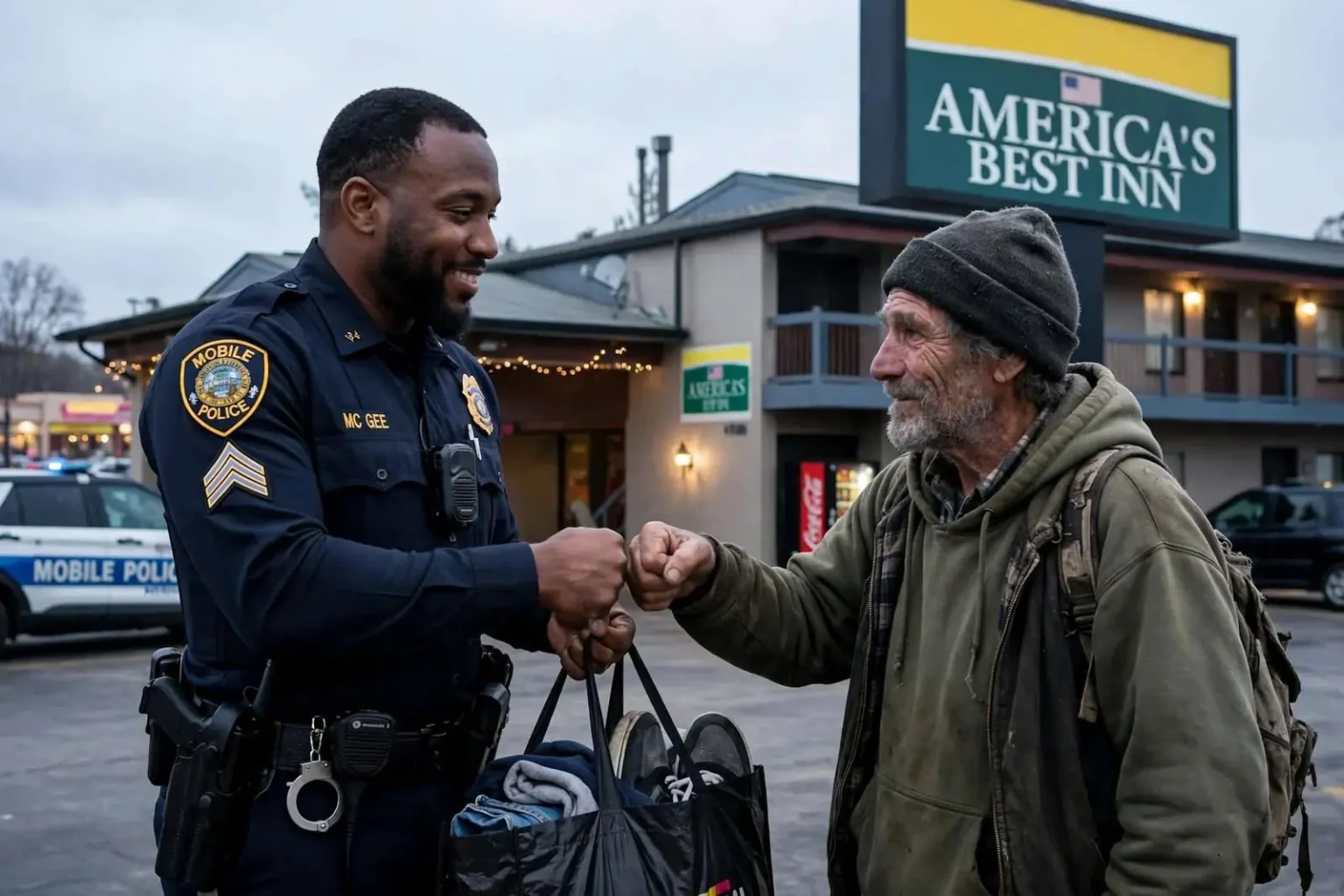
A Mobile police officer’s Black Friday shopping trip led him to a very different kind of holiday spending just days later, after he used his own money to give two homeless men a warm bed, clean clothes and a hot meal. Officer Santuan McGee said the idea struck him while he stood in a crowded Old Navy on Black Friday, watching a line of shoppers stretch across the store. Looking at the stack of deeply discounted clothes in his cart, he found himself thinking about the people he regularly passes on patrol near Interstate 10 and U.S. Highway 90 in south Mobile County, many of whom own only the clothes on their backs.
“I thought, ‘look at all these deals,'” McGee recalled. “Then I thought, we’re able to spend this money when there are people living on the streets in my area. I still had a lot of decent clothes I didn’t even wear.”
The stretch of Highway 90 that McGee patrols runs through some of the busiest commercial corridors south of the city, where big-box stores, fast-food restaurants and motels line the road between Mobile and the communities of Theodore and Grand Bay. The same corridors that draw shoppers during the holiday season also draw people with nowhere to go, and officers who work the area day after day come to know the regulars by name — who panhandles at which intersection, who sleeps behind which business, who picks up day labor at the day labs that dot the highway.
Less than a week after his trip to the store, McGee acted on the thought. During a patrol along Highway 90 near Theodore, he spotted a familiar face: a man named David Brown, who often panhandled outside a nearby Walmart and picked up odd jobs from local businesses to get by. McGee learned that Brown had once worked as a welder at the Mobile shipyards before a Parkinson’s disease diagnosis upended his life. Despite his circumstances, Brown told the officer he considered himself better off than a lot of people he knew on the street.
The shipyards have long been one of the region’s most important sources of blue-collar work, employing thousands of welders, pipefitters and tradesmen who built vessels for the Navy and commercial customers along the Mobile River. A diagnosis like Parkinson’s — a progressive neurological disorder that gradually affects movement and coordination — can end that kind of physically demanding career, and with it, the steady income that kept a worker housed. Brown’s path from the shipyards to the side of Highway 90 is the kind of slide that happens slowly and then suddenly.
A night off the street
McGee decided to help. He gathered clothes and shoes roughly Brown’s size, then arranged for Brown and another homeless man to spend a night at the America’s Best Inn in Theodore, paying for the room himself. For a man who had been living outdoors, a single night in a clean room meant a hot shower, a real bed and a locked door — small things that most people take for granted but that become luxuries on the street.
The hotel’s manager, who had worked there only a couple of months, said he had seen churches step in to help homeless guests before, but never a police officer acting on his own. Motels along the Highway 90 corridor serve travelers, visiting families and workers on temporary assignments, and managers there see a steady flow of the area’s struggles pass through their lobbies. To have an officer arrive and pay out of his own pocket for two men he met on patrol was, by the manager’s account, something new.
Not everything went as planned. The second man McGee hoped to help never showed up for his room, leaving the officer holding a pair of shoes that never found their intended owner. Anyone who has worked with the homeless population knows how often plans like this fall through — people move without warning, avoid contact, or simply are not where they said they would be. McGee kept the shoes, ready for the next person who needed them.
But the gesture toward Brown left a lasting impression on everyone involved. Brown reportedly could not stop expressing his gratitude, greeting McGee with fist bumps throughout the encounter. For an officer, those moments are the ones that stay with them through years of routine calls, and McGee described the meeting as a reminder of why he took the job in the first place.
McGee, who is married and has a young daughter, said the experience changed how he thinks about his patrols. He has told his family he wants to keep finding small ways to help the people he meets on the job, rather than treating those encounters as routine. That outlook — the idea that a traffic stop, a welfare check or a conversation at a gas station might be a chance to change someone’s week — is what community policing advocates describe as the everyday version of the profession that never makes the news.
Homelessness along the Gulf Coast
McGee’s gesture comes against a broader backdrop that Mobile-area residents know well. Homelessness in the region does not always look like the large urban encampments seen in other states; it often takes the form of individuals and small groups living in motels they cannot afford long-term, in vehicles, in the woods behind commercial strips, or doubling up with relatives one crisis away from the street. The corridors along Highway 90 and the Service Road, with their cheap motels and day-labor offices, concentrate much of that population in south Mobile County.
The holiday season tends to sharpen both the need and the response. Churches and nonprofits across Mobile and Baldwin County run extra meal services and coat drives in the weeks between Thanksgiving and Christmas, and stories of individual kindness circulate widely at a time when many families are looking for ways to give. What made McGee’s gesture stand out was its simplicity and its origin — one officer, one paycheck, one decision that the deals in his shopping cart mattered less than the people he passes every shift.
The moment offers a reminder that acts of generosity do not have to be large or organized to make a difference. For one Mobile-area man facing serious health and housing struggles, a single night of stability and a change of clothes became a meaningful bright spot during the holiday season. And for the officer who paid for it, the night at the Theodore motel was the start of what he says will be a habit — small, personal gestures toward the people the rest of the community drives past.
For officers, the arithmetic of patrol work usually runs the other way. Officers spend their shifts responding to calls where the outcome is rarely happy — wrecks, thefts, disputes — and the people they interact with are often having the worst day of their month. McGee’s trip to the motel inverted that routine for an evening: he walked in as a neighbor with a credit card rather than a uniform with a citation book, and the result was something everyone involved could feel good about.
The kind of help McGee offered also fills a real gap. A night in a motel is not housing, and a bag of clothes is not a job, but both are precisely what a person coming off a stretch on the street needs to get to the next appointment, the next interview or the next shelter bed. Transitional services in the Mobile area — shelters, soup kitchens, faith-based ministries — do steady work, but few programs are built to respond the same day to one officer’s observation that one man on one corner needed help that afternoon. Individual gestures can move faster than any system.
Stories like this one also travel. News of an officer’s quiet spending spree for strangers tends to circulate among coworkers and across social media, and officers elsewhere have followed similar examples with gestures of their own — buying meals for stranded travelers, replacing a stolen bicycle, filling a gas tank for a family passing through. None of it replaces the hard work of addressing homelessness as a policy problem, but all of it reflects a department culture in which officers are encouraged to see the people on their beats as neighbors rather than case numbers.
Brown, for his part, went back to his routines along Highway 90 after his night at the inn, still panhandling near the Walmart, still picking up whatever odd jobs local businesses would offer a man whose body no longer lets him weld. But he did it in fresh clothes, with new shoes, after a night indoors — and with the knowledge that the officer who watches that stretch of highway saw him as a man worth helping, not a problem to be moved along.
As the holiday season runs on, the story stands as a small, local counterweight to the usual narratives about the Gulf Coast’s struggles with poverty and addiction and the slow-motion crises that follow job losses and diagnoses. It took one shopping trip, one patrol shift and one officer’s paycheck. McGee says it will not be the last time, and the people who live and work along his beat say they will notice the difference.