Kellogg Foundation Grant Launches ‘Pathways to Prosperity’ for South Alabama Families
The Community Foundation of South Alabama announced a $398,000 grant from the W.K. Kellogg Foundation to launch Pathways to Prosperity, an initiative aimed at low-income families with children.
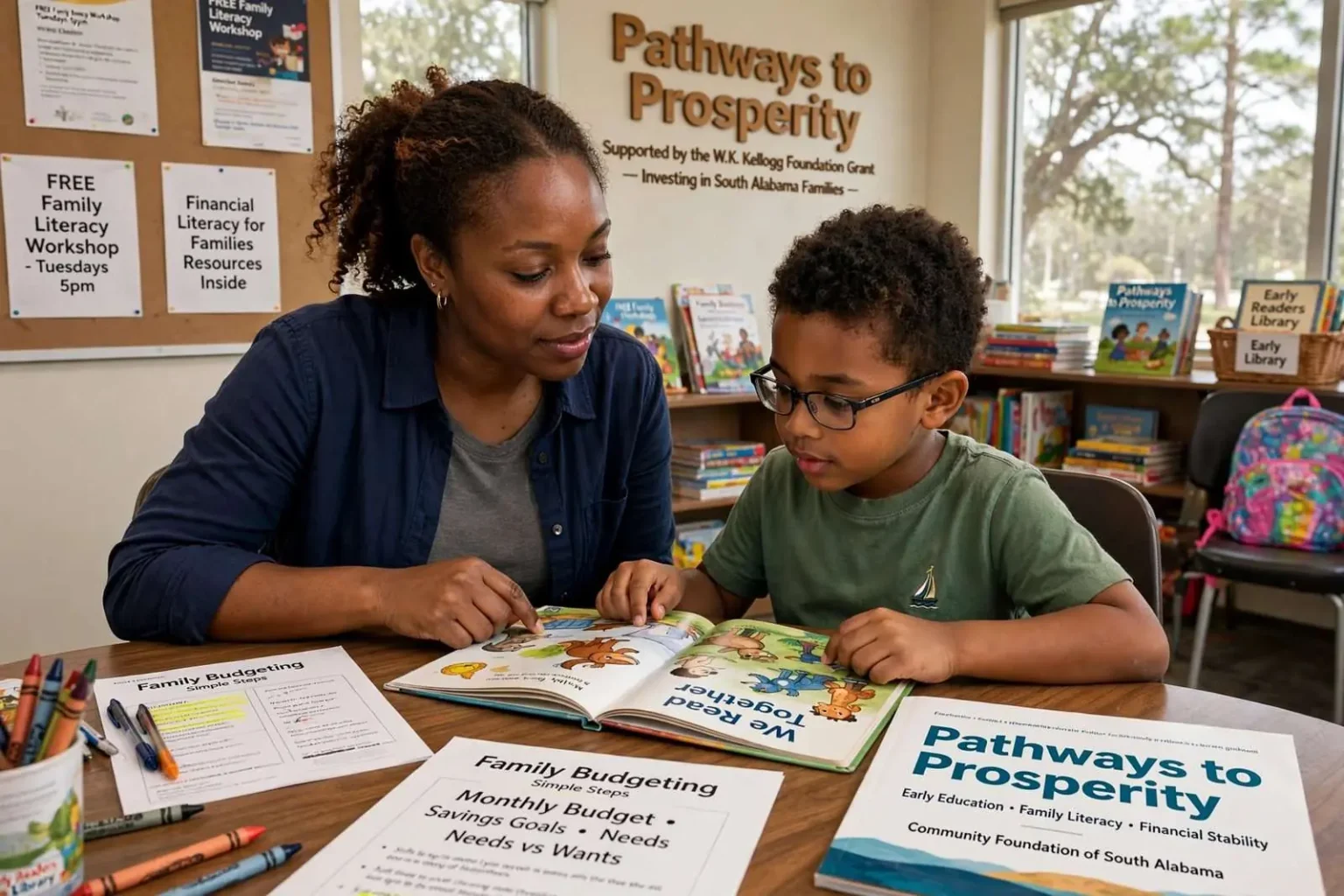
The Community Foundation of South Alabama announced a $398,000 grant that would allow it to launch Pathways to Prosperity, an initiative designed to increase the long-term economic security of low-income families with children across the region. The program set out to improve early education, promote family literacy and bolster financial stability among the families it served, treating those three goals not as separate problems but as a single challenge that had to be addressed in the same households at the same time.
The grant came from the W.K. Kellogg Foundation, based in Battle Creek, Michigan, one of the nation’s largest philanthropies devoted to the well-being of children. Established in 1930 by breakfast cereal pioneer W.K. Kellogg, the foundation has built its reputation on grantmaking that concentrates on children, families and the communities that surround them, with particular attention to vulnerable populations and to the earliest stages of a child’s development.
For a foundation whose mission is rooted in the eight counties of Southwest Alabama, the award represented a significant infusion of resources for work aimed at breaking cycles of poverty at their source — in the earliest years of a child’s life and in the households where habits of reading and money management take hold. The Community Foundation of South Alabama, headquartered in Mobile, pools charitable contributions from donors and directs them to nonprofit programs across the region, which made it a natural local partner for a national foundation looking to put dollars to work in South Alabama communities.
A focus on literacy and stability
From the outset, Pathways to Prosperity was framed as more than a single-service program. The initiative was built on the recognition that economic hardship rarely arrives alone. A parent who struggles to read may also struggle to hold steady work, to manage a household budget or to help a child with homework, and a child who starts school behind often stays behind. Addressing those conditions one at a time, the reasoning went, leaves the underlying instability in place; addressing them together offers a family a genuine path forward.
The emphasis on early education reflected a widely shared understanding among educators that the most consequential learning years come before kindergarten. Children who arrive at school with weak language skills and little exposure to books face an uphill climb that tends to widen as they move through the grades. By investing resources in the years before and during early schooling, the initiative aimed to catch families at a point where modest support could change a child’s entire trajectory.
Parents as role models
Alvertha Penny, president and chief executive officer of the Community Foundation of South Alabama, framed the effort around the connection between the literacy of parents and the prospects of their children. “We believe by investing in programs that promote literacy for children and parents the Foundation can have the most significant impact,” Penny said. “By emphasizing the parental role and showing low literacy parents how they can serve as role models for their children, programs can achieve more success.”
Her point was a practical one. In households where adults read with children, talk with them regularly and treat education as a family priority, children enter school better prepared and carry that advantage forward. Where adults lack those skills or the confidence that comes with them, the gap shows up early and compounds over time. Positioning parents as role models rather than as bystanders to their children’s education was the strategy’s central bet.
That approach reflected a growing body of thinking in early-childhood circles: that a child’s path is shaped not only by what happens in a classroom but by the environment at home, and that lifting the literacy and confidence of parents can pay dividends across a generation. Research in the field has consistently linked the educational engagement of parents to outcomes for children, from kindergarten readiness to high school completion, which is why family literacy programs pair adult instruction with activities designed for parents and children to share.
Money management, too
Beyond reading, the Pathways to Prosperity initiative was also designed to address the crucial need for responsible money management. By pairing family literacy with financial education, the foundation aimed to give low-income households both the skills and the confidence to handle the financial demands of daily life — budgeting on an unpredictable income, avoiding high-cost borrowing, building savings where possible and planning for the unexpected.
The pairing was deliberate. Financial instability and low literacy often travel together, and each makes the other harder to overcome. A household that cannot comfortably read a loan document or a lease is at a disadvantage in every transaction it enters, and a household living paycheck to paycheck has little room to absorb even a modest emergency. Programs that teach financial skills alongside literacy aim to strengthen the whole household rather than a single skill in isolation.
For families across the eight-county region, where many communities have watched manufacturing and other traditional employers recede over the years, the promise of the initiative was stability measured in years rather than weeks — steadier households, children reading on grade level and parents equipped to model the habits that make the difference.
A regional foundation with a local mission
The Community Foundation of South Alabama occupies a distinctive role in the region’s civic landscape. Rather than running its own programs, it connects donors with the nonprofits, schools and community groups doing the work on the ground, awarding grants across Mobile, Baldwin and the surrounding counties. That structure means an award like the Kellogg grant does not stay in one office; it flows outward to the organizations best positioned to reach families directly.
The eight-county footprint also matters for how an initiative like Pathways to Prosperity takes shape. The region stretches from the Gulf Coast’s urban centers to small rural communities in the Black Belt’s southern edge, and the needs of a family in downtown Mobile differ from those of a family in a rural county with limited transportation and few early-childhood providers. A regional approach allows resources to be directed where the gaps are greatest, instead of assuming every community’s challenges look the same.
Penny’s framing of the grant also signaled continuity with the foundation’s broader priorities. Community foundations across the country have increasingly gravitated toward early-childhood and family-stability work, on the theory that investments made in the first years of life produce returns that later interventions struggle to match. The Kellogg Foundation, whose grantmaking has long emphasized the same conviction, found in the Community Foundation a partner organized to carry that philosophy into South Alabama’s neighborhoods.
What it means for local families
For the low-income families the program set out to serve, the practical promise of Pathways to Prosperity was straightforward: help with reading that spans generations, and help with money that makes household life less precarious. Parents would be encouraged to see themselves as their children’s first and most important teachers, with support to build the skills that role requires.
For the wider community, the initiative’s backers argued, the payoff comes later — in school readiness, in graduation rates and in households better positioned to weather a job loss or a medical bill without spiraling. Those outcomes are slow to appear, which is precisely why funders like the Kellogg Foundation frame such work in generational terms. Breaking a cycle of poverty is not accomplished in a grant cycle; it is accomplished when the habits of literacy and financial confidence pass from parents to children and stay there.
The $398,000 award gave the Community Foundation of South Alabama the resources to begin that work, and the Pathways to Prosperity name captured the ambition behind it — not a handout, but a route that families across the region could travel toward lasting economic security.
Why early years carry so much weight
The choice to anchor Pathways to Prosperity in early education follows a simple arithmetic that educators and economists alike have repeated for decades: the earlier the investment, the longer the runway it has to compound. A child who enters kindergarten knowing letters, numbers and the rhythm of a story has a fundamentally different first year of school than a child who does not, and that first year sets the tone for every year that follows. Reading proficiency in the early grades, in turn, predicts whether a student will later absorb history, science and math through text or fall further behind with each passing term.
That is why family literacy programs place so much weight on the adult in the room. A preschool program sees a child for a few hours a day; a parent sees the child for the rest of it. When parents read aloud at bedtime, point out words on signs at the grocery store and let children see them reading for their own purposes, the instruction of the classroom is reinforced dozens of times over in ordinary life. When parents cannot do those things — because of low literacy, long work hours or simple lack of confidence — the classroom is working alone. Penny’s emphasis on showing low-literacy parents how to serve as role models was aimed squarely at closing that gap, giving adults who may have struggled with reading themselves a way to participate in their children’s education without embarrassment.
The financial component serves the same family from the other direction. Educators have long observed that children learn best in stable households, and financial chaos is one of the most corrosive forms of instability a family can face. A parent who can build even a small buffer against an unexpected car repair or utility bill is a parent better able to keep a child in the same school, in the same home and in the same routine. Viewed that way, financial education is not a separate program from literacy — it is the stability pillar that lets the literacy work take root and hold.