South Alabama Sizes Up Joe Biden: Mixed Verdicts From Mobile’s Political Class
Judges, lawyers, party officials and consultants across Mobile and the Eastern Shore delivered a split verdict on Barack Obama's selection of Sen. Joe Biden as his running mate in August 2008.
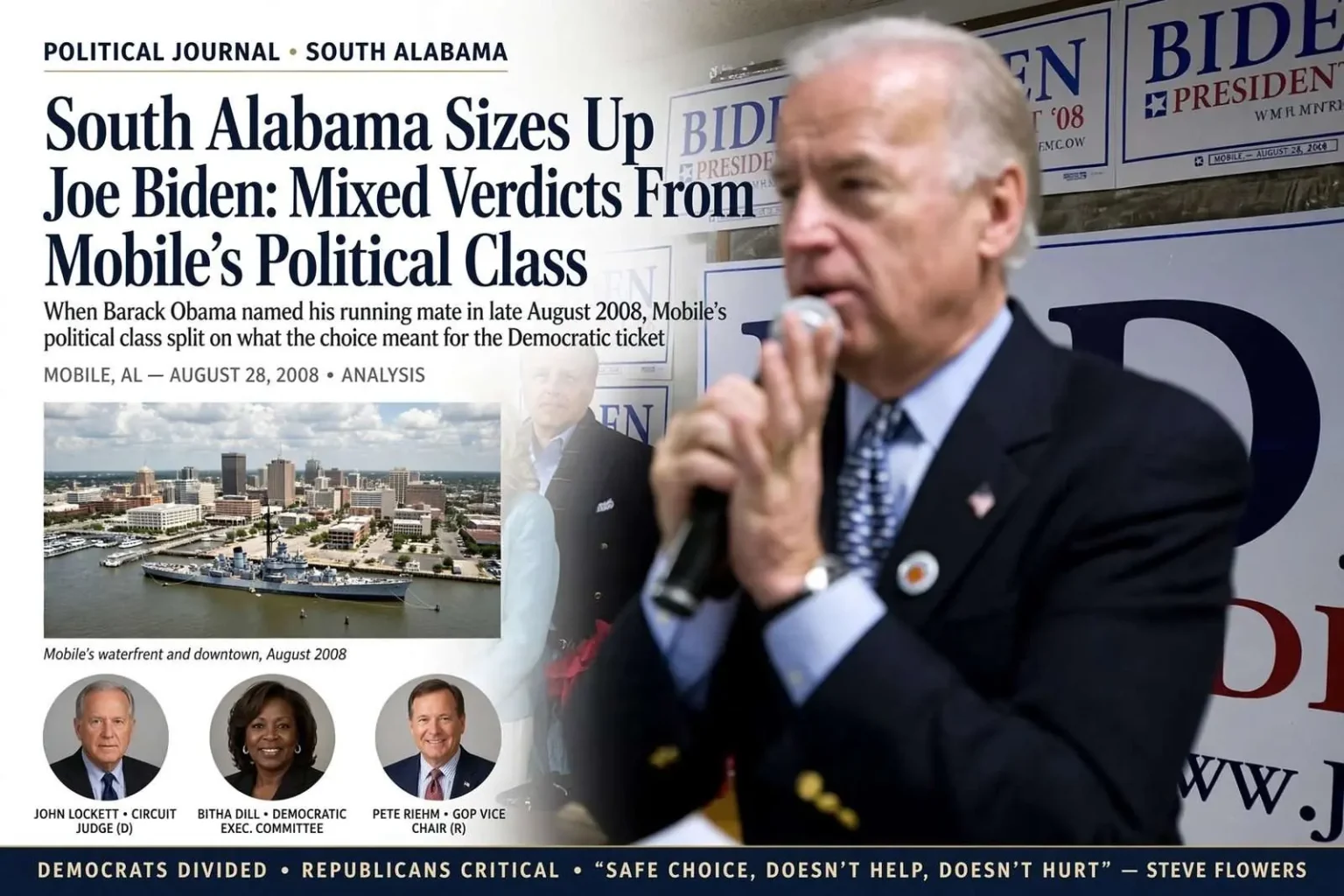
Few figures in American politics divided opinion as reliably as Joe Biden, and when Barack Obama named the Delaware senator as his running mate in the last week of August 2008, the reaction across south Alabama proved the point. Judges, lawyers, party officers, consultants and business people canvassed here delivered a verdict that split not only along party lines but within them.
The announcement landed in the final week of the Democratic National Convention in Denver, after months in which Obama had campaigned against the Washington way of doing things — a frame that made the choice of a 36-year Senate veteran the first question everyone asked. Biden brought a foreign policy résumé, a working-class biography rooted in Scranton, Pa., and a home in Wilmington, Del., that put him on Amtrak every night. Those were the facts Mobile’s political class worked from; what they made of them differed from one kitchen table to the next.
The Case for the Pick
Several Democrats saw a steadying choice. Circuit Judge John Lockett called Biden “a good solid pick as far as VP candidates go,” while cautioning that running mates rarely move votes. “I think Biden will be more of a help to Obama in governing,” he said, “but add or subtract little to his election chances.”
Jere Beasley, the attorney and former Democratic lieutenant governor, was more emphatic: Biden, he said, has “the common touch and it’s real,” predicting a winning ticket. Beasley had spent decades around Alabama politics and had seen plenty of tickets built on paper balance that never translated at the polls; his praise rested on something less measurable, the sense that Biden connected with voters face to face.
Mobile attorney Skip Brutkiewicz had wanted Biden all along, citing his grasp of geopolitical issues, and Richard Dorman, another Mobile Democratic attorney, said that on reflection he considered it a very wise decision. Bitha Dill, communications chair of the Mobile County Democratic Executive Committee, praised Biden’s 36 years of work across party lines, his record on policing, hate crimes, equal pay and care for the elderly, and called him “a good and honorable man.”
Retired educator John Paul Jones said the choice balanced the ticket and gave a young nominee an experienced partner “a heartbeat away.” The oldest argument in American vice presidential selection — the backup to the presidency — carried particular weight in 2008, when the Republican nominee himself was 72 and the campaign’s energy question had been raised by both sides.
The Case Against
Others in the same party were unimpressed. Brad Warren, then chairman of the Mobile County Democratic Party, said that while he had great respect for Biden and would have liked to see him as secretary of state, the choice struck him as “very uninspired.” He had hoped for Chuck Hagel, Hillary Clinton or Janet Napolitano — someone, he said, who would have shown bravery and freshness.
Warren’s preferred names made the complaint clear: Hagel was a Republican senator, Clinton the rival Obama had just defeated, Napolitano a Republican-leaning border-state governor. Any of them would have been a statement; Biden was, in this reading, a comfort. Within the same party, the pick could look like either prudence or timidity, depending on how much risk a given Democrat wanted the ticket to carry.
Republicans were predictably tougher, though not uniformly so. Pete Riehm, vice chairman of the Mobile County GOP, argued that the selection was a tacit acknowledgment of Obama’s inexperience and that bringing in a long-serving Washington insider sat badly with a message of change. Jerry Lathan, a Theodore roofing executive and Republican activist, argued that Obama should have taken Clinton and predicted the pick would help John McCain.
Eddie Menton, of the Mobile County Republican Executive Committee, said he liked the pick precisely because he expected Biden to talk himself into trouble, adding that a choice such as Texas Rep. Chet Edwards would have worried him more. Biden’s habit of speaking his mind, which Democrats counted as candor, Republicans counted as a liability waiting for its moment — a prediction history would oblige repeatedly, though not always where anyone expected.
The Professionals’ Read
The political operatives approached it as a math problem. Armand Dekeyser, a Washington consultant with Alabama roots, called Biden a formidable attack dog who would let the nominee stay above the fray, but doubted the selection would flip a single state that George W. Bush had carried in 2004. Mobile strategist Jon Gray judged Biden the best of the available options while insisting the real test would come when McCain named his own running mate.
One Mobile attorney, writing anonymously, laid out both sides at length: Biden’s Foreign Relations Committee experience and his standing with unions, police officers and Catholic voters could matter in Pennsylvania, Ohio and Michigan, but his central role in the 2005 bankruptcy legislation — a bill favored by the credit card companies chartered in Delaware — made him vulnerable to the charge of being exactly the insider the campaign had been running against.
That bankruptcy critique had real reach. Credit card issuers had clustered in Delaware for its corporate law, and the 2005 law had made it harder for households to shed debts in bankruptcy — a record that cut against the ticket’s economic populism in the very industrial states Biden was recruited to help. It was the kind of opposition research that never makes a headline by itself but surfaces in every close state’s advertising.
The union and Catholic-voter angles pointed the same way. Biden’s decades of labor-friendly votes and his Scranton upbringing played directly to the Reagan Democrats of the Rust Belt, and his Catholicism mattered in a party that had spent two cycles sorting out how to talk to Catholic voters on a range of issues. Consultants measured such things not in sentiment but in counties: the map from Philadelphia’s suburbs through Pittsburgh, and the river counties of Ohio, was where the ticket’s industrial-state argument would be won or lost.
Danny Sheridan, the Mobile oddsmaker, called the pick “fairly safe” and said McCain’s choice mattered more, rating the Republican at least a 2-to-1 underdog for November. Steve Flowers, the state political columnist, was briefest of all: “He was a safe choice. Doesn’t help, doesn’t hurt.”
A Note of Caution, and One of Hope
Fairhope lawyer David Bagwell thought Biden imperfect but the best available, while retired Mobile attorney Lewis Odom focused on the harder task ahead: bringing Clinton’s voters home. The primary season had left real wounds in the party — particularly among older women voters and in the working-class precincts where Clinton had run strongest — and the view from Baldwin and Mobile counties was that no vice presidential pick could heal them by itself.
Dom Soto, a Mobile Democratic attorney, argued that for the first time since Lyndon Johnson the choice of a running mate would make a real difference, describing Obama and Biden as being in balance with one another. The comparison reached back to the 1960 ticket, when a Senate majority leader with deep Washington connections was paired with a young senator whose youth was the campaign’s biggest question. Whatever one thought of the analogy, it captured what the Obama campaign plainly intended: a partner who could answer the experience charge on television, in debates, and at kitchen tables in states Obama had not carried in the primaries.
Adam Bourne, then a city councilman-elect in Chickasaw, offered perhaps the most even-handed assessment of all: Biden’s foreign policy expertise was a clear strength, and his candor had occasionally caused him trouble, “however, we could use more straight-shooters in public life.”
Judged in November
With the Republican convention still ahead and McCain’s own choice unannounced, the consensus in Mobile was that the race remained close and that the vice presidential picks, whatever their merits, would be judged in November rather than August. The Delaware senator’s selection had been telegraphed by the campaign’s own text message rollout, and within a day the speculation had already pivoted to McCain — a reminder that in a close presidential year, the second spot on either ticket is one half of an argument, not a verdict. Alabama’s own Electoral College vote, carried by the Republican in every presidential election of the era, kept the state out of the swing map, but Mobile’s political class followed national politics with the same intensity as anywhere, and the canvass above showed it.
The canvass in Mobile, a city whose politics have always run more complicated than its Alabama address suggests, captured that uncertainty. Democrats split between those who saw in Biden the governing partner Obama would need and those who saw a missed opportunity for something bolder; Republicans split between those who read the pick as confirmation of their opponent’s weakness and one who admitted a Chet Edwards would have frightened him more. All of them, whatever their party, treated the choice as a serious question rather than a settled one — which was, in the end, the most reliable verdict anyone offered.