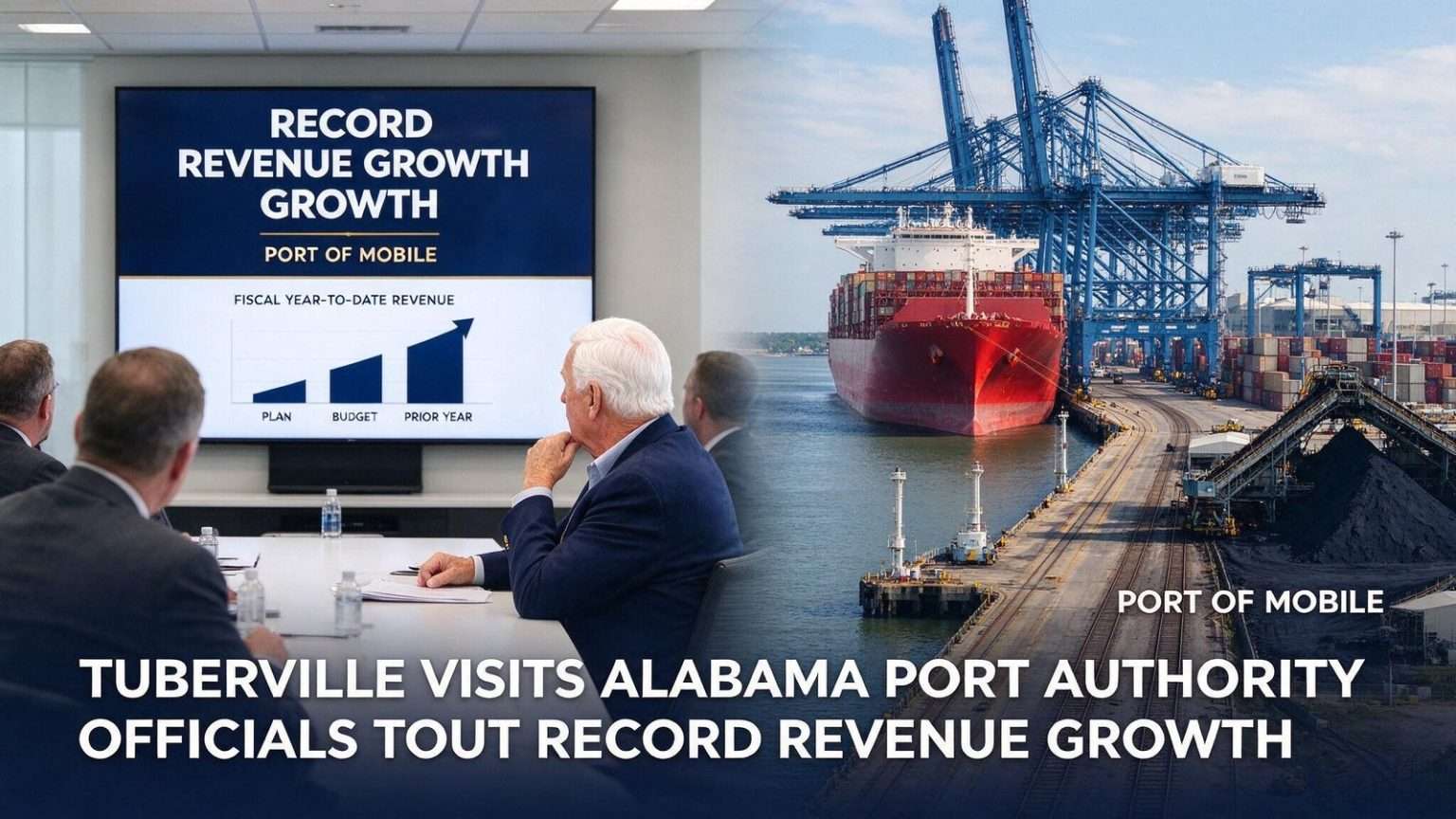
The Alabama Port Authority board welcomed a special guest to its monthly meeting Thursday: U.S. Sen. Tommy Tuberville, who is also a candidate for Alabama governor. Port Authority officials said Tuberville’s visit was not part of a larger tour of the port and that he dropped in for the meeting. Tuberville did not speak during the meeting or take questions afterward.
Even as a silent observer, the senator’s presence carried weight. The Port of Mobile depends heavily on federal partnerships — for harbor dredging, for infrastructure grants, and for the appropriations that fund the long list of capital projects underway across its terminals — and a member of the Senate Appropriations apparatus sitting in on the briefing gave port leadership a chance to make their case without saying a word about it. Tuberville, a former Auburn University football coach first elected to the Senate in 2020, has made economic development a recurring theme of his public appearances across the state, and his gubernatorial campaign has kept him traveling to civic and industrial venues in every region of Alabama.
As was the case in July, the report delivered by Port Authority Director and CEO Doug Otto was full of good news. For the current fiscal year, which concludes at the end of September, the port authority is running well ahead of both last year’s performance and this year’s budget.
“July revenue finished at $19.4 million, which is $1.3 million better than budget,” Otto said. “The year-to-date total was $23.4 million better than planned, $38.4 million better than the prior year.”
Otto again cited exports through the McDuffie Island Coal Terminal, imports through the Pinto Island Steel Terminal, and traffic handled by the port’s railroad as major drivers of the growth. Each of those three pillars tells its own story about the Port of Mobile’s role in the regional and national economy, and together they explain why the authority has been able to post results well beyond its own planning assumptions in a year when many forecasts called for slower trade.
The Cargo Behind the Numbers
The McDuffie Island Coal Terminal is among the busiest coal export facilities in the United States, serving mines in Alabama and neighboring states whose product moves through Mobile on its way to power generators and steel producers overseas. Metallurgical coal, used in steelmaking rather than electricity generation, has been the sturdier segment of that trade in recent years, and its continued movement through McDuffie has anchored the port’s export volumes through cycles that have punished other American coal ports.
On the inbound side, the Pinto Island Steel Terminal handles the raw materials and steel products that feed the state’s signature manufacturing sector. Alabama’s automotive plants and the steel mill operations along the Gulf Coast depend on a steady flow of imported slabs, coils, and billets, and Mobile’s position as the closest deepwater port to those customers has made it the natural entry point. When steel imports run strong, as they have this fiscal year, the effect registers quickly in the authority’s monthly reports.
The port’s railroad completes the triangle. Rail service ties the waterfront directly to inland customers across Alabama and the Southeast, allowing cargo to move between ship and hinterland without the delays and costs of long-haul trucking. That connectivity has become one of Mobile’s sharpest competitive advantages as shoppers of port capacity increasingly weigh total logistics cost rather than ocean freight rates alone.
A Capital Program in Full Swing
With Tuberville in attendance, Otto expanded his presentation to detail an extensive roster of capital improvements underway at the Port of Mobile, together totaling hundreds of millions of dollars. Those projects include new coal-handling equipment at McDuffie, efforts to expand capacity at the APM Terminals container terminal, and the replacement or refurbishment of docks dating back to the 1940s or earlier.
The age of that dock infrastructure is a quiet argument for the entire program. Much of the port’s original waterfront was built for the cargo ships and cargo-handling methods of the mid-twentieth century, and no amount of routine maintenance fully prepares eighty-year-old structures for the loads, vessel sizes, and equipment of the 2020s. Replacing and refurbishing those facilities in stages, while keeping the port operational throughout, is one of the less visible but most consequential investments on the list.
At the container terminal, capacity work reflects the growth of containerized trade through the Gulf. The APM Terminals facility on Mobile River has handled an increasing share of the Southeast’s container volume, particularly as shipping lines have diversified away from single-coast dependence on the West Coast. Every expansion of berth capacity, yard space, and gate throughput positions Mobile to capture more of that traffic as lines redraw their service networks.
Otto also touched on other developments, including the establishment of a Montgomery terminal to handle shipping containers arriving from the port by rail, and a plan to use dredged material to restore marshland in upper Mobile Bay. The Montgomery facility extends the port’s reach to the state’s capital region, giving central Alabama shippers a rail-linked option that reduces truck miles on Interstate 65. The marshland restoration, meanwhile, turns a byproduct of routine harbor dredging into an environmental asset, rebuilding wetlands that buffer the bay against storms and provide habitat for the fisheries that Mobile Bay’s commercial and recreational users depend on.
He described the extensive federal and state funding supporting much of the work, saying afterward that he appreciated the chance to show Tuberville what was being accomplished with the grants and appropriations flowing into the port. “So much of what we do, we’re dependent on federal and state partnerships to make these projects happen,” Otto said, adding that seeing the results firsthand tends to make a deeper impression than any document or request.
Why the Port Matters to the Whole State
The Port of Mobile’s reach extends far beyond the waterfront. Studies of the port’s economic footprint have consistently found that its activity supports tens of thousands of jobs across Alabama, in industries ranging from trucking, warehousing, and stevedoring to the manufacturers whose competitiveness depends on reliable, low-cost freight access. Farmers in the Tennessee Valley, paper mills in the Black Belt, auto plants in Tuscaloosa and Lincoln, and steel operations in west Alabama all count on the corridor between their facilities and Mobile’s berths.
That is why the governor’s race context is not incidental to a story about a monthly board meeting. Whoever occupies the governor’s office inherits the state’s side of the port partnership — the matching funds, the road and rail connections, and the bargaining position in negotiations with shipping lines and industrial prospects. Candidates for the office have routinely toured the port for exactly that reason, and Otto’s willingness to walk a visiting senator through the capital program line by line reflects how the authority advocates for itself: with operating results and project schedules rather than promises.
The meeting also underscored the continuity of the port’s leadership approach. Otto’s monthly reports have built a public record of the authority’s performance, revenue line by revenue line, in a way few public agencies of comparable size attempt. That transparency has served the port well in requesting public funding, because legislators and federal partners can see precisely what their earlier investments produced before being asked for the next round.
What Comes Next
The fiscal year that closes at the end of September will end with the authority well ahead of both its budget and the prior year, but the more significant figures may be the ones attached to the capital program. Hundreds of millions of dollars in construction, spread across coal handling, container capacity, dock replacement, rail connectivity, and environmental restoration, will shape what the port is able to handle for decades. If those projects land on schedule, Mobile enters the next decade with infrastructure that matches its ambitions.
For residents of Mobile and the surrounding region, the practical takeaway is straightforward. The port’s growth supports the jobs and tax base that fund local schools and services, and its visible expansion — new equipment on McDuffie, taller cranes at the container terminal, rebuilt docks along the river — is a physical reminder that the working waterfront remains the economic engine it has been since the city’s founding. And with federal and state partners paying close attention, including a senator who came to see the numbers for himself, the port’s run of good news appears built to continue.
One more piece of context helps frame the morning: the authority’s momentum has come without a disruption in service. Construction phases have been sequenced so that coal keeps flowing, ships keep berthing, and trains keep moving while the work proceeds around them, a balancing act that port engineers describe as the hardest part of the job. Keeping a working port open while rebuilding it is itself a competitive asset, and one Mobile has now demonstrated repeatedly.