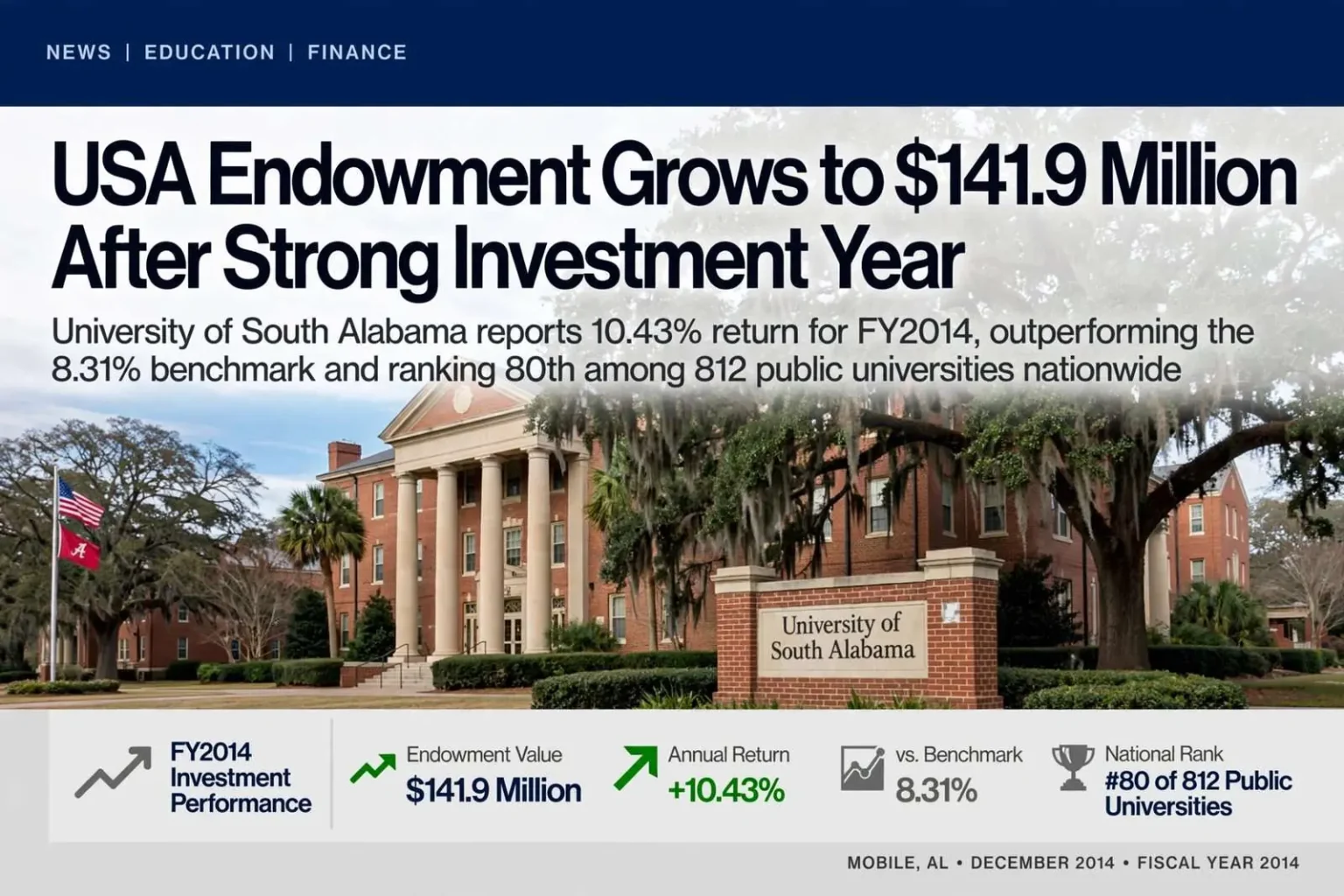
The University of South Alabama’s endowment closed the 2014 fiscal year on a high note, posting investment returns that outpaced both its benchmark and most public universities nationwide. Trustees reviewing the results at a December board meeting learned that the fund gained 10.43 percent for the fiscal year, comfortably ahead of the 8.31 percent benchmark return against which its performance was measured. The showing placed the Mobile-based university 80th out of 812 public universities tracked in the national survey compiled by the National Association of College and University Business Officers, outperforming the benchmark by more than two percentage points.
The NACUBO endowment study is the standard yardstick for how well colleges and universities across the country manage their invested assets, drawing participation from hundreds of public and private institutions each year. For a mid-sized public university in the Southeast, landing in the top ten percent of the national field is a notable result, particularly in a year when markets rewarded disciplined asset allocation. Investment committees at institutions of USA’s size typically work with external managers under policies adopted by the governing board, spreading holdings across domestic and international equities, fixed income and alternative assets to balance growth against risk.
University financial officials expressed satisfaction with how the year turned out. “We’re very happy with the performance of our endowment,” USA’s vice president for financial affairs told the board, adding that leadership feels good about both the earnings and the management policies guiding the fund. That confidence reflects a deliberate, long-term approach: endowments are designed to generate returns over decades, not quarters, so that a share of annual earnings can be spent while the underlying principal keeps pace with inflation and continues to grow.
A Fund Built Over Fourteen Years
The endowment’s story at USA is a relatively young one by university standards. The fund was established in April 2000, meaning the strong 2014 results came in the fund’s fourteenth year of existence. Older institutions in the Northeast and on the West Coast have had well over a century to accumulate endowment assets, which is why public universities in the South and Southwest generally appear lower in national rankings even when their returns are competitive. Building an endowment from a standing start requires consistent contributions from donors and, over time, the compounding effect of reinvested earnings.
Endowment income plays a practical role in university budgets that is easy to overlook. Scholarships endowed by alumni and friends, faculty positions supported by named gifts, and program funds for departments all draw on investment earnings rather than tuition or state appropriations. Because state support for public higher education in Alabama has been under sustained pressure since the recession, revenue streams that are independent of the state’s Education Trust Fund have become increasingly valuable to institutions trying to hold down costs for students.
For donors, the health of the endowment is also a signal. Alumni weighing a significant gift want to see that the university’s stewardship of existing assets is sound, and a year of double-digit returns measured against a credible benchmark helps make that case. Financial officers typically report endowment results to the board alongside spending rates, so trustees can confirm that the fund is neither being depleted too quickly nor hoarding earnings that could be supporting students and programs today.
Kept Separate From the Foundation
The university’s endowment is maintained separately from its affiliated foundation, an arrangement common among public universities in Alabama. The foundation, which reported net assets of $321.2 million as of the end of September, serves as the principal fundraising arm of the institution, receiving gifts from alumni, corporations and other supporters and managing them under its own governing structure. Keeping the two entities distinct allows each to be governed, audited and invested under rules suited to its purpose, and it gives donors clarity about where their money sits and how it is overseen.
The division also matters for transparency. Public universities and their affiliated foundations in Alabama are watched closely by legislators and by media organizations interested in how institutional money is managed, and separate reporting makes it easier to trace which assets belong to the university proper and which are held by the nonprofit fundraising arm. The foundation’s considerably larger net position reflects years of accumulated giving, including real estate and other holdings, while the endowment represents the invested pool whose earnings are spent according to board policy.
Medicaid Reimbursement Leaves Hospitals With No Revenue
Not every financial line in the report was positive. Changes to Medicaid reimbursement policy at the state level meant that USA Medical Center and USA Children’s & Women’s Hospital reported no revenue for the fiscal year from the affected category, a development that drew attention from trustees given how central the hospitals are to the university’s mission and finances. Administrators at both hospitals are working with state officials and expect the issue to be resolved before the close of the 2015 fiscal year.
The situation illustrates how sensitive hospital finances are to decisions made in Montgomery. Alabama’s Medicaid agency pays hospitals and physicians according to a reimbursement framework that the state periodically restructures, and when the rules change, institutions that treat large volumes of Medicaid patients can see revenue recognized in an accounting period shift or disappear entirely while the underlying care continues. For an academic medical system like USA’s, which trains physicians and nurses while serving a disproportionate share of patients who rely on public insurance, those policy shifts flow directly into the university’s consolidated financial statements.
USA Children’s & Women’s Hospital is the region’s primary referral center for obstetric, neonatal and pediatric care, and USA Medical Center serves as a major teaching hospital attached to the university’s College of Medicine. Both depend on predictable reimbursement to fund staffing and equipment, which is why administrators moved quickly to engage state officials rather than waiting for the accounting question to resolve itself. University leaders indicated they anticipated a resolution before the next fiscal year closed, allowing the hospitals’ books to reflect the care they had actually provided.
The contrast between the endowment’s strong year and the hospitals’ reimbursement headache captures the dual nature of USA as an institution. On one side sits a university with a growing investment fund and careful financial management; on the other sits a health system whose fortunes are tied to state policy decisions made far from the boardroom. Trustees must weigh both when setting budgets, and the December meeting gave them a clear picture of each.
Refinancing the Research Park Loan
Trustees also approved refinancing an $8.8 million loan tied to the USA Research and Technology Corporation, the nonprofit arm supporting the university’s technology and research park. The refinancing pushes the loan’s maturity from January 2031 to January 2036, stretching repayment out by five years, and is expected to save roughly $142,500 annually in debt service. For a nonprofit entity managing a research park, that kind of annual savings is meaningful, freeing cash flow that can be redirected toward park operations, maintenance or attracting new tenants.
The Research and Technology Corporation continues to service about $23 million in loans overall, a portfolio that includes nearly $795,000 tied to a dialysis building at the medical center. The corporation functions as a financing vehicle for facilities that support the university’s research and clinical enterprise, borrowing on favorable terms and passing the benefit along to projects that might otherwise struggle to secure funding on their own. Extending maturities when interest conditions allow is a routine but consequential piece of managing that portfolio.
The technology park itself reported total assets of $27.9 million against liabilities of $27 million, leaving a net position of $880,000. Research parks anchored by universities have become a familiar economic development tool across the Southeast, giving startups and established companies a place to locate near faculty expertise, laboratory space and a pipeline of student talent. A thin net position is not unusual for such entities, which exist to support development rather than to accumulate surplus, but it underscores why favorable refinancing matters: every dollar saved in interest is a dollar available for the park’s mission.
What the Numbers Mean for the University
Taken together, the December report gave trustees a wide-angle view of an institution managing several balance sheets at once. The endowment’s outperformance against its benchmark, the hospitals’ unresolved Medicaid reimbursement question, and the research park’s restructured debt each tell a different story about where USA stands financially. The common thread is careful stewardship in an environment where public universities can no longer count on state appropriations to cover growth.
For Mobile and the surrounding region, the health of USA’s finances has implications well beyond the campus. The university is one of the largest employers in southwest Alabama, and its medical institutions provide specialized care that would otherwise require travel out of state. Its research park aims to diversify the local economy beyond shipping, aerospace and shipbuilding. Strong investment returns help protect the scholarships and programs that keep students enrolled, while the refinancing keeps the research corporation on a sustainable footing.
Trustees will track whether the Medicaid reimbursement issue is indeed resolved before the close of the 2015 fiscal year, as administrators expect, and whether the endowment can sustain its momentum in a subsequent year that may not be as generous to markets. The university’s leadership signaled satisfaction with the management policies behind the 10.43 percent return, and with a fund still young in endowment terms, the compounding of years like 2014 is precisely how a $141.9 million endowment grows into the kind of asset base that older institutions take for granted.