Satsuma City Schools Plans $1.5 Million Renovation of Former Lee Elementary
Satsuma City Schools will renovate the former Robert E. Lee Elementary main building in a $1.5 million project funded by state bonds.
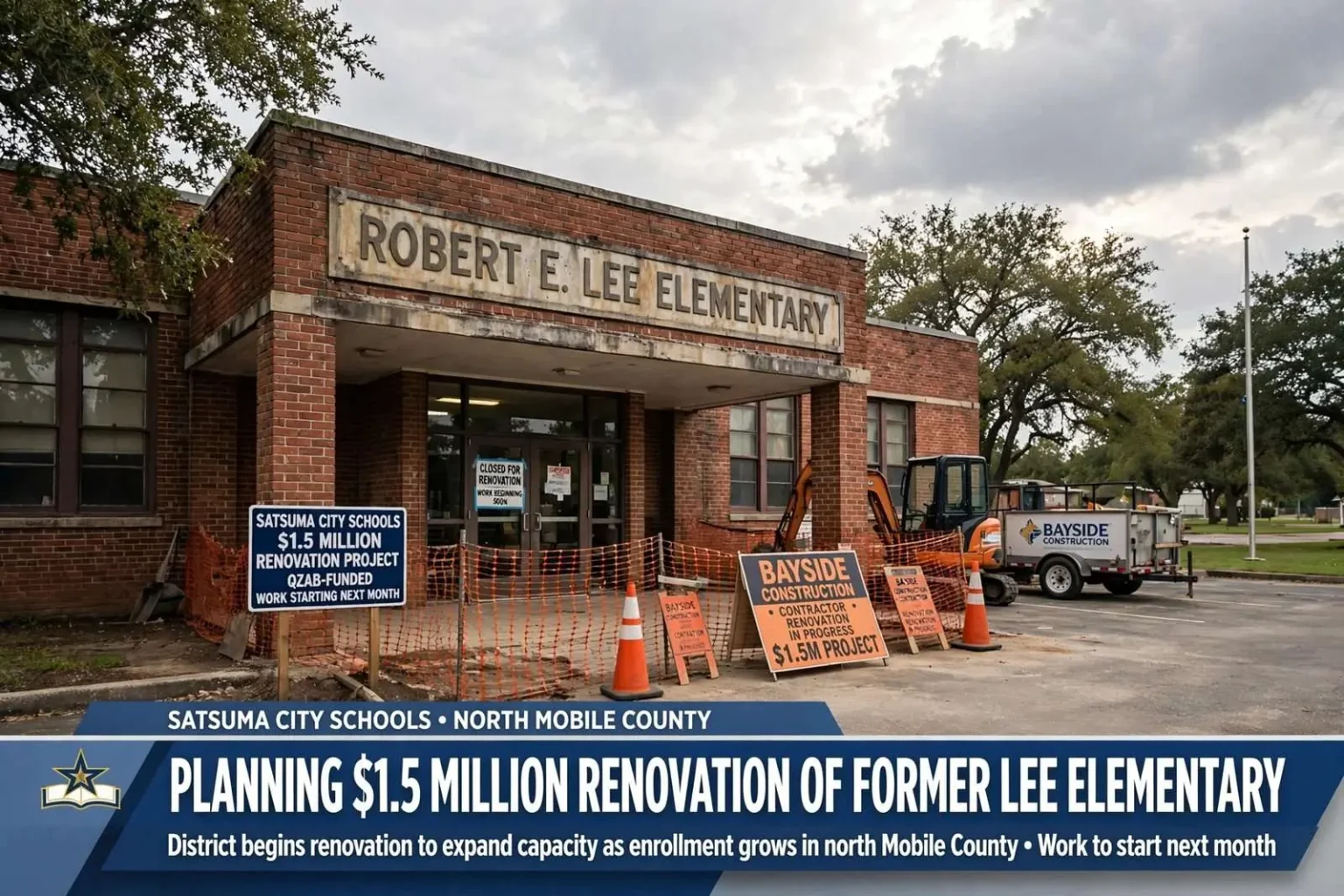
Satsuma City Schools is preparing to launch a $1.5 million renovation of the former Robert E. Lee Elementary School building as the district positions itself for future enrollment growth. The project marks another step in the small north Mobile County system’s effort to make full use of every facility it owns as residential growth continues to push students through its doors.
District administrators recently relocated their offices out of the school’s main building and into the former second-grade wing at the rear of the campus, a section that was constructed in 1997. The move cleared the way for work on the main building and freed up the wing that will now serve as the district’s administrative headquarters.
Superintendent Joe Walters said the upcoming renovations to the main building are intended to prepare the school for additional students in the years ahead. The system currently enrolls roughly 750 elementary-age children, a number that has grown along with the suburban communities surrounding the city.
A Contractor and a Funding Plan
The Satsuma school board has approved a construction contract with Bayside Construction, a Baldwin County-based firm, to carry out the project. Hiring across the bay reflects the competitive construction market along the Gulf Coast, where established firms regularly take on public school work in neighboring counties.
Funding will come from a $2 million qualified zone academy bond, or QZAB, issued to the district last year by the Alabama Department of Education. QZAB financing is specifically designed to help school systems renovate existing buildings rather than fund new construction, making it a natural fit for a district with usable but aging campus space.
The bonds work differently from conventional borrowing. Under the federal QZAB program, which Alabama participates in, the federal government provides tax credits to the bond holders in lieu of interest payments, which dramatically lowers the cost of borrowing for the school district. The catch is that the money must be spent on repair and renovation of existing structures — a limitation that shapes how districts like Satsuma plan their capital projects.
For a district weighing its options, that structure makes the choice fairly clear: a QZAB can turn a tired 1970s-era building into a modern working campus at a fraction of the financing cost of a bond issue, but it cannot buy land or fund a new gymnasium. Satsuma’s plan to pour its bond capacity into the Lee Elementary main building follows directly from those rules.
Not the First Project on This Bond
This is not the first project the district has funded using the bond. Walters said the system previously used a portion of the same QZAB loan for a $500,000 renovation of restrooms at Satsuma High School, addressing aging infrastructure at the district’s secondary campus.
That earlier project tackled some of the most heavily used square footage in any school building. Restroom renovations rarely make headlines, but they address daily comfort, hygiene and building condition in ways that students and staff notice immediately, and they often uncover plumbing and structural issues that older campuses have quietly carried for decades.
With the restroom work behind it, the district has turned the remaining bond capacity toward the former Lee Elementary main building — the largest unused asset on its campus inventory.
Work Set to Begin
Work on the elementary school renovation is expected to begin the following month, according to Walters, though a detailed construction timeline for completion has not yet been released. District officials have not specified how the renovated space will be phased into use, but the intent is to have the building ready to absorb enrollment growth as it arrives rather than scrambling for capacity after it does.
Renovation projects of this size on school campuses typically require coordination around the academic calendar, with the most disruptive work scheduled during summer months and holiday breaks to keep classes running without interruption.
Contractors also have to sequence the work so that utilities, fire systems and access routes remain available to the parts of the campus still in use — a planning exercise that grows more complicated when administrative offices and classrooms share the same grounds, as they now do in Satsuma.
A Broader Strategy for a Growing District
The project reflects a broader effort by the small Mobile County district to modernize its facilities using available state financing rather than relying solely on local tax increases. For a municipal system of Satsuma’s size, stretching bond dollars across multiple projects multiplies the value of every financing tool the district can access.
Satsuma City Schools, like several other municipal districts in the Mobile area, has worked in recent years to expand and update its campuses as suburban communities north of Mobile continue to see steady residential growth. New rooftops in Saraland, Satsuma and Creola feed enrollment pressure southward through the county, and districts that fail to plan for it end up with overcrowded classrooms.
Municipal school systems across Alabama have formed at a steady pace since state law made it easier for cities to break away from county systems, and each new district has had to build or reclaim a campus inventory with limited resources. Satsuma’s approach — renovating the buildings it already owns rather than building new — is the playbook most small systems follow, and the QZAB program is one of the few federal-state tools aimed squarely at that need.
The former Robert E. Lee Elementary building carries its own history in the community. Generations of Satsuma students passed through its classrooms before the district’s restructuring, and bringing the main building back into active use would return a familiar landmark to the center of the city’s school system.
What the Renovation Means for Families
District officials say the renovated main building will provide additional flexibility for the district as it manages classroom space across its campuses. Flexibility is the operative word for a system Satsuma’s size: enrollment does not grow evenly across grades, and a district that can shift programs, offices and classrooms between buildings absorbs those swings without resorting to portable classrooms or overcrowded sections.
For parents, the project signals that the district expects to grow and is investing ahead of that growth rather than behind it. Modernized space also helps with the practical challenges of recruiting and retaining teachers, who notice the condition of their buildings as much as any family does.
There is a long-term payoff as well. Buildings that sit empty deteriorate quickly, and the cost of bringing a neglected structure back from disrepair only climbs with each passing year. By renovating the main building now, the district is protecting an asset it will almost certainly need as enrollment climbs.
The $1.5 million contract with Bayside Construction covers the main building work, with the district’s administrative move already complete in the 1997-era wing at the rear of the campus. As construction gets underway in the coming month, residents can expect updates from the district as timelines firm up.
How Satsuma Compares to Its Neighbors
Satsuma sits among a cluster of north Mobile County municipal districts — alongside Saraland and Satsuma’s own neighbors to the south — that have invested heavily in their campuses over the past decade as the communities along U.S. 43 and Interstate 65 have grown. The corridor’s proximity to Mobile’s job centers, combined with the appeal of small city school systems, has made it one of the fastest-growing areas in the county.
That growth is the backdrop for every capital decision Satsuma makes. A district of roughly 750 elementary-age students today is planning for a tomorrow with more of them, and the $2 million QZAB — split between high school restrooms and the Lee Elementary main building — represents the district’s most recent answer to the question of how a small system pays for big needs.
It is an answer with a track record. The $500,000 restroom renovation at Satsuma High School came in ahead of the elementary project, giving the district — and its board — a completed proof of concept for managing bond-funded work before committing the larger share of the money.
The answer, so far, has been to mine every available financing program, renovate before building new, and keep administrative costs out of classroom space. The main building renovation, with work beginning next month, is the latest installment of that strategy — and district officials have made clear it will not be the last project the system undertakes as growth continues.
The Road Through Construction
In the months ahead, crews from Bayside Construction will work through the main building’s renovation while the district’s offices operate from their new home in the rear wing. When the work is finished, Satsuma City Schools will have converted a dormant building into usable capacity — and positioned itself to welcome the next wave of students the growing north Mobile County corridor is certain to send its way.