Former Brink’s Employee Indicted Over Missing $434,200
A federal grand jury indicted a former Brink's employee accused of taking $434,200 while working as a money services teller in Mobile.
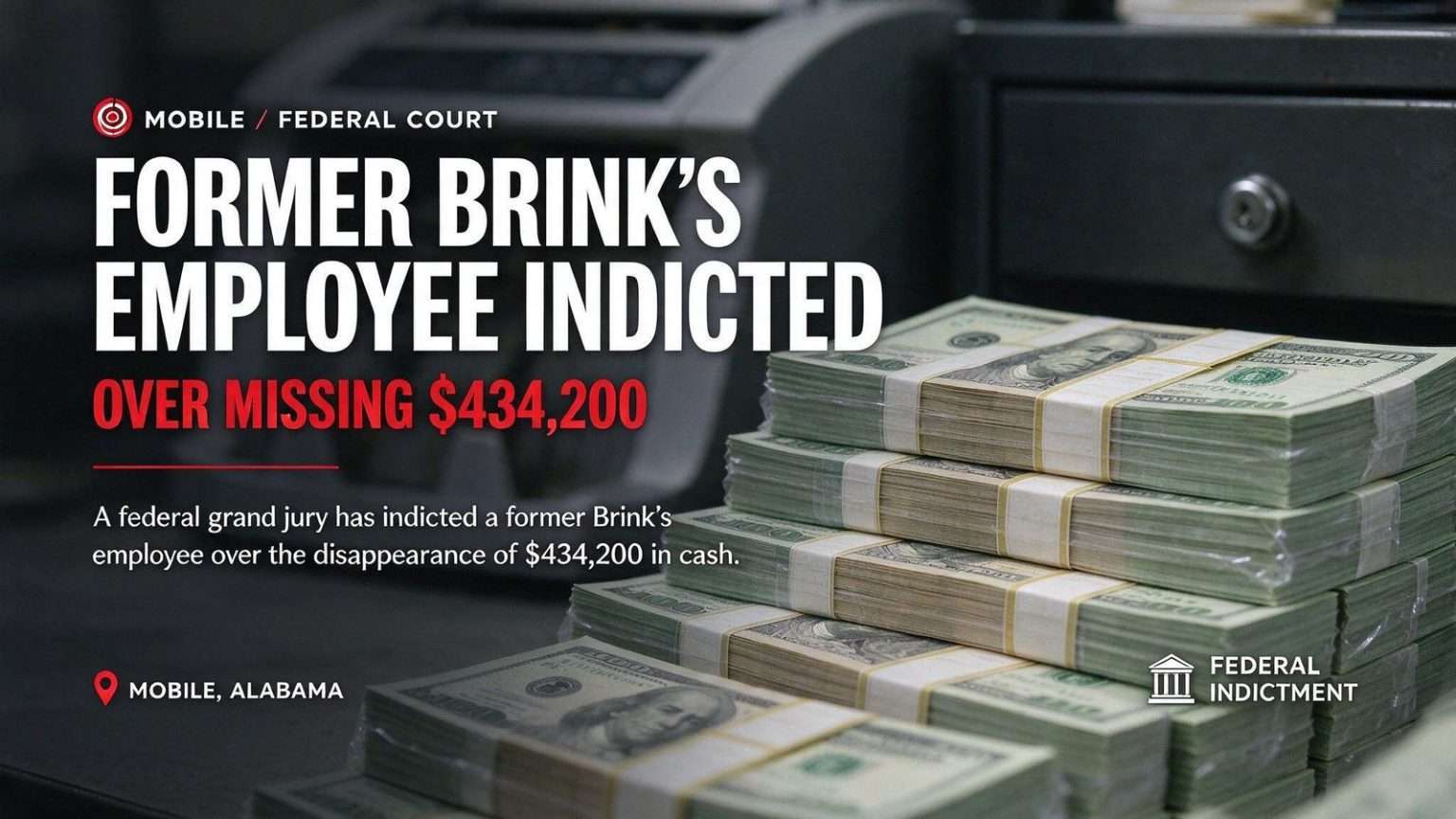
A federal grand jury has indicted a Mobile-area woman who worked for Brink’s on charges connected to the disappearance of $434,200 in cash. The indictment was filed in federal court in Mobile and accuses the former employee of theft in connection with her duties handling currency for the security and cash-management company.
Court records indicate the woman worked as a money services teller for Brink’s, a role that involved securing currency, verifying deposits, preparing bank orders and processing transactions on behalf of client banks. Brink’s held a contract to load currency belonging to a local bank into that bank’s ATM machines, giving employees in her position significant access to large sums of cash as part of routine daily operations.
What the Indictment Alleges
According to the indictment, the missing funds were taken in late September. Investigators have not detailed publicly how the alleged theft was carried out or how it was ultimately discovered, though the case proceeded to a federal grand jury, which returned an indictment on a federal theft charge. The grand jury process — in which a panel of citizens hears evidence presented by prosecutors and determines whether probable cause exists to charge — is the standard route by which federal criminal cases begin, and its return in this matter signaled that prosecutors viewed the evidence as sufficient to proceed to trial.
Because cash in transit and in ATM servicing belongs to financial institutions and moves in interstate commerce, thefts by employees of cash logistics companies fall squarely within federal jurisdiction. Federal prosecutors in the Southern District of Alabama, whose offices are located in Mobile, handle such cases alongside local law enforcement partners, and the involvement of a grand jury indicates the case was developed with that coordination from an early stage.
Brink’s Role in the Local Cash Economy
Brink’s is a major player in cash logistics for banks throughout the Mobile area, transporting and managing currency for numerous financial institutions and retail businesses. The company’s operations form a largely invisible backbone of everyday commerce: armored trucks move cash between branches and vaults, money room staff count and verify deposits, and ATM servicing crews replenish machines at banks, grocery stores and standalone kiosks across the region. Customers who withdraw cash from a local ATM on a Friday evening are, in most cases, drawing on currency that passed through a facility and workforce like the one involved in this case.
Employees who work directly with cash, like money services tellers, typically undergo background checks and are subject to internal auditing procedures designed to catch discrepancies. Vaults are monitored with cameras and dual-control requirements, transactions are reconciled daily, and client banks expect detailed accounting for every dollar entrusted to the carrier. Those controls are precisely what companies like Brink’s market to financial institutions, and when large sums go missing, the internal audit trail — camera footage, transaction logs, custody records — usually provides investigators with a starting point.
How Such Cases Typically Unfold
In cases involving missing cash at cash-handling firms, discrepancies are often flagged during routine reconciliation, when the currency on hand fails to match documented movement. From there, investigators review access records and transaction histories to narrow the window and the personnel involved. The indictment in this case indicates investigators concluded the loss was not an accounting error but a deliberate taking, though the specific evidence supporting that conclusion remains sealed in grand jury materials and has not been made public.
The case now moves through the federal court system in Mobile, where the defendant will have an opportunity to respond to the charge. Following an indictment, the standard sequence includes an initial appearance before a magistrate judge, entry of a plea, pretrial motion practice and, if no plea agreement is reached, trial before a district judge. Defendants are presumed innocent unless proven guilty beyond a reasonable doubt, and the burden rests entirely on the government to establish every element of the offense.
The Stakes of a Federal Theft Charge
Federal theft charges connected to work performed under contract with financial institutions can carry significant penalties depending on the amount involved and the specifics of how the alleged theft occurred. Statutes covering embezzlement and theft from banks and from goods moving in interstate commerce authorize prison terms measured in years, and sentences in federal court are calculated under advisory guidelines that weigh the loss amount — in this case, a sum approaching half a million dollars — along with the defendant’s role, criminal history and other factors. A conviction can also carry restitution obligations requiring repayment of the full amount taken.
The dollar figure at issue places this case among the larger alleged employee thefts recorded in the Mobile area in recent years. Losses of that magnitude typically involve either repeated takings over time or the exploitation of a processing step where accountability between employees shifts — situations that internal controls are designed to make detectable, if not always preventable.
What It Means for Local Institutions
Local financial institutions and cash-handling companies in the Mobile area watch cases like this one closely, because the arrangements that make cash logistics efficient also concentrate risk. Banks that outsource ATM replenishment and cash vault services do so to avoid the cost and liability of running those operations themselves, but the outsourcing depends on trust in the carrier’s workforce and systems. When an insider is charged with stealing client funds, client institutions review their contracts, and carriers review their screening and audit practices.
Industry experience suggests that most currency handled by cash logistics employees moves without incident, and theft by insiders remains rare relative to the enormous volume processed daily. But the concentration of cash in vaults and ATM routes means a single dishonest employee can access amounts that would require a bank robbery crew weeks of effort to match. That asymmetry is why the industry pairs background screening with layered controls — dual custody, surveillance, surprise counts — and why discrepancies, when they surface, are pursued aggressively through both civil recovery and criminal referral.
For now, the matter rests with the federal court in Mobile, where the indictment marks the beginning — not the end — of a process that will determine whether the government can prove what it has alleged. Court filings in the coming weeks are expected to establish the defendant’s plea and a schedule for the case, while the financial institutions whose currency was involved await the outcome of both the prosecution and any parallel recovery efforts.
Inside a Money Room
The job of a money services teller, as described in court records, sits at the center of the cash cycle that connects local merchants, bank branches and ATMs. Each business day, currency collected from retailers and bank teller drawers is delivered to the carrier’s facility, counted by machine and by hand, verified against deposit slips, and prepared for delivery to client banks or for loading into ATM cassettes. Orders for specific denominations are filled to meet each institution’s anticipated demand, and every bundle is logged as it changes hands. The role demands accuracy and discretion, and the pace of work is high — a single servicing facility can process millions of dollars in a day.
Contract arrangements like the one described in the indictment, in which the carrier loads a bank’s currency directly into the bank’s ATMs, are common across the Gulf Coast and nationally. They spare banks the labor of maintaining their own vault staff and armored fleets, and they compress the time between a customer’s deposit and the same dollars’ availability for withdrawal. The tradeoff is that the carrier’s employees handle client-owned currency at every stage, which is why custody documentation — who touched the money, when, and in what quantity — is maintained continuously from pickup to final load.
The Investigation Ahead
With the indictment returned, the investigative record in the case will begin to emerge through pretrial filings. Defense counsel may challenge the sufficiency of the evidence, the scope of any searches, or the government’s accounting of the loss. Prosecutors, for their part, will be prepared to present the audit trail, surveillance records and witness testimony developed during the investigation. Any plea discussions would weigh the strength of that evidence against the sentencing exposure the charge carries.
The case serves as a reminder to businesses and institutions across Mobile that the movement of cash — so routine as to be invisible — relies on a chain of custody that is only as strong as the people and controls within it. For the local bank whose ATMs were being serviced, for Brink’s, and for the employees whose work will now be examined in open court, the resolution of the case will be watched as a measure of how well those controls perform when they are put to the test.