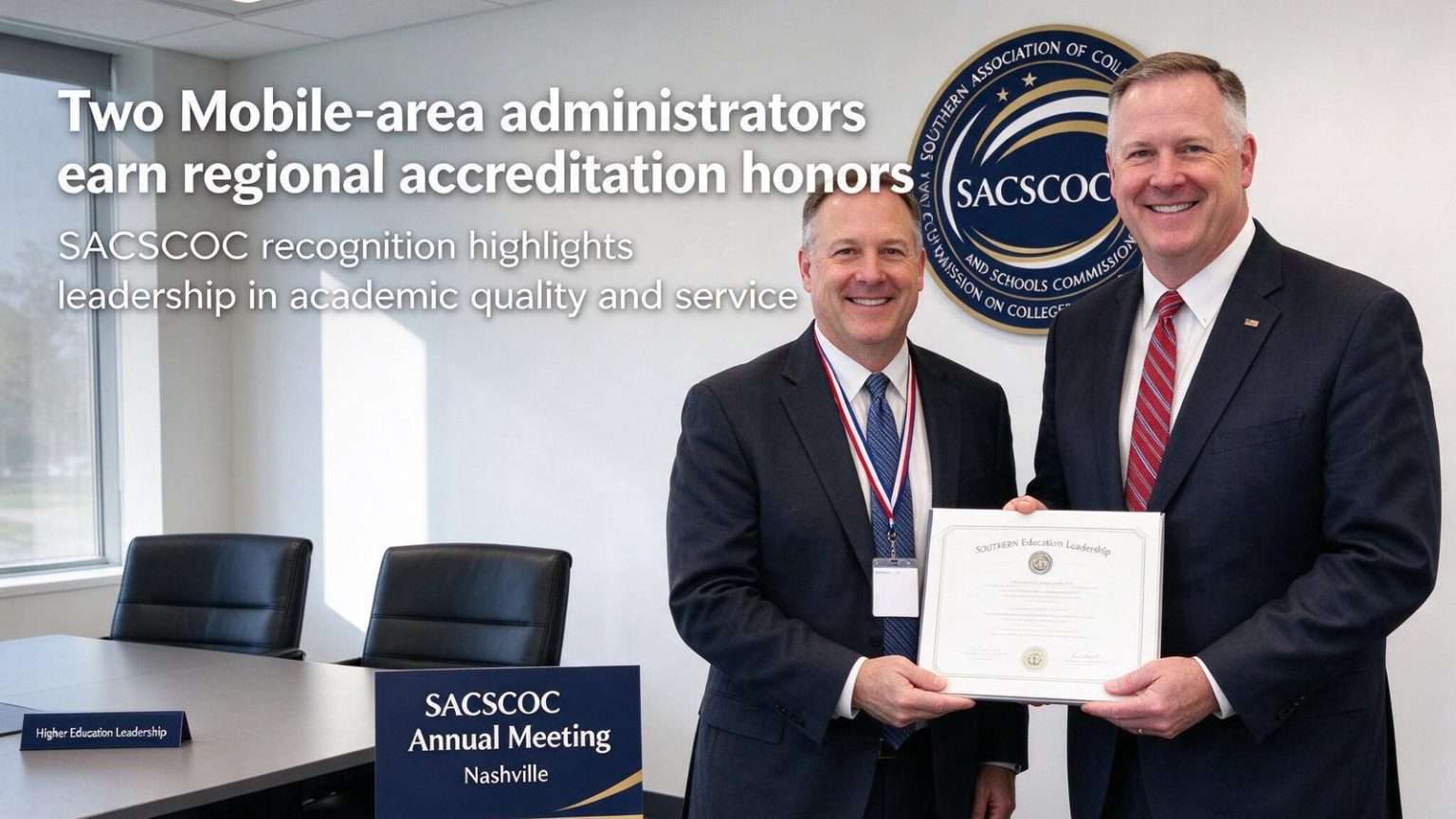
Two Mobile-area university administrators received recognition from the Southern Association of Colleges and Schools Commission on Colleges during the accrediting body’s annual meeting in Nashville. The honors — a seat on the commission’s board of trustees for one, the Meritorious Service Award for the other — put two members of the Port City’s higher education leadership on a regional stage that shapes standards for hundreds of colleges and universities across the South.
David Johnson, the University of South Alabama’s first provost and senior vice president for academic affairs, was selected to serve on the commission’s board of trustees. The commission is the accrediting body overseeing higher education institutions across an 11-state region that includes Alabama, Mississippi, Florida, Georgia, Texas, Louisiana, South Carolina, North Carolina, Virginia, Kentucky and Tennessee.
Johnson will be one of eight trustees representing Alabama on the commission’s 77-member board, which sets direction for the organization and oversees the accreditation process for member schools. The board’s work touches nearly every aspect of institutional life at accredited colleges: degree program quality, faculty standards, financial stability, governance and the periodic reviews that determine whether an institution keeps its accreditation.
In a statement, Johnson called the appointment both an honor and a significant responsibility, noting the commission’s role in ensuring accredited colleges and universities meet established standards of quality and integrity. For the University of South Alabama, having its top academic officer at the table where regional accreditation policy is set is a meaningful position — accreditation is the foundation on which federal financial aid eligibility, credit transfer and institutional reputation all rest.
What the Commission Does
The Southern Association of Colleges and Schools Commission on Colleges is the recognized regional accreditor for degree-granting institutions in an eleven-state southern region. Its decisions determine whether an institution is accredited, placed on warning, or removed from membership — outcomes with enormous consequences for students, whose degrees depend on their school’s standing, and for institutions, which rely on accreditation for access to federal funds and participation in federal aid programs.
The commission’s 77-member board is the body that steers that process, adopting standards, reviewing accreditation actions and guiding the organization’s direction. Trustee seats are filled by peer administrators and educators from member institutions, making an appointment to the board both a personal recognition and a signal of the appointing institution’s standing among its peers.
A Meritorious Service Award for Steve Lee
Separately, Steve Lee, vice president for business affairs and chief financial officer at the University of Mobile, received the commission’s Meritorious Service Award at the same conference. The award recognizes sustained, substantive service to the accrediting body — contributions made over years, alongside the demanding full-time work of running a university’s finances.
Lee was recognized for his extensive service to the accrediting body, including participation in 19 committee site visits along with work on the commission’s Accreditation Process Project and its Finance Subcommittee. Site visits are the backbone of the accreditation process: teams of peer reviewers descend on a member institution for an intensive examination of its programs, finances, governance and compliance with standards, and the evaluators who serve on them give days of their time for each visit. Nineteen of them represents years of service to institutions across the region.
The Accreditation Process Project and the Finance Subcommittee work placed Lee inside the machinery that shapes how accreditation itself functions — how reviews are structured, how standards are applied, and how the commission evaluates the financial health of member institutions. That kind of behind-the-scenes contribution rarely draws public attention at the institution being served, which is precisely what the Meritorious Service Award exists to recognize.
Lee, a certified public accountant, has held his position at the University of Mobile since 1995. Before joining the university, he worked as an audit manager at a Mobile-area accounting firm from 1988 to 1995 and earlier ran a moving and storage company from 1974 to 1986. That background — private-sector accounting discipline combined with entrepreneurial operating experience — has informed a finance career that now spans decades in Mobile higher education.
Leadership at the University of Mobile
In recent years, Lee has overseen a $7 million campus enhancement project at the University of Mobile. The effort touched facilities across the private Christian university’s campus, part of the broader work of keeping a residential campus competitive in a higher education market where students and families scrutinize everything from dormitory quality to academic buildings. Capital projects of that scale require exactly the blend of financial management and operational judgment that has marked Lee’s tenure.
University of Mobile President Mark Foley praised the recognition, calling it among the highest honors the accrediting commission bestows and noting it was well deserved given Lee’s years of service. For a university of the University of Mobile’s size, having its chief financial officer hold that standing within the regional accreditor is a notable distinction — the institution’s own accreditation reviews depend on relationships and credibility within that same body.
The dual honors also highlight the distinctive role Mobile’s higher education community plays in the region. The city hosts a range of institutions — a major public research university, private colleges, and specialized institutions — and their administrators routinely serve as peer reviewers, committee members and officers in the bodies that govern academic quality across the South. That service flows both ways: Mobile institutions benefit from the expertise their leaders gain inside the accreditation system, and the system benefits from the operational experience those leaders bring.
Why Accreditation Matters to Students and Families
Accreditation is easy for the public to overlook, but it underwrites nearly everything a college promises its students. A degree from an unaccredited institution can be unusable for graduate school admission, professional licensure and many employers. Federal student aid — the financial backbone for most American college students — flows only to accredited institutions. Credit transfer between schools depends on the accreditation status of both.
That is why appointments like Johnson’s and awards like Lee’s carry weight beyond the ceremony in Nashville. The trustees who set the commission’s direction and the experienced administrators who serve on its site visit teams are, collectively, the quality-control system for Southern higher education. When Mobile’s administrators hold those roles, they are helping to write and apply the standards their own institutions — and every student enrolled in them — will be measured against.
For the University of South Alabama, Johnson’s seat on the board comes as the institution continues to grow its academic and research profile in the region. For the University of Mobile, Lee’s award caps a service record built over nearly three decades on campus and 19 site visits across the South. Both men were honored for the same underlying work: keeping institutions honest about their quality, and keeping the region’s colleges accountable to the students they serve.
The People Behind the Institutions
Johnson’s path to the provost’s office at the University of South Alabama reflected a career spent inside the academic enterprise. As the university’s first provost and senior vice president for academic affairs, he was responsible for the institution’s entire academic operation — its colleges and schools, its faculty affairs, its curriculum and its academic budget. The role of provost is often described as the university’s chief academic officer, the person who answers for educational quality day in and day out. Serving as the first person to hold that title at an institution means building the office itself: defining how academic priorities are set, how deans are supported and evaluated, and how the university’s teaching and research mission is administered as it grows.
That experience is directly relevant to the work of the commission’s board. Accreditation reviews ask precisely the questions a provost lives with: Are programs coherent and rigorous? Are faculty qualified and supported? Does the institution’s planning actually connect to its resources? Boards benefit from trustees who have sat on the institutional side of that process and understand where standards meet the practical realities of running a university.
Lee’s career path into higher education finance was anything but conventional. Before his accounting career began, he spent more than a decade running a moving and storage company — an operating business where scheduling, payroll, equipment and customer service all land on the owner’s desk. He moved from that world into audit management at a Mobile accounting firm, where he spent seven years examining the books of businesses and organizations across the area before the University of Mobile brought him in as its chief financial officer in 1995.
Colleagues in university business offices describe the CFO role as part accountant, part strategist and part crisis manager. Enrollment swings, capital campaigns, deferred maintenance, debt service and the endless compliance demands of federal financial aid all pass through the business office. Lee’s oversight of the university’s $7 million campus enhancement project put his accounting discipline to work in physical form — a reminder that a university’s finances ultimately show up as buildings, systems and campus experiences that students see every day.
A Region Watches Its Own Standards
The annual meeting in Nashville where both honors were presented is the commission’s principal gathering — the event where member institutions send their presidents, provosts and business officers to hear updates on standards, attend sessions on compliance and institutional effectiveness, and conduct the organization’s business. It is also where the commission traditionally recognizes individuals whose service to the accreditation enterprise stands out.
Two Mobile-area administrators being recognized at the same conference underscored something the region’s higher education community already knows: the Gulf Coast is well represented in the peer structures that govern academic quality in the South. Peer accreditation works only when experienced administrators are willing to give their time — to serve on site visit teams, sit on committees, and take on the governance work that keeps the system credible. Johnson and Lee have both done that work, in different roles, for years.
For students and families choosing among Mobile’s colleges and universities, the practical significance is straightforward. The institutions their children attend are measured against regional standards by people who know those standards intimately — and two of the people shaping and applying them come from right up the road.