On the Eve of the 2006 Primary, Mobile’s Insiders Placed Their Bets
Ahead of Alabama's June 2006 party primaries, a panel of anonymous Mobile-area political insiders forecast the sheriff's race, the state Supreme Court contests and two closely watched coastal state Senate seats.
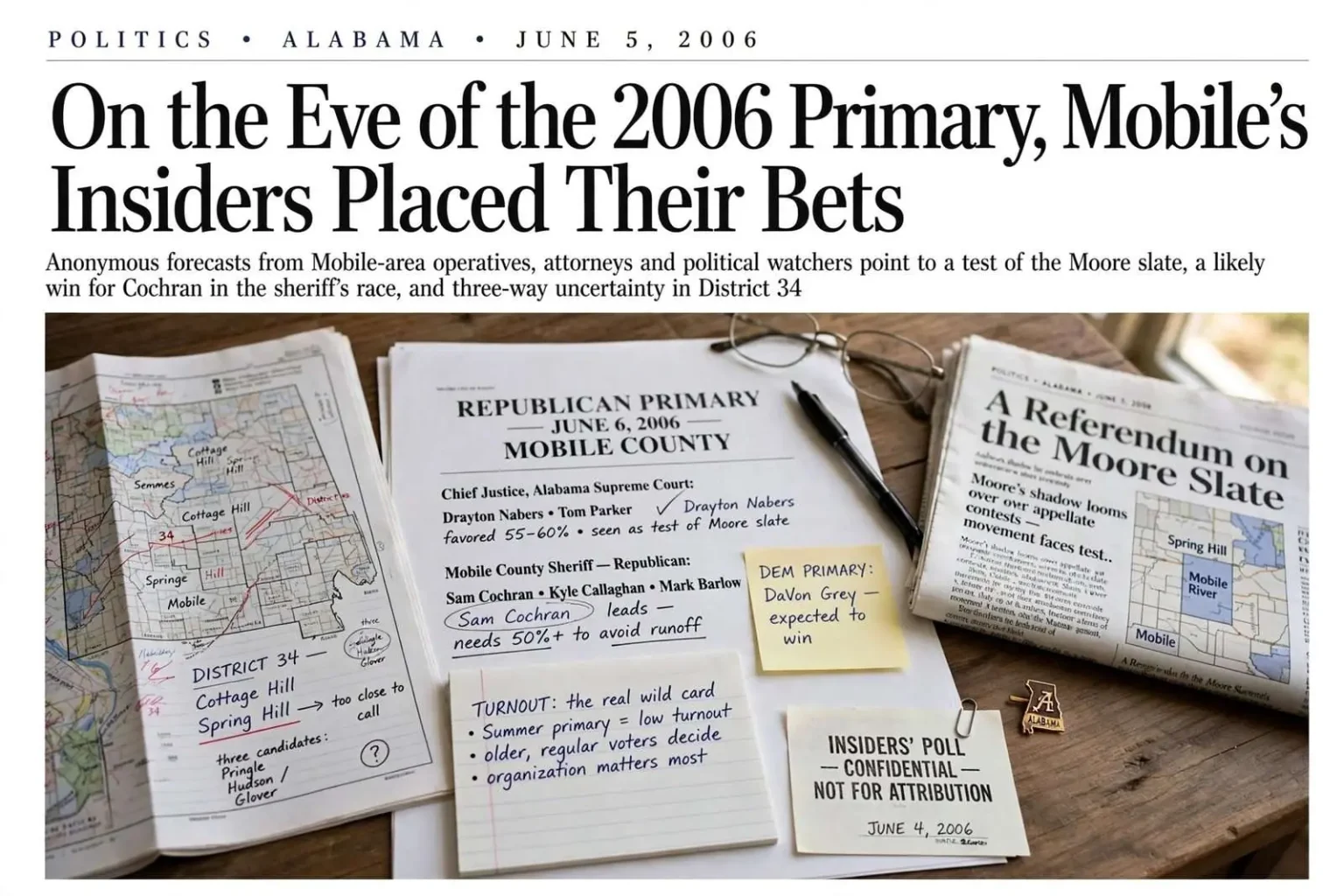
With Alabama’s party primaries set for Tuesday, the region’s political class had little else on its mind, and a rotating cast of Mobile-area operatives, attorneys and longtime office-watchers agreed to share their forecasts on one condition: that their names never appear in print. Anonymity, they reasoned, let them speak plainly without staking a hard-won reputation on a coin-flip contest. Their letters, gathered over the final days of the campaign, ranged across a crowded ballot that stretched from the Alabama Supreme Court down to the Mobile County sheriff’s office and two of the most closely watched state Senate races on the coast.
The practice of the informal insiders’ poll is a fixture of every Alabama election season. Campaign operatives read turnout models the way meteorologists read radar, and lawyers who practice before the local courts often know the candidates as colleagues first and politicians second. Taken together, the letters amount to a temperature reading of the political class — not a prediction, but a portrait of what the people who watch closest actually believe. Their near-unanimity on some races and their deep hedging on others is itself information.
A Referendum on the Moore Slate
Nearly every insider treated the appellate court contests as a measuring stick for former Chief Justice Roy Moore and the slate of candidates aligned with him. Most predicted incumbent Chief Justice Drayton Nabers would turn back challenger Tom Parker, with several putting Nabers in the 55-to-60 percent range. The race had become, in the eyes of the panel, a direct test of whether the movement Moore built — the coalition of religious conservatives galvanized by the Ten Commandments fight and its aftermath — still commanded a winning share of the Republican primary electorate two years after its founder left office.
Moore’s own shadow hung over the ballot beyond the appellate races. The former chief justice had already mounted a campaign for governor in this cycle, challenging the sitting Republican incumbent from the right, and his candidacy had framed the entire primary season as a contest between establishment Republicans and the activist conservative base. Every Moore-aligned judicial candidate on Tuesday’s ballot, the insiders understood, would be read as a down-ballot measurement of that same division.
One panelist argued the Moore movement had peaked before the 2004 election and that mainstream conservatives had grown weary of what he called Johnny One Note rhetoric. On that reading, the movement’s energy had been spent in the monument fight and the recall-era campaigns that followed, and Republican voters — pragmatic by temperament, this panelist argued — had moved on to budgets, roads and economic development. Several letters echoed the thought that a single-issue coalition, however passionate, struggles to hold a primary electorate that also cares about keeping a courthouse running.
A dissenting voice cautioned that the Moore-aligned candidates might do better than expected, blaming the mainline field for a graceless campaign. The establishment’s candidates, this panelist contended, had run as the absence of their opposition rather than as a positive argument, and resentful base voters punish that kind of campaign at the turnout level if nowhere else. Whether weariness or enthusiasm defined the base, the panel agreed, would show up in the numbers by Tuesday night.
The Race for Sheriff
The insiders were nearly unanimous that Sam Cochran, the recently retired Mobile police chief, would lead the Republican field. Cochran’s name identification in Mobile County was close to universal — decades of public visibility in the police department’s top job tend to produce that — and his law-and-order profile fit the office. The only real suspense, most agreed, was whether Cochran could clear 50 percent and avoid a runoff with Kyle Callaghan or Mark Barlow.
The arithmetic of the sheriff’s race came down to turnout geography. A candidate favored across most of the county can still be dragged into a runoff if his opposition concentrates its votes in a few strong boxes, and Alabama’s primary rules require a majority — not a plurality — to win a nomination outright. A candidate who falls short faces a runoff three weeks later, a sprint that rewards the campaign with the remaining money and the sharper organization.
On the Democratic side, the panel expected DaVon Grey to prevail. The Democratic primary drew less of the panel’s attention — a reflection of the county’s electoral arithmetic in statewide and countywide races, where the Republican primary winner is generally regarded as the heavy favorite in the fall. A handful warned of a bruising and possibly nasty second round if Cochran fell short of an outright win, on the theory that a runoff between a familiar former chief and a challenger with nothing to lose tends to get personal quickly, and that an extended intra-party fight would hand the fall campaign a ready-made set of attack lines.
Two Senate Seats in Play
District 34, spanning Semmes, Cottage Hill and Spring Hill, drew the most hedging. With Chris Pringle, Connie Hudson and Rusty Glover each strong in a different corner of the district, most forecasters declined to pick a winner at all. The district’s geography tells the story: Semmes and the fast-growing western reaches of Mobile County form one political community, the Cottage Hill and western Mobile neighborhoods another, and Spring Hill — with its established, civically active precincts — a third. A candidate rooted in one of those communities starts with a floor of votes the others cannot easily reach, which is precisely why the panel split.
Runoff mathematics hover over every letter about the race. With three strong candidates dividing a primary electorate, the most likely outcome the insiders saw was a first round with no majority, followed by three weeks of hard campaigning between the top two. Which pairing emerges from Tuesday — and whether the third candidate’s supporters defect, stay home or split their loyalty — was, in the panel’s judgment, genuinely unknowable on the eve of the vote. A few letter-writers noted that this kind of three-cornered contest often turns less on issues than on each campaign’s ability to identify and drag its voters to the polls in a low-turnout summer primary.
The second coastal Senate race on the ballot drew its own share of letters, with the panel’s consensus softer there than in District 34 but the stakes understood to be similar: a Senate seat in Montgomery carries influence over the county’s delegation interests, and in Alabama’s tradition of strong legislative delegations, a state senator from Mobile County matters to every road project, port appropriation and local bill that comes through the State House.
Turnout: The Real Wild Card
Beneath every forecast, the letters kept returning to the same question: who actually votes. Summer primaries in Alabama are low-turnout affairs, often decided by well under a third of the eligible electorate, and the composition of that electorate skews toward older, more reliable voters with long memories and settled loyalties. A motivated faction — a church network, a public-safety association, a neighborhood group — can move a countywide race more in a June primary than it could in a November general election, when the broader electorate dilutes any single bloc.
That dynamic is why the insiders’ near-unanimity on Cochran and their confidence in Nabers coexist with their hedging on the Senate races. Name recognition and organization carry countywide races in low turnout; in a three-candidate district race where organization is evenly matched, the letters suggest, the outcome belongs to whoever turns out their corner of the district twice — once this week, and once again in a runoff three weeks later if nobody clears fifty percent.
What Tuesday Settles — and What It Doesn’t
The panel was careful to note what the primaries would not decide. Nominees are only nominees; the general election in November follows, and in a handful of the down-ballot contests a minor-party or independent candidate will still be waiting. But in a state where the dominant party’s primary has become the decisive round in most countywide and judicial races, Tuesday’s vote was understood to be, for practical purposes, the election — which is exactly why the political class spent the final weekend writing predictions instead of resting.
There was also agreement on how to read the results afterward. A dominant Nabers win would, in the panel’s framing, support the argument that the Moore movement’s peak had passed; a closer-than-expected finish — or a surprise elsewhere on the Moore-aligned slate — would revive talk of the base’s strength heading into the fall and the next cycle. A Cochran first-round majority would end the sheriff’s race before it started; anything less would begin three of the least relaxing weeks a local campaign can offer.
By Wednesday morning, of course, the letter-writers’ anonymity would be back where it belongs — and the only forecasts that would matter were the ones written in ink on the tally sheets. The rest of us get to see how the people who watch politics for a living sized up a crowded ballot, on the eve of the only poll that counts.