Satsuma Puts $1.5 Million Into Old Lee Elementary as Mobile County Schools Grow
Satsuma is spending $1.5 million to renovate the former Lee Elementary School, while Mobile County adds a welding academy and new testing data.
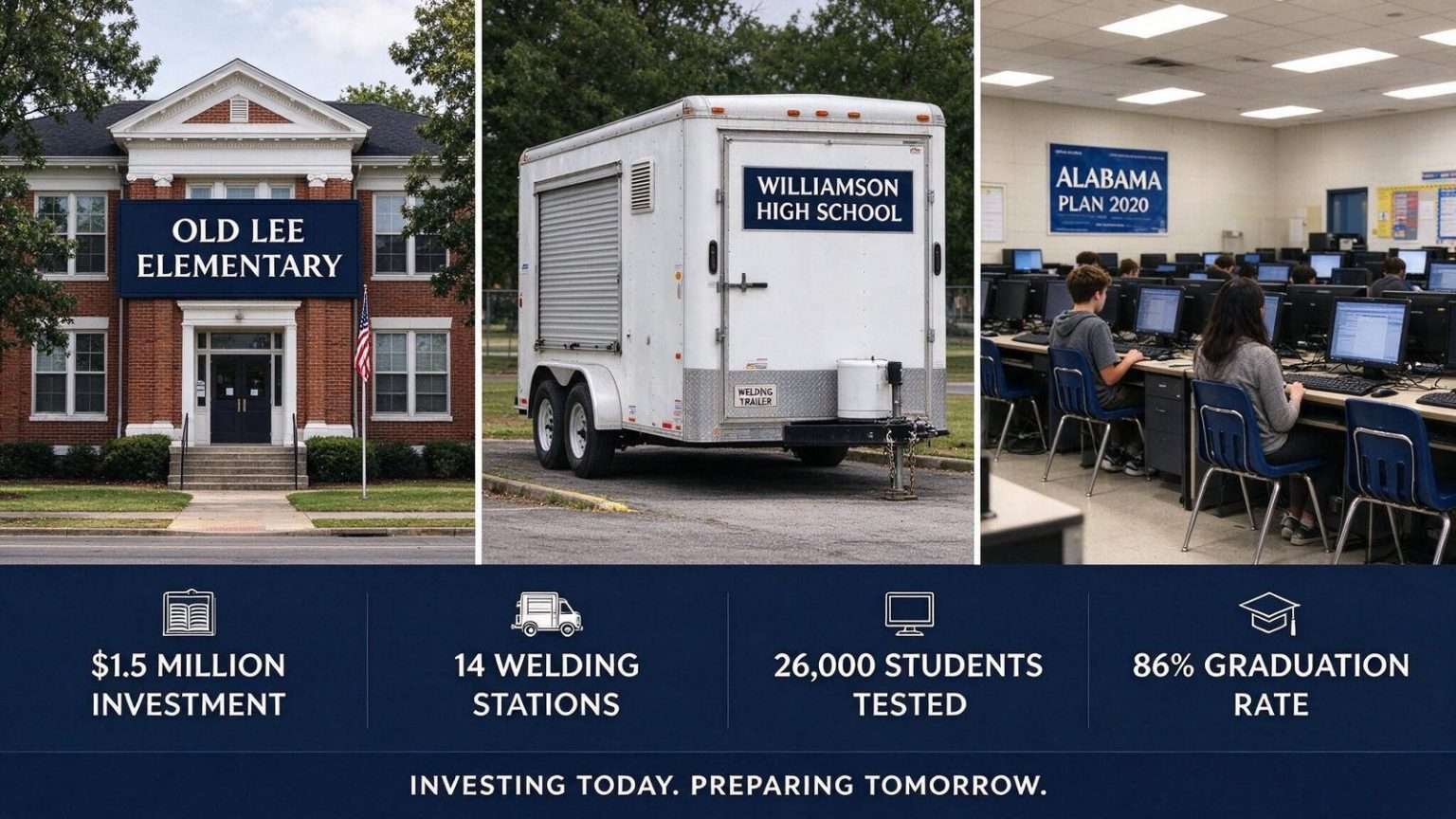
The Satsuma school system is investing $1.5 million to renovate the former Lee Elementary School building, a move district leaders say will help the growing north Mobile County city keep pace with future enrollment. The renovation is being funded through a $2 million qualified zone academy bond issued to the district by the Alabama State Department of Education last year, freeing up local dollars for other priorities.
Qualified zone academy bonds are a federal financing tool that states allocate to school districts for building renovation and repair, offering favorable terms that reduce the cost of borrowing compared with conventional bonds. For a small system like Satsuma’s, the $2 million authorization represents a meaningful slice of capital capacity, and directing $1.5 million of it at the old Lee Elementary building converts a vacant campus into usable space without a new construction project.
District officials have not released a detailed timeline for reopening the building, but the project reflects a broader push among small municipal school systems along the Mobile County line to modernize aging campuses rather than build new ones from scratch. Renovation preserves existing infrastructure, keeps facilities near the neighborhoods they serve, and typically costs a fraction of a greenfield build.
Satsuma, which operates its own separate system from Mobile County Public Schools, has leaned on state bond financing in recent years to stretch its capital budget further. The city broke away from the Mobile County system to run its own schools, a path several north Mobile County municipalities have taken, and independence means the city bears both the responsibility and the financial weight of its own facilities. State bond programs soften that load.
Renovating rather than replacing also carries practical advantages for a growing city. Satsuma’s enrollment pressure comes from residential growth in the area, and a district that already owns a structurally sound elementary building can bring capacity online faster than one starting from drawings and dirt work. The renovation dollars will go toward bringing the old campus up to the standards the district’s newer facilities already meet.
South of the city line: a welding trailer at Williamson
South of Satsuma, Mobile County Public Schools is rolling out new career-training infrastructure of its own. Williamson High School recently took delivery of a welding trailer outfitted with 14 individual work stations, a key addition to the school’s signature career academy program. The trailer gives students hands-on welding instruction without requiring a full standalone shop building.
The mobile format matters for districts watching their construction budgets. A conventional welding shop requires foundations, ventilation and dedicated square footage, all of it expensive. A trailer with 14 stations delivers the same hands-on instruction in a unit that can, over time, be shared among campuses or repositioned as demand shifts. For Williamson, the stations mean more students can earn certifications and practice hours simultaneously rather than waiting turns at a limited set of machines.
The welding program is expected to feed graduates directly into regional manufacturing and shipbuilding employers that have long driven demand for skilled trades workers along the central Gulf Coast. Mobile’s shipbuilding and industrial sector, anchored by major yards and their supplier networks, has sustained demand for certified welders for decades, and programs like Williamson’s career academy connect local students to that pipeline while they are still in high school. Graduates who leave with welding credentials enter a labor market where skilled trades command strong wages without requiring a four-year degree first.
A district-wide testing milestone
The investments come as Mobile County also digests a fresh round of standardized testing data. The district released ACT Aspire results this fall for roughly 26,000 students in grades three through eight who sat for the exam last spring. The Aspire battery measures student progress against college-readiness benchmarks across subjects, giving the district a longitudinal picture of how its elementary and middle schools are preparing students before they reach high school.
Mobile County was the only school system in Alabama to administer the entire ACT Aspire battery by computer, a distinction officials pointed to as evidence of the district’s investment in classroom technology even as they work through the results district-wide. Computer-based testing requires devices, connectivity and logistics that many districts administer partially or not at all, and Mobile County’s full-computer administration signals a technology infrastructure built out across its schools.
The testing data serves a practical role alongside the district’s facility and program investments. Results from 26,000 students give principals and curriculum staff a map of where instruction is landing and where it is not, and the fall release allows schools to adjust before the next spring’s testing cycle. Districts that treat assessment as a feedback loop, rather than an annual judgment, get more value from the same data.
Statewide context: graduation rates climbing
The local moves come against a backdrop of statewide improvement. The Alabama State Department of Education announced that the state’s high school graduation rate has climbed to 86 percent, putting officials four years ahead of schedule on Plan 2020, the state’s roadmap for reaching a 90 percent graduation rate by the end of the decade.
Plan 2020 set a series of ambitious targets for Alabama schools, and the graduation-rate trajectory has outpaced the plan’s own timeline. State officials credited a mix of targeted interventions and career-focused programming, similar to the welding academy now underway at Williamson, for the gains. The connection is direct: students who see a credible path from high school to a paying career are more likely to stay enrolled through graduation, and career academies are the mechanism schools use to make that path visible.
Taken together, the Satsuma renovation, the Williamson welding trailer and the district’s testing overhaul illustrate how Mobile County-area schools are trying to balance immediate facility needs with longer-term workforce preparation. Satsuma is solving a capacity problem with renovated space; Mobile County is building a trades pipeline with mobile equipment; both systems are working from the same statewide assessment framework to measure whether academic results keep pace.
What it means for north Mobile County families
For Satsuma residents, the Lee Elementary renovation signals that the city’s independent school system intends to grow into its enrollment rather than crowd it. Families choosing where to live weigh school capacity heavily, and a district that can show renovated facilities and a financing plan for them has an easier case to make to prospective homeowners. The qualified zone academy bond structure means the work is funded without the district diverting local operating dollars from instruction.
The municipal school movement in north Mobile County, which Satsuma joined when it separated from the county system, reflects a broader pattern of small Alabama cities taking direct control of their schools. Independence brings local accountability and control over facilities decisions like the Lee Elementary renovation, but it also means smaller systems must be resourceful with capital, which is why state bond programs matter so much to them.
The absence of a detailed reopening timeline means families should expect updates from the district as the renovation progresses. Renovation projects of this scale typically proceed through design, contractor selection and construction phases, and the district’s leaders have framed the building’s return to service as a matter of when, not whether, given the enrollment trajectory they are planning around.
For families with students zoned to Williamson, the welding trailer adds tangible capacity to a program already positioned as the school’s signature. Career academies succeed when students can actually get machine time, and 14 work stations change the math for a program that previously had to schedule students through limited facilities. The equipment also sends a message to regional employers that Mobile County schools are producing graduates with current, hands-on training.
The statewide graduation gains give both efforts their larger frame. Alabama’s 86 percent rate and the four-year head start on Plan 2020’s 90 percent target did not happen by accident; they reflect interventions and programs of exactly the kind now operating in Satsuma and at Williamson. The high school graduation rate is a lagging indicator, shaped by what happens in elementary and middle school years, which is why the district’s computer-based Aspire testing of 26,000 younger students matters to the same long-term picture.
The years ahead will show whether these investments keep pace with growth and expectations. Satsuma will renovate and reopen a building for a growing population; Mobile County will measure the Aspire results and the output of its welding academies; the state will track whether the graduation rate crosses 90 percent on schedule. For now, the moves illustrate two neighboring systems, one small and independent, one large and comprehensive, making facility and program decisions aimed at the same destination: students who graduate ready for the workforce and college opportunities the Gulf Coast offers.