New $10.5M Calcedeaver Elementary Set to Open in January
Students at Calcedeaver Elementary in Mount Vernon will move into a new $10.5 million school building when classes resume after the holidays.
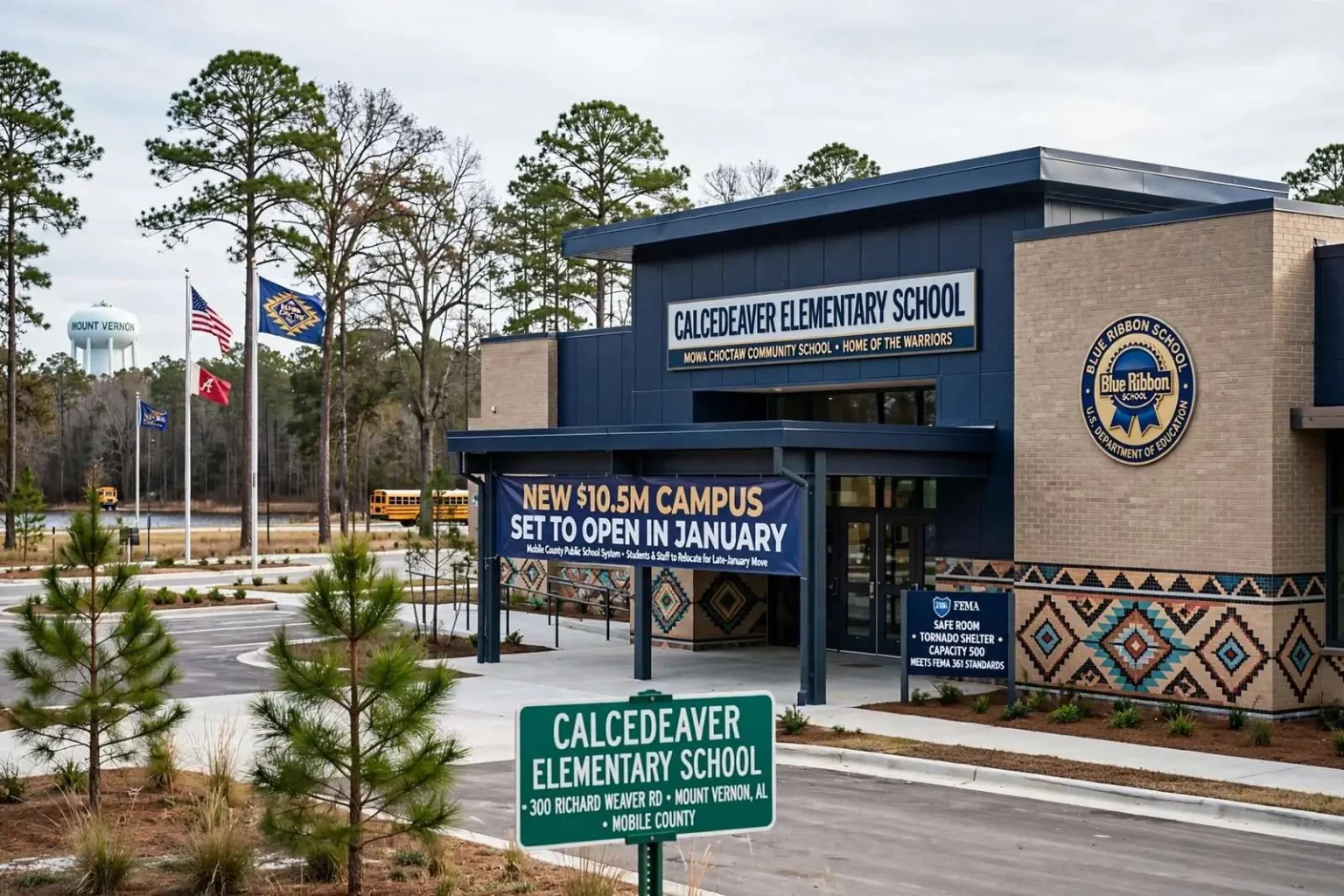
Students and teachers at Calcedeaver Elementary School in Mount Vernon will start the new year in a brand-new building, with the Mobile County school system planning a late-January move into the $10.5 million facility. The relocation caps a project years in the making in one of the most distinctive corners of the district, a small community in north Mobile County where the school has long served as both an educational anchor and a center of cultural pride. District officials describe the move as one of the most anticipated campus openings in recent memory.
Tommy Sheffield, facilities manager for the Mobile County school system, said the plan is for students to report to the new campus as soon as classes resume following the holiday break, weather and construction schedules permitting. “If everything goes without a hitch through the holiday, the kids will report to the new facility,” Sheffield said, noting the district is watching for any weather delays that could affect construction or equipment delivery. Winter in south Alabama can bring heavy rain and the occasional severe storm, and officials have built their timeline with enough room to absorb routine construction slippage.
Calcedeaver holds a special place among Mobile County’s schools. It is one of 12 schools in the district recognized as a Blue Ribbon school by the U.S. Department of Education, and most of its students come from the MOWA Choctaw Indian tribe. The Blue Ribbon designation, the highest honor the federal government awards to American schools, marks Calcedeaver as a standout for academic performance or dramatic improvement, a notable achievement for a small rural campus serving a community in the far northern reaches of the county.
The MOWA Choctaw community, whose name reflects the Mobile, Washington and Baldwin counties where its members have lived for generations, descended from Choctaw families who remained in the region after the removals of the 1830s. The tribe has maintained its identity in the Mount Vernon area for nearly two centuries, and Calcedeaver Elementary has been at the heart of that story, teaching generations of tribal children in a district where their heritage is now woven visibly into the physical campus itself.
A Building That Tells a Story
The new 58,000-square-foot building, designed to hold up to 500 students, incorporates floor tiles and mosaic artwork reflecting MOWA Choctaw heritage throughout the facility. The design choices were not decorative afterthoughts; planners worked heritage elements into the fabric of the building so that students walk through hallways that reflect the community’s own history. District officials say the result is unlike any other campus in the system.
The MOWA Choctaw heritage woven into the building’s design also carries educational value inside the classroom. Students at Calcedeaver will learn each day in a facility that treats their community’s history as something worth embedding in tile and mosaic rather than confining to a textbook page, and educators have long argued that children perform better when their environment reflects who they are. For a school that has already earned a Blue Ribbon honor, the new campus is both a reward for past achievement and a bet on what comes next.
“It’s one of the neatest, coolest schools we have in the district,” Sheffield said. “The community really supports the school up there.” That support has shown itself in the attention local families have paid to the construction itself. Community members in the Mount Vernon area have closely followed the work, viewing the new campus as both an educational upgrade and a point of pride for the MOWA Choctaw community it primarily serves.
Mount Vernon itself is a small town in the far northern stretch of Mobile County, near the Washington County line, and its distance from Mobile’s urban core has historically made school investment there easy to overlook. The state of the school facility often shapes how a rural community sees its own trajectory, and the arrival of a $10.5 million campus sends a message about the district’s intentions that residents say goes beyond brick and mortar. Local leaders have tied the school’s fortunes directly to the community’s hopes of attracting and keeping young families in the area.
The new building also makes Calcedeaver the third school in Mobile County built with a tornado shelter designed to meet Federal Emergency Management Agency storm-safety standards, following Taylor-White and Whitley elementary schools, both completed in 2013. The shelters are designed to protect everyone inside the school for up to three hours during a severe weather event, with reinforced walls, dedicated ventilation and independent structural support intended to keep occupants safe even if the rest of the building is damaged.
The timing of the move, right at the semester break, was chosen deliberately. Moving students between buildings mid-semester disrupts instruction, so districts aim for the natural seam of a holiday break to complete the transition. Teachers typically spend the final days of the break unpacking, setting up classrooms and testing technology so that the first morning in the new building runs as close to a normal school day as possible, and Calcedeaver’s staff face that task now with the reward of a modern campus waiting on the other side.
A Law Born of Tragedy
State law now requires all newly constructed Alabama schools to include such shelters, a requirement that grew out of 2010 legislation passed in response to the EF4 tornado that struck Enterprise High School in March 2007, killing eight students and severely damaging several buildings. The Enterprise tornado, one of the deadliest school disasters in modern Alabama history, collapsed sections of the school onto students during the school day and exposed how few Alabama campuses offered any certified protection from violent weather.
In the years since the law passed, tornado shelter construction has become a standard feature of school building across the state, and the Gulf Coast’s vulnerability to hurricanes and spring tornado outbreaks has made the requirement particularly relevant for coastal districts. Mobile County officials have cited the shelters as among the most important safety investments in recent campus projects, noting that a shelter capable of holding an entire student body can double as protected space for staff during dangerous weather events that strike during school hours.
How the Project Came Together
The Mobile County school board set aside local funding for the new Calcedeaver campus in the spring of 2012, with the overall project budget totaling roughly $12 million. The board’s decision to fund the project locally, rather than waiting on state or federal construction dollars, reflected the district’s capital program approach during a period when it was replacing and renovating aging campuses across the county. For Mount Vernon, the commitment signaled that a small community school ranked alongside larger suburban projects in the district’s priorities.
The new site sits about 300 yards from the current school building on Richard Weaver Road, on 30.9 acres donated by the Tensaw Land and Timber Company in the spring of 2013. The land, valued at about $90,000, made the relocation possible without additional acquisition costs to the district. The donated acreage gave designers room to orient the building properly, add parking and circulation that the old campus lacked, and leave space for future expansion on a site where none had existed before.
David Barr and Robert Kirchak served as architects on the project, with Rod Cooke Construction Inc. serving as general contractor. The collaboration between the design team and the contractor has drawn positive notices from district facilities staff, who have pointed to the campus as an example of what the system’s building program can deliver when design, funding and construction stay on schedule. Moving a functioning school into a new building 300 yards away is itself a logistical exercise, requiring careful sequencing of furniture, technology, books and equipment so that classes resume without interruption.
What the Move Means for Mount Vernon
For the students, the change will be felt immediately. The old Calcedeaver campus served its community for decades, but like many rural school buildings it carried the limitations of its age, from crowded multipurpose spaces to infrastructure maintained far past its expected life. The new facility’s 58,000 square feet brings modern classrooms, current mechanical and electrical systems, and the storm protection that no older campus can retrofit economically.
For the MOWA Choctaw community, the campus represents something larger than square footage. Schools in small communities serve as gathering places, sources of shared identity and, in communities as close-knit as this one, connective tissue across generations. The heritage design elements mean that the building itself tells the community’s story, and district officials have suggested the campus will be a source of pride well beyond the school day.
As the late-January opening approaches, the remaining work is the kind districts do best: final inspections, furniture delivery, technology hookups and the hundred small tasks between a finished building and a functioning school. If the weather cooperates, students will walk into their new school when classes resume after the holidays, closing one chapter of Calcedeaver Elementary’s history and opening another in a building built to carry the community’s name, and its heritage, for decades to come.