Williamson High School Adds Welding Trailer for New Career Academy
A new mobile welding classroom at Williamson High School gives Mobile County students hands-on training through a growing maritime career academy.
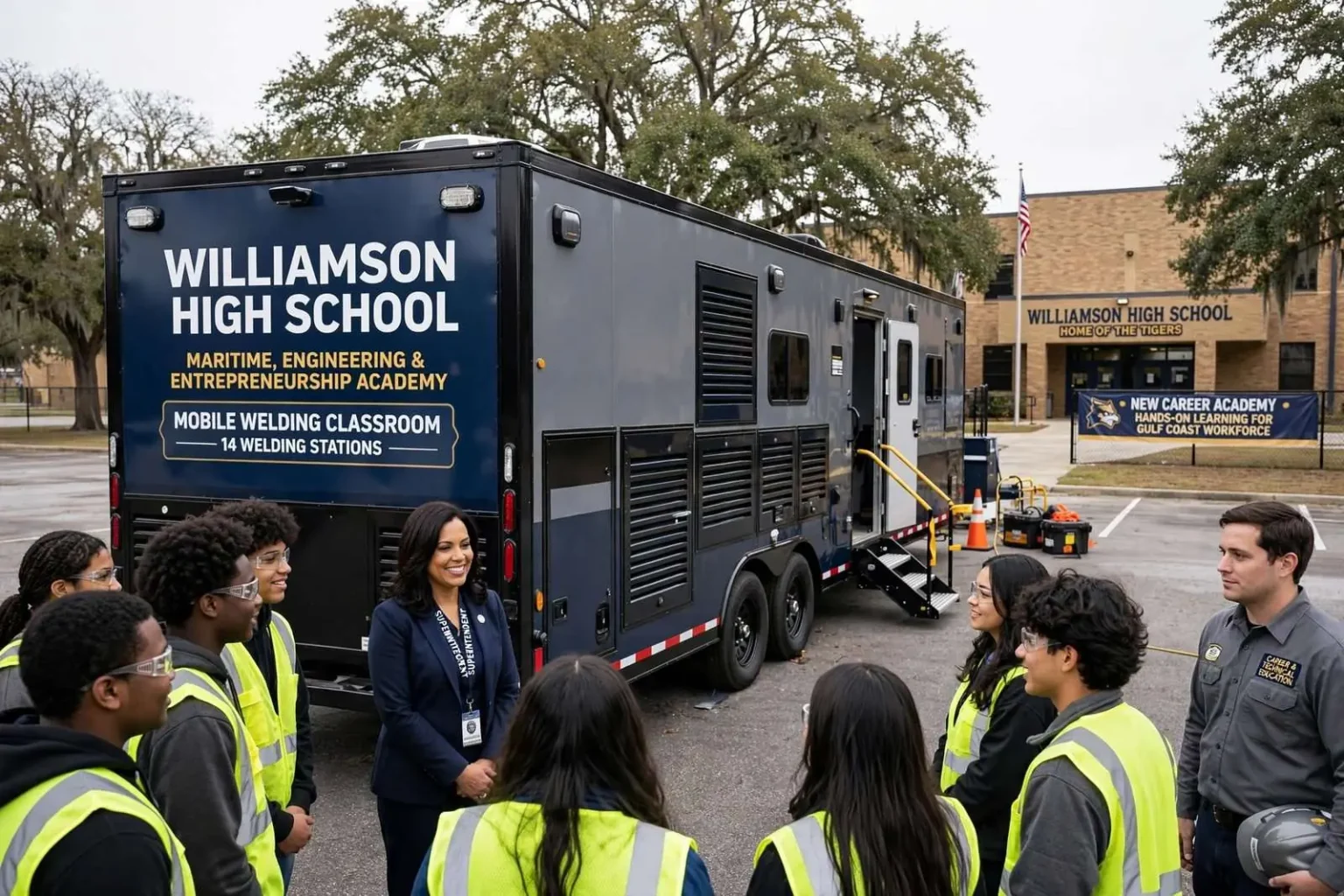
Williamson High School in Mobile has taken a major step toward launching a new career-training program, with a mobile welding classroom now parked on campus. The specialized trailer, outfitted with more than a dozen individual welding stations, gives students hands-on access to industry-standard equipment without the need for a permanent shop building, and it turns a long-planned academy idea into something students can walk into and use this school year.
The addition supports the school’s new Maritime, Engineering and Entrepreneurship signature academy, which opened its doors this past fall. The welding trailer is the academy’s most visible piece of equipment so far, and its arrival on campus marked the moment when the program moved from planning documents into actual instruction space.
Mobile County school officials secured roughly $555,000 in state funding for the effort nearly a year earlier, with plans to build out both a welding track and a culinary arts program under the academy’s umbrella. The funding covers equipment, outfitting and program development, giving Williamson a career-training footprint that few campuses its size could otherwise support.
The money came through a statewide push tied to the 21st Century Workforce Act, a $50 million effort approved by state lawmakers in 2012 to help Alabama school systems modernize classroom technology and equipment for career and technical courses. Mobile County was among the districts that applied for a share of the funding to expand vocational training options for high schoolers, and the Williamson award became one of the cornerstones of the district’s plans.
A rollout on wheels
Mobile classrooms have become a practical answer for districts that need specialized instruction space faster than construction timelines allow. A permanent welding shop requires architectural design, permitting and construction that can take years; a purpose-built trailer can be delivered, connected and put to work within months, and it can later be relocated if enrollment patterns or program needs shift.
The trailer features 14 separate welding booths, each a self-contained station where a student can work through joints, beads and certifications under an instructor’s eye. That configuration lets a full class section practice simultaneously — a significant advantage over shared-station setups, where students spend much of their lab time waiting for a turn.
School officials, students and community guests gathered on campus for a brief welcoming ceremony before touring the new trailer. For many of the students in attendance, the tour was their first look at the equipment they will use in coursework that could begin within weeks of the trailer’s arrival.
Superintendent Martha Peek said students are expected to begin formal welding coursework inside the unit in January. The January start aligns with the beginning of the spring semester, giving the academy a full term to work out scheduling, safety training and course sequencing before the program’s first full year.
What students will learn
The academy’s coursework is designed to expose students to a range of maritime-industry careers, including engineering, architecture, welding and engine repair — fields with strong demand along the Mobile County coastline. Program designers have emphasized breadth in the early years, letting students sample multiple pathways before settling into a concentration as upperclassmen.
Welding sits at the center of that menu for good reason. Skilled welders are consistently among the most sought-after tradespeople on the Gulf Coast, and fabrication shops, shipyards and industrial contractors across the region hire at wages well above typical entry-level work for graduates who arrive with demonstrated skills. Students who complete a high school welding track can enter apprenticeships, community college programs or the workforce directly, with a head start measured in hundreds of lab hours.
Several area employers and institutions have signed on as business partners for the program, among them Alabama Power, shipbuilder Austal, PNC Bank and the University of South Alabama’s Small Business Development Center. Those partnerships matter beyond their names: business partners advise on curriculum, host student visits, provide equipment and expertise, and give schools a direct pipeline for internships and first jobs.
Austal’s involvement is particularly pointed for a maritime academy. The shipbuilder’s Mobile River facility is one of the region’s largest industrial employers, and its production lines consume welding, fitting and electrical skills on a scale that has made workforce development a standing priority for the company. A high school program feeding that pipeline benefits both sides.
A districtwide strategy
Career academies like Williamson’s signature program have become an increasingly common tool for Mobile County Public Schools as officials look to connect classroom instruction more directly with regional job markets. The district has rolled out signature academies across its high schools, each anchored to industries with documented demand, from health care and teaching to engineering and maritime trades.
Officials have pointed to the maritime and shipbuilding sector in particular as an area where skilled local graduates could fill workforce gaps in the years ahead. The region’s industrial employers have repeatedly said that finding qualified tradespeople is among their biggest constraints on growth, and educators have responded by building programs that start students on that path while they are still in high school.
With the trailer now in place, the welding component of the academy is expected to be fully operational for the spring semester, giving Williamson students an early credential path into a trade that remains in demand across the Mobile Bay region. For a campus that has weathered its share of challenges over the years, the sight of 14 welding booths parked outside the school represents a concrete bet on its students’ futures — one funded by the state, staffed by the district, and backed by some of the biggest employers on the Gulf Coast.
The 21st Century Workforce Act’s reach
The state funding behind Williamson’s trailer traces back to a deliberate legislative bet on career and technical education. The 21st Century Workforce Act, passed in 2012, committed $50 million across Alabama school systems for the equipment and technology that modern career training requires — welding machines, machining centers, health science simulators, computer labs and the specialized infrastructure that goes with them.
Before the act, many Alabama high schools were teaching career courses with equipment a generation old, and districts that wanted modern labs had to fund them largely from local sources. The statewide program changed that calculus, letting systems compete for grants tied to specific program plans. Mobile County’s application for the Williamson funding fit squarely within that model: a named academy, a documented regional workforce need, and a specific equipment list.
The investment reflects a broader shift in how Alabama approaches high school education. State education leaders have spent years expanding career and technical education, dual enrollment with community colleges and industry credential opportunities, on the theory that a diploma should carry students somewhere — into work, into further training, or both. Welding programs, with their clear credential pathways and hiring demand, have been among the most visible beneficiaries statewide.
Why Williamson, why now
Williamson High School sits in the Toulminville area of north Mobile, a community with deep ties to the city’s maritime and industrial heritage. Many families there have generations of connection to the yards, docks and plants that line the Mobile River, and school leaders have framed the maritime academy as a way of turning that heritage into opportunity for current students.
The Maritime, Engineering and Entrepreneurship academy joins the district’s growing roster of signature programs, and its three-part name captures the range school officials envisioned: the technical skills to work on vessels and industrial systems, the engineering background to advance in those fields, and the entrepreneurial grounding to eventually build businesses of their own. The culinary arts track planned under the academy’s umbrella adds a service-industry pathway that rounds out the offerings.
Entrepreneurship has a practical angle as well. The University of South Alabama’s Small Business Development Center, one of the academy’s named partners, works with small business owners across the region, and its role with the academy points toward teaching students how trades skills can lead not just to jobs but to contracting businesses of their own — a path especially relevant in the region’s shipbuilding supply chain, where small firms perform much of the specialized work.
Measuring success
The real test of the trailer will come over the next several semesters: how many students enroll in welding courses, how many earn industry-recognized credentials, and how many leave Williamson with jobs, apprenticeships or further training already lined up. District officials have pointed to those outcomes as the metrics that matter for signature academies, and business partners typically track how many graduates they hire.
For the students who gathered to tour the 14 booths on ceremony day, the program offers something concrete: skills that translate directly into one of the Gulf Coast’s strongest hiring markets, learned on equipment that meets industry standards, at a public school within their own neighborhood. The welding coursework begins in January — and with it, the first Williamson students will strike arcs toward careers that the state’s $555,000 investment was designed to make possible.