Mobile County School Board Selects Contractor for New $25 Million Citronelle High
The Mobile County school board approved White-Spunner Construction to build the new $25 million Citronelle High School, set for completion in 2016.
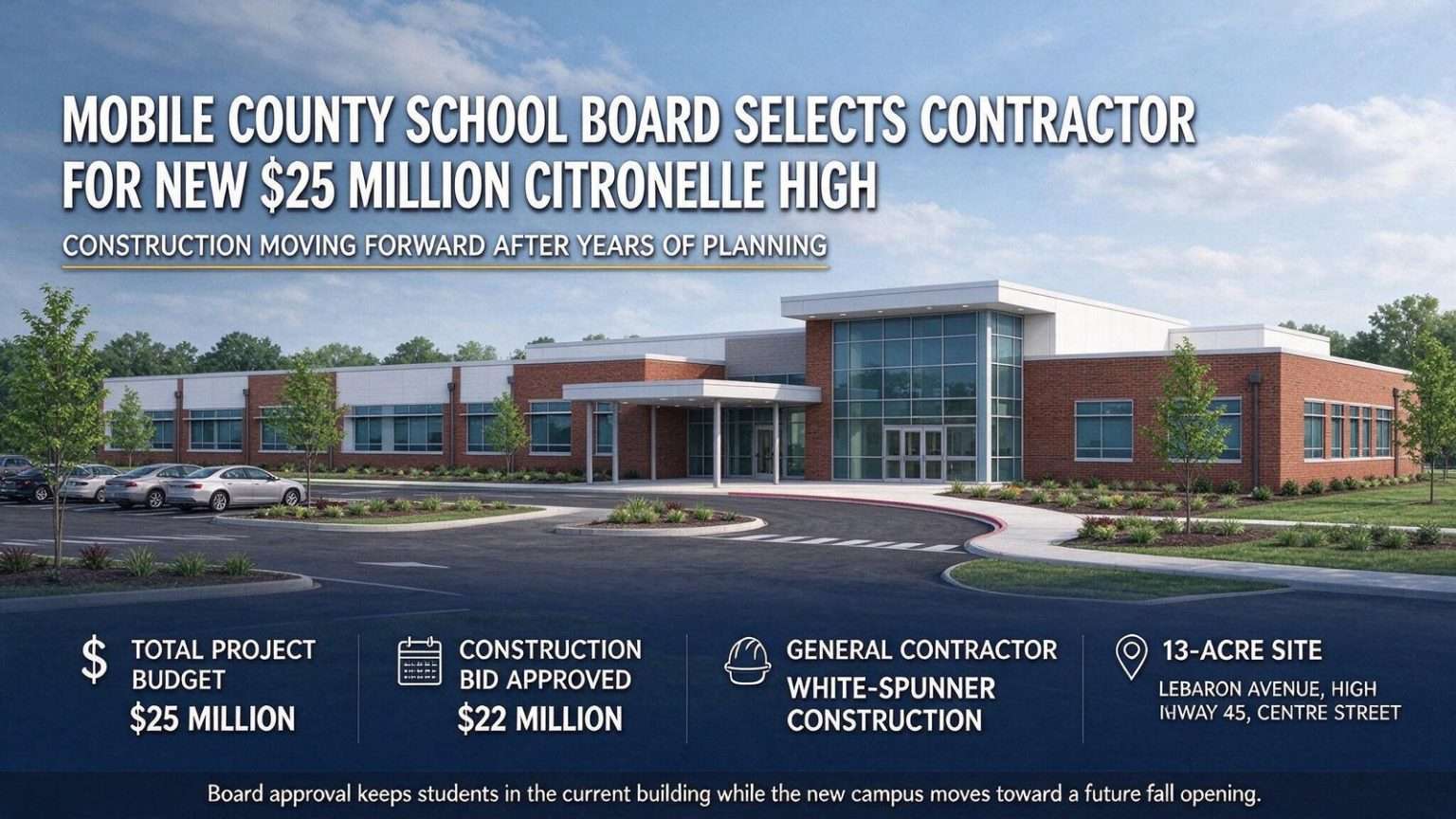
MOBILE, Alabama – The Mobile County school board has taken a major step toward replacing Citronelle High School, approving a $22 million construction bid that clears the way for groundbreaking on the long-planned new campus next month.
Board members selected White-Spunner Construction as general contractor after bids were opened on Dec. 16, with White-Spunner submitting the lowest of three proposals received. The construction bid represents the bulk of the project’s overall $25 million budget, which also covers site work, equipment and other associated costs.
Schools Superintendent Martha Peek called the vote a milestone for the district following the board’s Monday meeting, saying it was exciting to finally have a contractor in place and to see the project moving toward construction after years in the planning stages.
The new high school will rise on a 13-acre site directly across the street from the current Citronelle High School building, bordered by Lebaron Avenue, Highway 45 and Centre Street. Keeping the new campus near the existing one is intended to minimize disruption for students and staff during the construction period, since classes will continue at the current building until the new facility is ready.
Under the current timetable, construction is expected to wrap up by July 2016, positioning the new school to open in time for a future fall semester.
The project falls under the oversight of Hoar Program Management, the firm the school system selected to manage roughly $100 million in capital construction projects across Mobile County schools over a multiyear period.
The Citronelle project was not the only major construction item the board approved during Monday’s meeting. Board members also signed off on a $1.5 million bid from Rod Cooke Construction Inc. to build a new science and technology wing at Burns Middle School in west Mobile, along with a $5.6 million bid from Don Gordon Construction to fund renovations at Tanner Williams Elementary School.
Together, the approvals reflect a broader wave of capital investment underway across Mobile County Public Schools, as the district works through a multiyear list of new construction and renovation projects aimed at replacing aging facilities and expanding capacity at schools throughout the county, from the northern Citronelle community to west Mobile campuses.
District officials have not yet announced specific groundbreaking ceremony details for the new Citronelle High School, though construction activity is expected to begin at the site in the coming weeks.
A long-awaited replacement
The push to replace Citronelle High School has been years in the making, and residents of the community have watched the project move through feasibility discussions, planning and design phases before ever reaching the bid stage. For a town perched near the northern edge of Mobile County, the high school is more than a collection of classrooms; it is a gathering point for a rural community whose students otherwise travel long distances for most other activities.
Decades of use take a predictable toll on school buildings, and districts across the Gulf Coast have grappled with the same question Mobile County officials faced in Citronelle: whether to keep patching an aging structure or invest in a modern replacement. The board’s answer was to build new, on land close enough to the old campus that the transition between buildings will be short.
That adjacency carries practical benefits beyond convenience. Students will continue attending classes in the existing building while construction proceeds across the street, eliminating the need for portable classrooms or split schedules at other campuses, and utilities and access roads can be shared between the sites during the build.
The contractor and the bid process
White-Spunner Construction emerged from a competitive field, submitting the lowest of the three bids the district received when proposals were opened on Dec. 16. Competitive bidding of this kind is designed to protect public dollars, ensuring that a project funded by taxpayers is awarded to the qualified firm offering the best price.
The Mobile-based firm now takes on one of the largest single school construction projects in the county’s current building program. As general contractor, it will coordinate the site work, subcontractors, inspections and scheduling needed to carry the new campus from groundbreaking to a finished building within roughly two years.
The $22 million construction bid sits within the project’s overall $25 million budget, with the remainder reserved for site work, equipment and other associated costs that come with standing up a complete high school campus, from furniture and technology to the infrastructure that connects the buildings to the surrounding streets.
Oversight across a $100 million building program
The Citronelle campus is one piece of a much larger picture. Hoar Program Management, the firm the school system selected to manage roughly $100 million in capital construction projects across the county, will shepherd the project from design through completion, providing the professional oversight that keeps large public builds on budget and on schedule.
Program management of this kind has become the standard approach for districts undertaking many projects at once. Rather than asking school administrators to supervise contractors directly, the district relies on a dedicated firm to coordinate budgets, change orders, inspections and timelines across the entire portfolio of work, from small renovations to full replacements like Citronelle’s.
For taxpayers, that structure provides a measure of accountability. Each project’s spending is tracked against its approved budget, and the program manager reports progress back to board members, who answer to the public for how the money is used.
Other projects approved the same night
The Citronelle award anchored a busy agenda for the board’s Monday meeting. The $1.5 million bid from Rod Cooke Construction Inc. will build a new science and technology wing at Burns Middle School in west Mobile, adding modern lab and instructional space at a campus serving one of the county’s fastest-growing suburban corridors.
Board members also approved a $5.6 million bid from Don Gordon Construction to fund renovations at Tanner Williams Elementary School, another west Mobile-area campus. Renovation work of that scale typically touches classrooms, mechanical systems and common areas, extending the useful life of a building that serves a community whose population has grown considerably in recent years.
Taken together, the three approvals show the district’s capital program reaching into every corner of Mobile County, from the rural north to the western suburbs. Each project addresses a different need, but the common thread is a district working through a backlog of aging buildings while student populations shift across the county.
What comes next for Citronelle
With a contractor under contract and a timetable targeting completion by July 2016, attention in Citronelle now shifts to the ground itself. Construction activity is expected to begin at the 13-acre site in the coming weeks, though district officials have not yet announced the details of a formal groundbreaking ceremony.
For students, the more meaningful milestone will arrive with the new school’s opening for a future fall semester. When the doors open, the community will trade a building shaped by decades of wear for a campus designed around how schools operate today, with room to grow as the community does.
For now, classes continue as they have all along, in the current building across Lebaron Avenue from the work site, while one of the county’s most anticipated school projects finally moves from plans on paper to machines on the ground.
What the new campus means for students
For the students who will eventually walk its halls, the difference between the old building and the new one will show up in the details. Modern high schools are designed around technology-driven instruction, with networked classrooms, dedicated laboratory space and flexible areas that can be reconfigured for group work, all of which are difficult to retrofit into buildings constructed generations ago.
Safety and accessibility standards have also advanced considerably since the current campus was built. New construction brings the campus up to current codes for fire protection, accessibility and traffic flow, and allows designers to plan student arrival and dismissal around the realities of Highway 45 traffic rather than adapting to a layout inherited from another era.
The July 2016 completion target, if met, gives the district a narrow window between the end of one school year and the start of the next to move furniture, equipment and materials across the street, train staff on the new systems and prepare the building for its first students.
A boost for the wider community
School construction projects of this size ripple beyond the classroom. A $25 million build brings dozens of construction jobs to northern Mobile County, directs spending to local suppliers and subcontractors, and puts activity at a site that sits along one of the community’s main corridors.
A modern high school also plays a role in the community’s long-term prospects. Families considering a move to the area routinely weigh the quality and condition of local schools, and a new campus gives Citronelle an asset that neighboring communities can only build through years of effort. Local officials have long viewed investment in rural schools as a way of signaling that growth and opportunity are not limited to the county’s suburbs.
The existing building’s fate after the new school opens will be decided later in the process, but communities across Alabama have found second lives for retired school buildings, from civic centers to community offices, and those conversations typically follow once students have moved out.
For now, the milestone that matters most to Citronelle residents is a simple one: after years of planning, the project has a contractor, a budget, a timetable and a site. Groundbreaking next month will mark the first visible sign of the new campus, and the months that follow will gradually transform the 13 acres across Lebaron Avenue from vacant land into the community’s next high school.