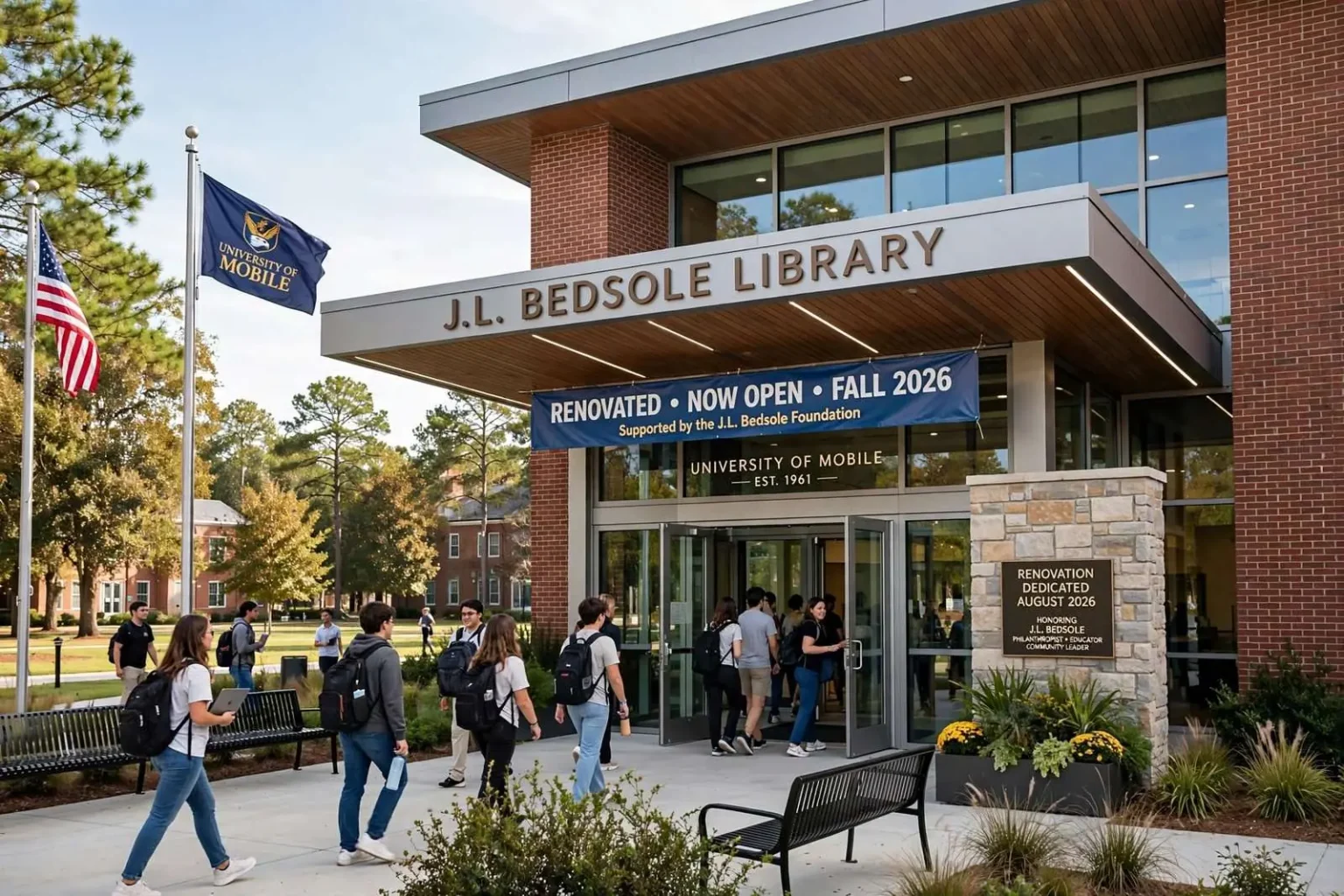
MOBILE, Ala. — The University of Mobile has unveiled its renovated J.L. Bedsole Library, giving students a refreshed central hub for study and research as the fall semester gets underway.
The private university, founded in 1961 and located in west Mobile, counts the J.L. Bedsole Library among its most recognizable campus buildings. The library bears the name of J.L. Bedsole, a Mobile businessman and philanthropist whose family’s foundation has long supported education and youth causes across the region.
A New Look for a Campus Landmark
Details of the renovation were highlighted as the university showed off the updated space this week. Like academic libraries across the country, the facility’s transformation reflects how college libraries have evolved from quiet book warehouses into multipurpose learning environments that blend collections, technology and collaborative space.
The timing matters as much as the paint. Campuses across Alabama open their fall terms in late August, and a revamped library lands at the moment when new students are forming the study habits — and favorite study spots — that will carry them through four years of coursework. For upperclassmen, the renovated building offers a familiar landmark with a new feel.
Why Campus Libraries Still Matter
Even in an era when nearly every journal article is a click away, university libraries remain among the busiest buildings on campus. They provide quiet zones for focused work, group rooms for team projects, access to research databases and librarians who can help students separate credible sources from the rest of the internet.
For a university of Mobile’s size, the library also serves an outsize community role: education students, nursing majors cramming for exams, and student-athletes balancing travel schedules all rely on flexible hours and accessible resources that a modernized facility is better equipped to provide.
Part of a Broader Campus Investment
The unveiling adds to a stretch of visible investment at the university, which has worked in recent years to update facilities as part of its recruitment pitch to prospective students across the Gulf Coast. Facility upgrades — dormitories, athletic venues and academic buildings alike — have become a competitive necessity for private colleges in a region crowded with public universities and community colleges.
The University of Mobile enrolls students from across Alabama and the Southeast and fields teams in the NAIA, but its academic core remains anchored by institutions like the Bedsole Library, where research instruction and information literacy are woven into the curriculum.
Students and faculty can now make use of the renovated space as the fall 2026 term settles in, with the university presenting the project as an investment in the daily academic life of the campus rather than a single ribbon-cutting moment.
A College Rooted in Mobile’s Baptist Heritage
The University of Mobile traces its roots to 1961, when the Alabama Baptist State Convention chartered the school as Mobile College on a wooded campus off Cottage Hill Road in west Mobile. The college grew steadily through the 1960s and 1970s, adding academic programs and residence halls as enrollment climbed, and in 1993 the institution was renamed the University of Mobile to reflect its expanded mission and university-level course offerings, including graduate programs in nursing, business and Christian ministry. Today the university describes itself as a private Christian institution serving several thousand students, with an academic structure built around colleges of arts and sciences, business, education, nursing and Christian ministry. The Bedsole Library has functioned as the intellectual center of that campus for decades, the building most students pass through repeatedly during a four-year degree, whether for reserved textbooks, group study rooms or access to databases their coursework requires.
The Bedsole Name in Mobile Philanthropy
J.L. Bedsole was a longtime Mobile businessman whose name appears on buildings, scholarships and civic institutions throughout the region, a legacy carried forward by the philanthropic foundation established in his honor. Foundations of this kind are common fixtures in mid-sized Southern cities, where a handful of family or corporate foundations often provide the seed money that public budgets and tuition revenue alone cannot cover — funding everything from hospital wings to youth sports complexes to, as in this case, university library renovations. For a private university like Mobile, which does not have access to state capital-improvement appropriations the way public institutions such as the University of South Alabama sometimes do, philanthropic support of this kind is often the difference between a library that slowly ages in place and one that gets reimagined for how students actually study today.
How Academic Libraries Have Changed
The renovation fits a pattern playing out on campuses nationwide. Twenty years ago, a university library renovation typically meant new carpet, more shelving and perhaps expanded hours. Today it more often means something closer to a rebuild of the building’s purpose. Print collections have shrunk as journal subscriptions and reference materials move online, freeing up square footage that libraries have redirected toward group study rooms, presentation-practice spaces, writing centers, tutoring services and technology bars where students can check out laptops, cameras or specialized software licenses. Many academic libraries have adopted the “learning commons” model, physically merging the library with tutoring, writing assistance and information-technology help desks so that students facing a research paper deadline can get research guidance, citation help and technical support without leaving the building. Quiet, book-lined reading rooms haven’t disappeared, but they now typically coexist with brighter, louder collaborative zones designed for the kind of team-based coursework that has become standard in business, nursing and education programs.
The shift also reflects how students search for information. A student in 1995 had little choice but to walk into the library to find a journal article; a student today can often find one from a dorm room, which means the physical library increasingly has to earn foot traffic by offering something a laptop and Wi-Fi connection cannot — quiet focus away from distractions, access to librarians trained in navigating subscription databases, and space built specifically for collaboration rather than improvised around it.
Libraries and Accreditation
There is also a less visible reason libraries remain a priority for university administrators: accreditation. The University of Mobile, like other regionally accredited colleges in the state, is evaluated periodically by the Southern Association of Colleges and Schools Commission on Colleges, which examines whether an institution provides students with adequate learning resources, including library services, staffing and access to research materials appropriate to the degree programs offered. A library that has fallen behind peer institutions — in technology, seating capacity or database access — can become a liability during an accreditation review, giving administrators another incentive, beyond recruitment and campus pride, to keep the building current. Nursing and education programs in particular often carry their own specialized accrediting requirements that reference library and research resources as part of demonstrating program quality, adding another layer of pressure to keep facilities like Bedsole Library modern.
Competing for Students on the Gulf Coast
Mobile’s higher-education landscape includes the University of South Alabama, a public research university, alongside smaller private institutions such as Spring Hill College and the University of Mobile itself. In a region where public universities can often offer lower tuition, private colleges frequently compete on smaller class sizes, a defined campus identity and visible investment in student-facing facilities — dormitories, athletic complexes, dining halls and, as with this project, libraries. Prospective students and their families touring campuses during the spring and summer before enrollment routinely cite the library as one of the buildings that shapes their impression of a school, alongside residence halls and student centers, because it signals how seriously an institution invests in the day-to-day academic experience rather than just admissions marketing. For a tuition-dependent private university, a renovated library functions simultaneously as an academic resource and a recruitment tool, one more reason administrations across the country have prioritized these projects even in years when other capital spending gets deferred.
As the fall 2026 semester unfolds, the renovated Bedsole Library gives University of Mobile students a facility better aligned with how research, group work and independent study actually happen on a modern campus — a shift years in the making that mirrors what has occurred at college libraries throughout Alabama and across the country.
What Renovation Projects Typically Involve
Library renovation projects at universities the size of Mobile generally unfold in phases rather than as a single closure-and-reopening event, since few institutions can afford to take a central academic building fully offline for an extended period during the school year. A common approach is to renovate in sections — reworking one floor or wing while keeping core services such as circulation, reserve materials and computer access running elsewhere in the building — then rotating construction to the next area once a section is complete. Planning typically starts with a needs assessment that surveys students and faculty about how they actually use the space, followed by architectural design phases that account for electrical and data infrastructure upgrades needed to support modern technology, updated HVAC and lighting systems, and accessibility improvements required under the Americans with Disabilities Act. Furniture selection has become its own significant piece of these projects, as libraries increasingly favor modular, moveable seating that can be reconfigured for a large study group one day and quiet individual work the next, replacing the fixed carrels and long reading tables that defined library design for much of the twentieth century.
Funding for these projects at private universities typically comes from a mix of sources: designated capital campaign gifts, as appears to be the case with the Bedsole family’s long association with the university, combined with general institutional reserves and sometimes debt financing repaid over time through the operating budget. Because a library renovation delivers a highly visible, photogenic result that donors and prospective students can immediately appreciate, these projects are often among the easier capital priorities for university advancement offices to raise money for, compared to less visible needs like deferred maintenance on utility systems or classroom HVAC replacement.