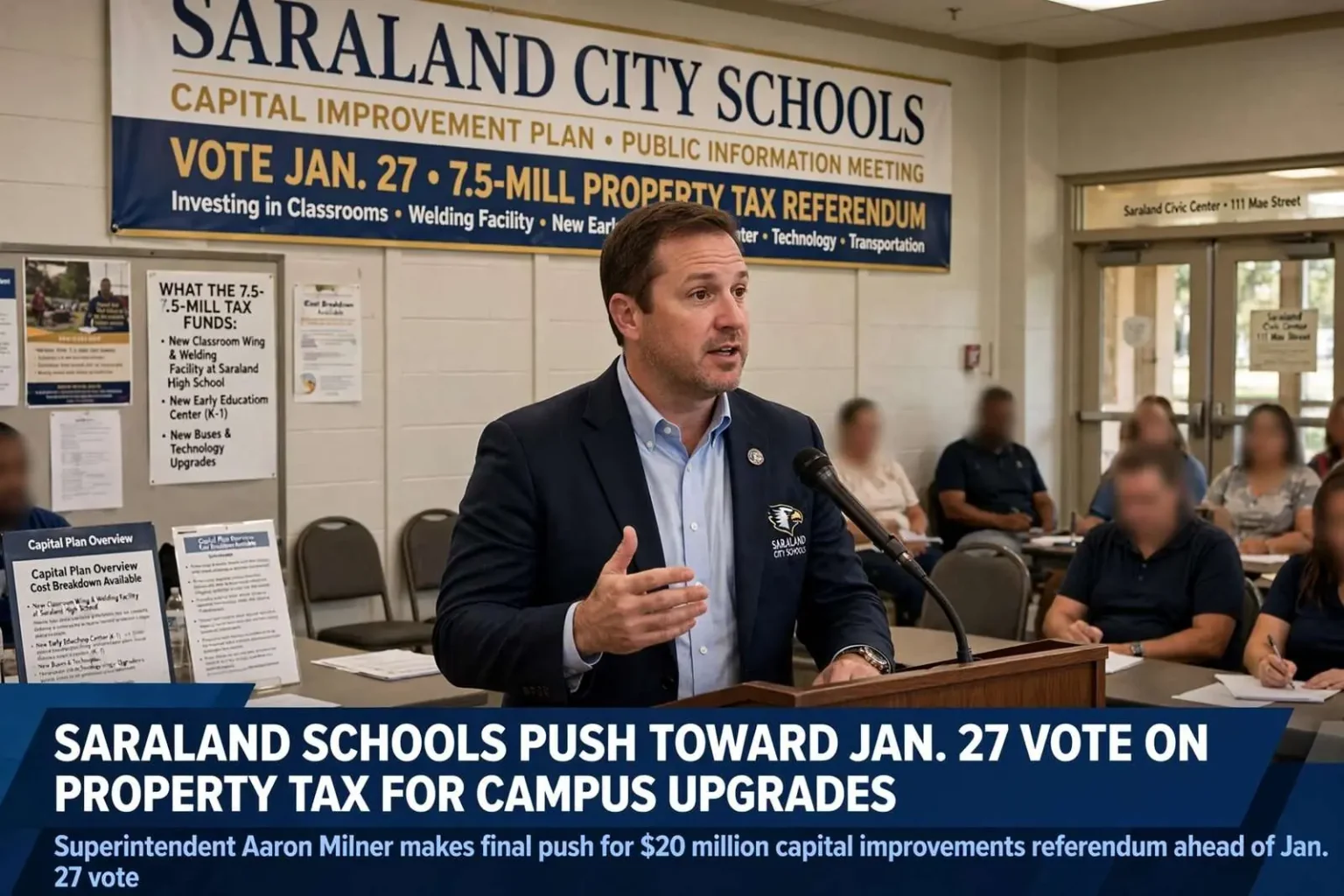
With just over two weeks remaining before a pivotal vote, Saraland City Schools Superintendent Aaron Milner is making his case directly to voters. Milner planned a third public presentation on the district’s capital improvement plan, part of an ongoing push to build support ahead of a Jan. 27 property tax referendum. The final stretch of a school tax campaign is where elections of this kind are usually decided, and district officials have treated every public meeting in the run-up as a chance to answer questions face to face rather than leave the plan to be interpreted through secondhand summaries.
Registered voters in Saraland will decide whether to approve a 7.5-mill property tax increase intended to fund a roughly $20 million package of upgrades across the school system. A mill is one dollar of tax for every thousand dollars of assessed property value, and a 7.5-mill levy translates into a measurable annual cost for homeowners weighed against a building program that touches nearly every school in the district. Election-day referenda of this type draw turnout far below general elections, which makes each public presentation — and each voter persuaded to show up — disproportionately important.
The informational meeting was scheduled for 6:30 p.m. at the Saraland Civic Center on Mae Street, giving residents a chance to ask questions before heading to the polls. The civic center setting keeps the sessions close to the city’s residential core, and the evening hour is designed to reach the working parents whose children would fill the new classrooms the plan promises. District officials have used the sessions to walk through the capital plan line by line and to take unscripted questions from the floor.
“So far, we’ve had an overwhelmingly positive response,” Milner said in the days leading up to the meeting. “We know we’re in the home stretch.” The superintendent’s confidence reflects a campaign built on months of groundwork — public presentations, school-based communications and the district’s record of academic performance — rather than a late rush of advertising. But tax referenda in Alabama are rarely won on enthusiasm alone, and the district’s leadership knows the final two weeks are where voters who have been listening finally decide.
What the tax would fund
If approved, the tax increase would be earmarked specifically for capital improvements, technology and transportation costs, according to district officials. The earmarking matters in school tax campaigns: voters are consistently more willing to approve new revenue when it is legally directed to buildings, buses and classroom technology rather than absorbed into an operating budget. The restriction also gives the district a clear accountability standard — the money can be spent on the plan presented to voters, or not spent at all.
Milner said the first priority, should voters approve the measure, would be adding a new classroom wing and a welding facility at Saraland High School. The welding program answers one of the Gulf Coast economy’s loudest signals: industrial employers across the region, from shipyards to fabrication shops, have struggled to hire skilled welders, and schools that train them can place graduates into well-paying work without a four-year degree. Pairing the new wing with a dedicated welding facility ties the district’s building program directly to its career education push.
The broader plan also calls for expanding the high school, building a new early education center for kindergarten and first grade students, purchasing new buses and upgrading technology systemwide. The early education center addresses the enrollment pressure working its way up from Saraland’s growth in new housing, while the bus purchases and technology upgrades touch every school — a deliberate balance that gives voters in every part of the city a stake in the plan’s passage.
Built on community feedback
District leaders say the proposed classroom expansion responds directly to community feedback. When Saraland officials sought public input while developing their strategic plan, one of the most frequent requests was to grow the district’s career and technical education offerings. Parents and business leaders alike have pressed the district to prepare students for the region’s industrial workforce, and the strategic plan’s emphasis on career pathways grew out of that input rather than preceding it.
The high school’s new health science program has already drawn 75 students, and the system recently added robotics programs at both the middle and high school levels. Health science has become one of the most popular career tracks in Alabama high schools, feeding students toward nursing, emergency medicine and allied health fields that anchor the Gulf Coast’s growing healthcare sector. Robotics, meanwhile, gives the district a STEM pipeline that starts in middle school — the same engineering skills area employers along the Interstate 10 corridor continue to demand.
The referendum comes as Saraland schools have been highlighting academic achievements alongside the funding push. The district recently recognized more than a dozen Advanced Placement scholars, along with teachers honored for their work at the elementary, middle and high school levels, underscoring the case that further investment could build on recent momentum. The pairing is deliberate: districts that ask voters for money generally fare better when the request arrives alongside evidence that the existing investment is already producing results.
Saraland’s city schools were founded on exactly that kind of community commitment, created after residents voted to separate from the Mobile County system and the city committed its own resources to building a standalone district. The Jan. 27 referendum asks for a second generation of that investment, and district officials have framed the vote in those terms — not as a new tax for a new idea, but as the continuation of a civic project the community chose for itself a decade ago.
The final stretch
School officials are encouraging Saraland residents to attend the informational session and to review the capital plan online through the district’s website before casting their ballots on Jan. 27. The district has posted the plan’s project list and cost breakdown for public review, an effort to keep the campaign’s claims anchored to documents voters can read for themselves.
Turnout is the variable district officials watch most closely. Referenda decided by a few hundred votes are common in Alabama school tax elections, and the difference between passage and defeat often comes down to whether a district’s natural supporters — parents, school employees and the families tied to the schools — actually vote on a late-January election day with nothing else on the ballot.
For the district, the stakes are concrete: a $20 million building program that would add classrooms at the high school, relieve elementary crowding with a new early education center, modernize transportation and technology, and build the welding facility the region’s employers keep asking for. For Saraland’s voters, the question on Jan. 27 is simpler and older — whether the schools that have grown up with the city should grow a little further, at a cost measured in mills and paid by the community that chose its own school system in the first place.
The 7.5-mill figure gives Saraland homeowners a concrete number to weigh. In practical terms, a mill is $1 in tax for every $1,000 of assessed value, and Alabama assesses owner-occupied homes at 10 percent of market value — so the annual cost for a typical household is a modest but visible addition to the property tax bill, one the district has presented alongside the $20 million in projects it funds. School officials have encouraged residents to run those numbers for their own homes before election day, reasoning that voters who understand the cost are more likely to support the measure than voters who fear it.
The welding facility’s prominence in the plan tracks with a regional labor reality. Along the Gulf Coast, industrial employers have spent years competing for certified welders, pipefitters and industrial maintenance workers, and the shipbuilding and fabrication sectors around Mobile Bay have repeatedly identified skilled-trades shortages as their top constraint on growth. A high school welding program that produces job-ready graduates gives Saraland’s students a direct line into that market — and gives the district’s career education push a flagship that employers themselves have asked for.
The proposed early education center reflects the same demographic math. New subdivisions continue to push Saraland’s enrollment upward from the bottom grades, and a district that waits until kindergarten classrooms overflow to respond builds its additions two years too late. A dedicated center for kindergarten and first grade concentrates the district’s earliest learners in one purpose-built facility, freeing space across the existing elementary campuses and smoothing the transitions that follow as those classes move up through the system.
The technology and transportation lines in the plan, while less visible than new construction, touch every student daily. Bus fleets age on fixed schedules, and deferred replacement costs compound quickly; classroom technology, likewise, is now core infrastructure rather than an accessory. By including both in the referendum package, the district positioned the vote as an investment in the whole system’s operation rather than a construction project for one or two schools.
And the academic record the district has publicized during the campaign — the AP scholars, the honored teachers, the new health science and robotics programs — serves a purpose beyond celebration. Every school tax campaign asks voters to extend trust, and Saraland’s officials have made the case that their district has already converted community investment into measurable results. On Jan. 27, voters will decide whether that record justifies the next round of it.