Byrne Opposes Gas Tax Hike as Mobile Bay Bridge Funding Looms
Rep. Bradley Byrne opposed a federal gas tax hike even as funding questions loom over the proposed new I-10 bridge crossing Mobile Bay near Mobile.
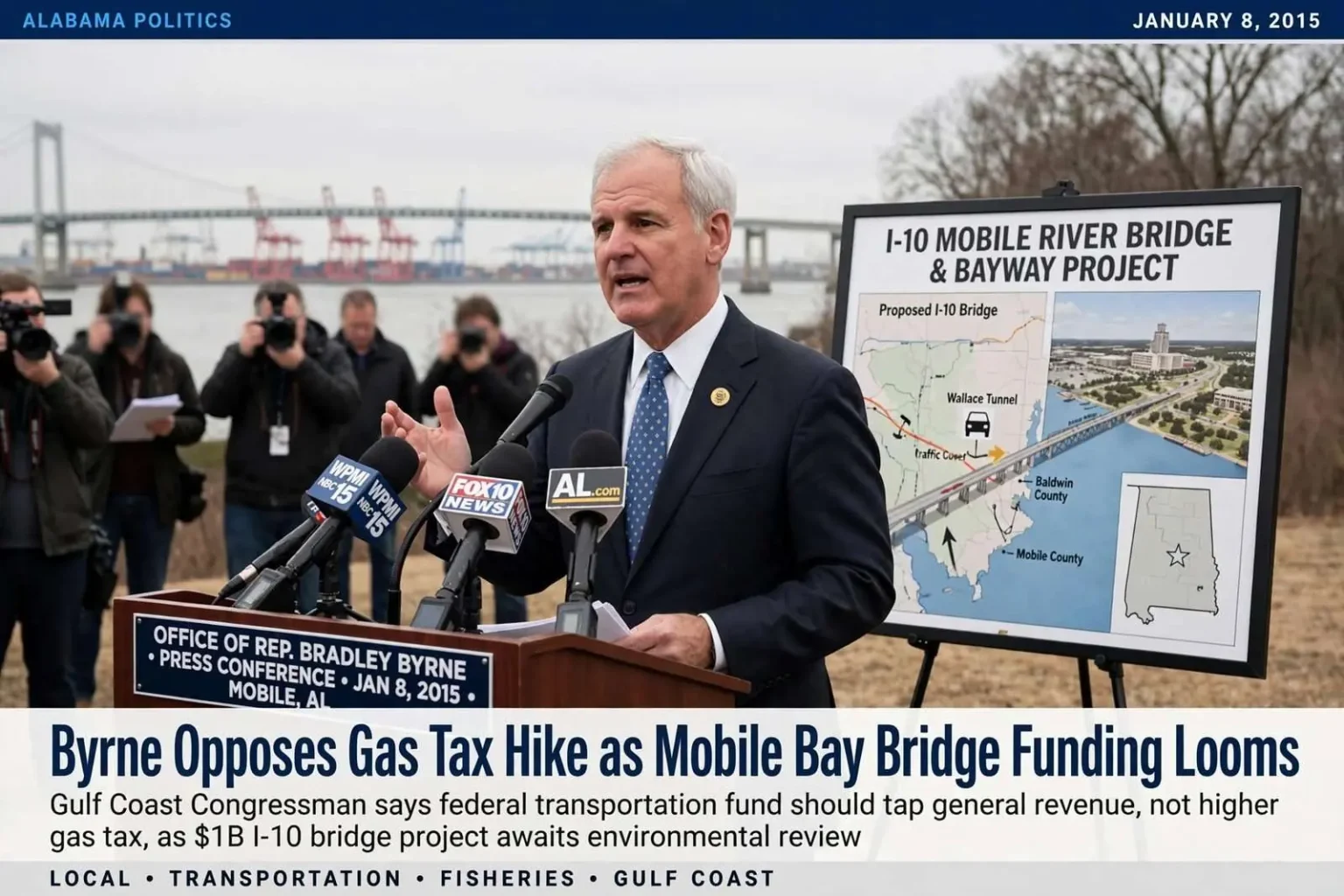
U.S. Rep. Bradley Byrne, R-Fairhope, used a conference call with reporters in early January 2015 to lay out his opposition to raising the federal gas tax as a way to shore up the nation’s transportation fund, arguing the money should instead come from general government revenue. The position put him at odds with a growing group in Congress that has floated an increase in the per-gallon levy, and it carried direct weight for Mobile and Baldwin counties, where planning was underway for a proposed new Interstate 10 bridge over the Mobile River and an expanded Bayway meant to relieve the chronic gridlock that backs up through the Wallace Tunnel.
The I-10 crossing has been one of the most consequential transportation questions on the Gulf Coast for years. The current route funnels interstate traffic through downtown Mobile and across Mobile Bay on a corridor never designed to carry modern freight volumes, and the combination of the Bankhead and Wallace tunnels produces backups that residents and truckers alike have come to regard as a daily tax on time. A new bridge over the Mobile River, paired with improvements to the Bayway stretch, is the remedy state and federal planners have coalesced around, and Byrne’s support for the project’s funding has been a consistent theme of his tenure in the House.
Byrne said he expected the U.S. Secretary of Transportation to visit Mobile early in the year to see the bottleneck firsthand, a visit that local officials hoped would reinforce the project’s case within the Department of Transportation. He also noted that the Alabama Department of Transportation was working toward completing a final environmental review of the bridge project sometime during the year, the regulatory milestone that moves a project from study toward design and construction. Environmental review is often the longest and least visible phase of a major highway project, and its completion would mark a genuine step forward.
A Trust Fund Running Short
With a price tag approaching $1 billion, the bridge project would rely heavily on federal Highway Trust Fund dollars, along with other regional priorities such as a widening of U.S. Highway 45. That trust fund, however, is fed by gas tax collections that have been shrinking as vehicles become more fuel efficient, prompting some in Congress to consider raising the per-gallon tax for the first time since the early 1990s. Every mile a car travels on less fuel means less revenue for the same wear on the roads, and Congress has repeatedly patched the gap with short-term transfers rather than a structural fix.
Byrne said he would rather see transportation funded out of general revenue, arguing Congress could find sufficient savings elsewhere in the federal budget without touching drivers’ wallets further. The argument reflects a broader Republican skepticism about tax increases, but it also reflects the particular economics of his district: Baldwin and Mobile counties are dominated by car-dependent commutes, port freight and tourism traffic, and any rise at the pump lands directly on constituents who already feel the cost of the region’s growth. Funding roads from the general fund, in his view, spreads the burden across all taxpayers rather than concentrating it on drivers.
For local leaders, the debate in Washington is not academic. Without a reauthorized and solvent trust fund, large projects like the I-10 bridge compete for a shrinking pool of federal money, and delays at the federal level ripple into state construction schedules. Byrne’s early-January call was in part an effort to reassure constituents that he understood the stakes and intended to keep the project in front of federal decision-makers as the year’s funding fights unfolded.
Fighting Over Red Snapper
Byrne also addressed several other matters important to the Gulf Coast during the call. He reiterated his criticism of federal fisheries regulators over red snapper season limits, saying population estimates used to set increasingly short seasons undercount the true number of fish in the Gulf of Mexico. Anglers and charter boat operators across the Alabama Gulf Coast have made the same argument for years, watching what they describe as abundant snapper populations paired with federal seasons that have contracted from months to a matter of days.
The dispute is fundamentally about data and jurisdiction. Federal managers set seasons using stock assessments that attempt to count fish across the entire Gulf, and when those assessments indicate pressure on the population, the recreational season bears the adjustment. Gulf Coast fishermen and their representatives in Congress have long contended that the assessments miss what is plainly visible to anyone dropping a line near an artificial reef, and Alabama’s extensive artificial reef program has made the state a focal point for the disagreement.
Byrne pointed to legislation from a fellow Gulf Coast congressman that would shift fisheries management authority from Washington back to the states, an approach favored by officials in Alabama, Mississippi, Louisiana, Texas and Florida who argue they can manage nearshore stocks responsibly. He said he had offered an amendment to a Gulf fisheries reauthorization bill that would let states manage waters closer to shore, effectively drawing a line between federal offshore management and state control nearer the coast. The proposals are part of a sustained regional effort to rewrite the federal law governing marine fisheries in ways that return day-to-day decisions to the states.
What the Visit Could Mean
Both threads of the call — transportation funding and fisheries management — trace back to the same underlying reality: southwest Alabama’s economy runs on infrastructure and natural resources controlled by federal agencies, and the region’s representatives spend much of their energy trying to move those agencies. A Cabinet secretary walking the Wallace Tunnel corridor at rush hour, or seeing the charter fleet in Orange Beach, gives local arguments a concreteness that position papers cannot.
The environmental review ALDOT was completing during the year would set the stage for the next round of decisions on the bridge, including alignment details, cost estimates and the eventual question of how a roughly $1 billion project would be split among federal, state and possibly toll-backed funding. Byrne’s refusal to support a gas tax increase shaped that conversation: if the federal funding pool is not going to grow, Alabama’s share of the project depends more heavily on formula allocations, discretionary grants and state commitment.
On fisheries, the amendment and the broader state-management legislation faced an uncertain path through Congress, but the issue had already moved decisively into the national debate, with Gulf delegations united and allies in other coastal regions watching closely. For Byrne, whose district stretches across both the port city and the beach communities, the early-January call compressed the region’s two biggest federal policy battles into a single message: the Gulf Coast wants its roads funded and its fish managed closer to home.
The Politics of a Per-Gallon Tax
The federal gas tax has stood at 18.4 cents per gallon since the early 1990s, and the erosion of its purchasing power is the arithmetic problem at the heart of the debate Byrne weighed in on. Inflation has cut the real value of the levy roughly in half since it was last set, while fleet-wide fuel economy has steadily improved, meaning each vehicle on the road generates less revenue per mile than it did a generation ago. The Highway Trust Fund has repeatedly neared insolvency, surviving on a series of congressional transfers from the general fund — a fact Byrne used to argue that general-revenue funding was already the de facto practice, and that making it explicit was cleaner than raising the tax.
Critics of the general-fund approach counter that it subjects transportation spending to the annual appropriations fight and breaks the user-pays principle that has historically governed highway finance, in which those who drive on the roads are those who pay for them. Supporters of Byrne’s position answer that the user-pays link was already broken by fuel economy, and that electric and hybrid vehicles contribute almost nothing at the pump no matter how many miles they travel. Alternative approaches such as vehicle-miles-traveled fees have been studied for years but remain politically and practically difficult to implement on a national scale.
For the Gulf Coast, the stakes of that abstract debate are concrete. The I-10 Mobile River bridge and Bayway project ranks among the largest single transportation undertakings in Alabama’s history, and no realistic state-only funding package could carry it alone. How Congress resolves the trust fund question in the sessions ahead would do much to determine whether the project moves on the timeline local officials envision or stretches into a much longer wait.
A District Shaped by Both Issues
Byrne’s district ties the two topics of the call together geographically. The same First District that ends at the Wallace Tunnel on one side reaches the charter docks and reef fishing grounds of the Gulf on the other, and the constituents most affected by bridge traffic — commuters crossing the Bay daily, truckers moving port freight, tourists funneling to the beaches in summer — are often the same people who fish red snapper in the fall. That overlap is why the congressman’s quarterly calls with reporters tend to blend the two subjects, and why advocates in both camps watch Washington budget and fisheries debates with equal attention.
The planned visit by the U.S. Secretary of Transportation fit into a familiar pattern of federal officials being brought to the region to see its needs directly. Previous administrations had sent transportation leaders to the Gulf Coast to view the tunnel bottleneck, and each visit has been used by local officials to argue that the corridor’s problems are national ones — the interstate carries freight connecting the port to the rest of the country, and delays there ripple through supply chains far beyond Mobile County.
As the year began, the pieces were in motion: ALDOT working toward a final environmental review, a Cabinet-level visit being arranged, a funding debate forming in Congress, and a fisheries fight headed for another round of reauthorization maneuvering. Byrne’s early-January message to constituents was that he intended to be part of each of those conversations, and that his answer on how to pay for the roads — general revenue rather than a higher gas tax — would remain unchanged as the debate intensified.