Robertsdale Native Tim Cook’s Voice Featured in Historic First iPhone Keynote
Long before leading Apple, Robertsdale native Tim Cook lent his voice to a memorable moment during the company's historic first iPhone unveiling.
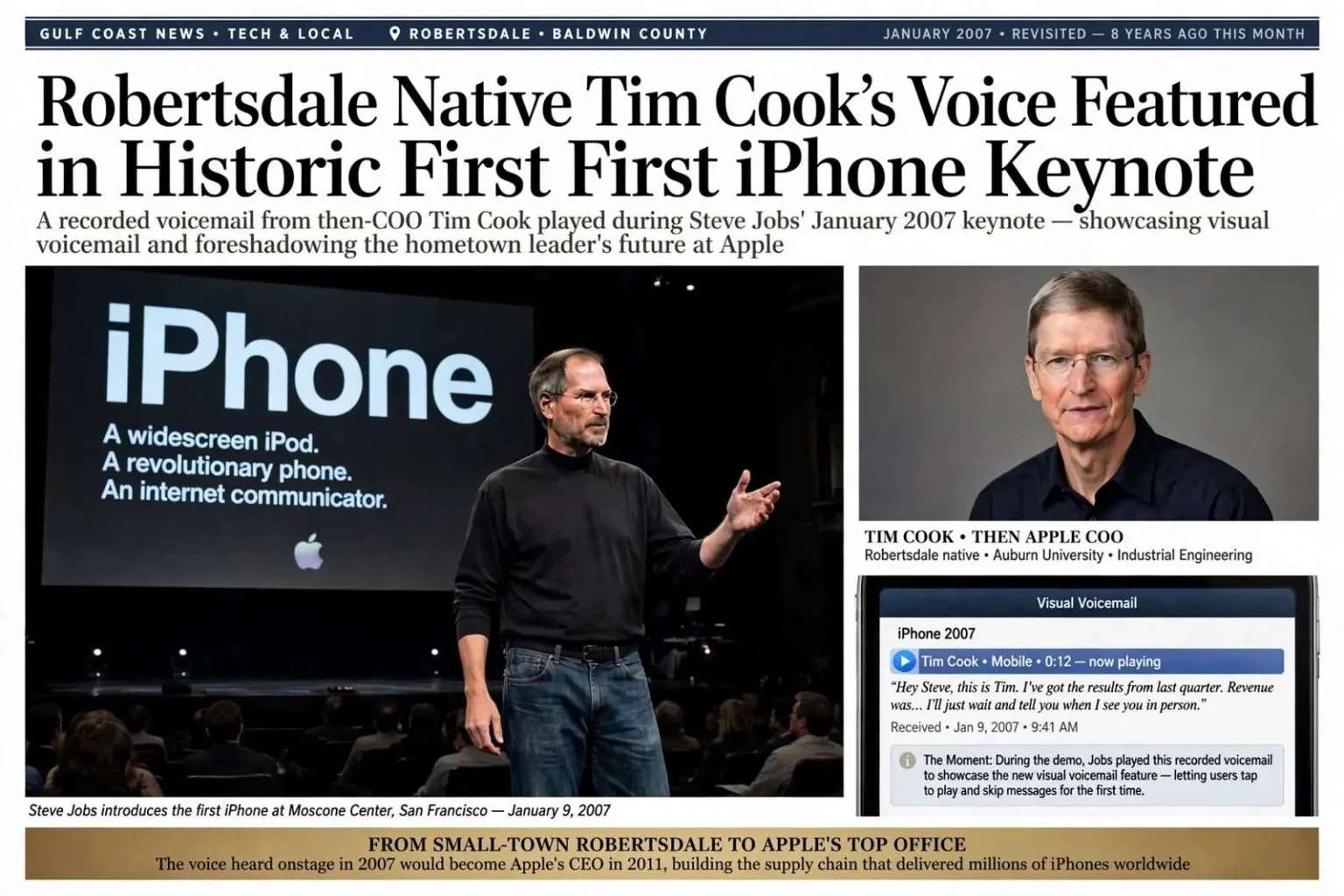
Eight years ago this month, Apple co-founder Steve Jobs stood before a packed auditorium and declared that the company was about to reinvent the phone, unveiling the very first iPhone in a keynote address that would go on to reshape the technology industry. Tucked into that historic presentation was a brief but memorable moment featuring the voice of a Robertsdale native who would later go on to lead Apple himself.
During the January 2007 keynote, Jobs demonstrated the new device’s visual voicemail feature, which allowed users to see and select messages instead of listening through them sequentially the way traditional voicemail systems required. To showcase the feature, Jobs played a recorded voicemail message purporting to come from Tim Cook, who was then Apple’s chief operating officer overseeing global operations.
“Hey Steve, this is Tim. I’ve got the results from last quarter. Revenue was… you know, I’ll just wait and tell you when I see you in person,” the recorded message said, drawing laughter from the audience as Jobs demonstrated how easily users could skip between different voicemails using the iPhone’s touch interface. The bit worked on two levels: it showed off a genuinely novel feature while poking fun at the fretful dynamic between a company’s operations chief and its demanding co-founder.
Cook, who grew up in Robertsdale and graduated from Robertsdale High School before attending Auburn University, was already a key figure inside Apple by 2007, having joined the company nearly a decade earlier and steadily risen through its operations leadership. He would go on to become Apple’s chief executive in 2011, following Jobs’ resignation shortly before Jobs’ death later that year.
A Baldwin County Product at Apple
Cook’s path from the small Baldwin County railroad town to the upper ranks of Silicon Valley remains one of the more remarkable career stories connected to south Alabama. Raised in a working family in Robertsdale, he left for Auburn, where he studied industrial engineering, a discipline focused on efficiency and logistics that would define his professional identity. He built his early career managing manufacturing and supply chains at major technology companies before Apple recruited him in 1998 to straighten out an operation many considered unsalvageable.
What he found at Apple was an inventory problem that was eating the company alive, and what he built was one of the most efficient supply chains in corporate history. Closing factories, cutting warehouses and tightening the pipeline between components and finished products, Cook helped transform Apple from a struggling computer maker into a company capable of launching a product as complex as the iPhone and shipping millions of them on schedule. The visual voicemail joke on keynote day landed precisely because everyone in the audience knew Cook ran the machine that made such launches possible.
The original iPhone officially reached consumers on June 29, 2007, several months after the keynote demonstration, and quickly became one of the best-selling consumer electronics products in history, fundamentally changing how people use mobile phones, access the internet and interact with software applications. The App Store, multi-touch screens and pocket computing that followed trace directly to the device Jobs held up that January afternoon, with Cook’s operations behind every unit delivered.
Cook’s Baldwin County roots have remained a point of local pride in the years since he took over one of the world’s most valuable companies. Robertsdale, a community of a few thousand residents along Highway 90 north of the resort corridors of the coast, has watched its most famous native ascend with a mixture of astonishment and claiming rights, and the connection surfaces whenever Apple makes headlines. The story of the hometown boy running Apple is one locals never tire of telling.
The keynote moment itself has aged into tech-industry lore. The January 2007 presentation at San Francisco’s Moscone Center, where Jobs introduced the iPhone as three products in one, a widescreen iPod, a revolutionary phone and an internet communicator, is routinely ranked among the greatest product demonstrations ever staged. Within that hour of orchestrated reveals, a scripted voicemail from the company’s operations chief was the only appearance of Cook’s name and voice, an accidental piece of history preserved in the recording of the event.
Visual voicemail, the feature the bit showcased, solved a genuine annoyance of the era. Traditional voicemail forced callers to sit through messages in order, dialing through menus and waiting through old recordings to reach the one that mattered. The iPhone displayed each message as a selectable item, letting users tap straight to what they needed. The feature ran on visual metaphors that seem obvious now and were startling then, which is why Jobs chose it for a keynote designed to show that the phone had truly been reinvented.
The Road From 2007 to the Corner Office
By 2011, when Jobs stepped down as chief executive months before his death, the succession to Cook was unsurprising to anyone who had followed the company’s operations. Cook had repeatedly run the company during Jobs’ medical leaves, and his command of the business side complemented Jobs’ product instincts. The transition preserved the momentum the iPhone had created, and under Cook Apple’s value has grown to levels that dwarf its 2007 valuation, driven by successive generations of the device introduced that January day.
The device’s journey from keynote stage to consumers’ hands also became a case study in launch logistics. Jobs showed off a prototype in January, but the phones that reached stores that June had to be manufactured, shipped, secured and merchandised across the country in a matter of months, with lines forming outside stores days in advance. The operation behind that summer launch, from component suppliers to store shelves, was the machine Cook had spent nearly a decade building, and it performed exactly as the keynote audience had been promised it would.
For Auburn and Baldwin County, Cook’s rise turned keynote footage into local history. University references to the industrial engineering graduate appear in campus materials, and Robertsdale High School claims him in the way small-town schools do when one of their own reaches the top of a global industry. The 2007 voicemail cameo, a throwaway joke at the time, now gets replayed as a curiosity: the moment the voice of Apple’s future chief executive drifted out of a prototype phone on the most famous stage in consumer technology.
The anniversary of the keynote offers a reminder of how compressed the timeline was. Cook was helping launch the device in January 2007, the iPhone was in customers’ hands by June, and four years later he was running the company. Eight years out from the keynote, the man whose voice joked about revenue on stage had guided Apple to revenues beyond anything the 2007 audience would have believed, and the phone in their pockets had a Robertsdale native’s fingerprints on its supply chain from the very first shipment.
Retail history remembers that first June 29 launch as the moment the phone-buying experience changed. Customers who lined up did so for a device whose interface had no manual to speak of, whose keyboard lived on the screen, and whose carrier partnership broke the mold American phone buyers had lived with for years. The cultural shift that followed, from app culture to pocket-first internet use, started with the decision thousands of people made that morning, trusting a keynote they had watched months earlier.
Why the Moment Still Matters
Looking back eight years later, the keynote illustrates both how much has changed and how small the world of top-tier consumer technology remained. The iPhone’s unveiling drew on a company of fewer than 20,000 employees, then a fraction of its later size, and its success rested on the unglamorous work of manufacturing coordination that Cook oversaw. The joke about quarterly revenue worked because Cook, more than anyone else at Apple, lived those numbers, and the audience knew the product they were cheering depended on his ability to deliver it at scale.
The moment also captures something about Apple’s storytelling under Jobs: even the operations side of the company was folded into the theater. Voicemail from the COO, played on the prototype, made the product the star and the executives the supporting cast, a dynamic that continued even after the succession made Cook the headliner. Executives at rival companies rarely became recognizable voices to consumers; at Apple, the COO’s voice got a laugh line in the most-watched product demo of the decade.
For Gulf Coast readers, the deeper story is one of mobility that runs both ways. Cook left Baldwin County for Auburn and never worked in the region again, yet his origin story is retold here because it suggests what a student in a small south Alabama school can reach. The June 2007 launch, the January keynote, the 2011 succession: each milestone renewed the local claim on a global figure, and each replay of that scripted voicemail reminds residents that when the iPhone was born, a Robertsdale voice was already on the line.