Baldwin County Names a Veteran Principal to Steer the Schools Through a Leadership Change
The Baldwin County school board chose Rockwell Elementary principal Robbie Owen to serve as interim superintendent once Alan Lee steps down on Nov. 1, easing the district into a search for a permanent leader.
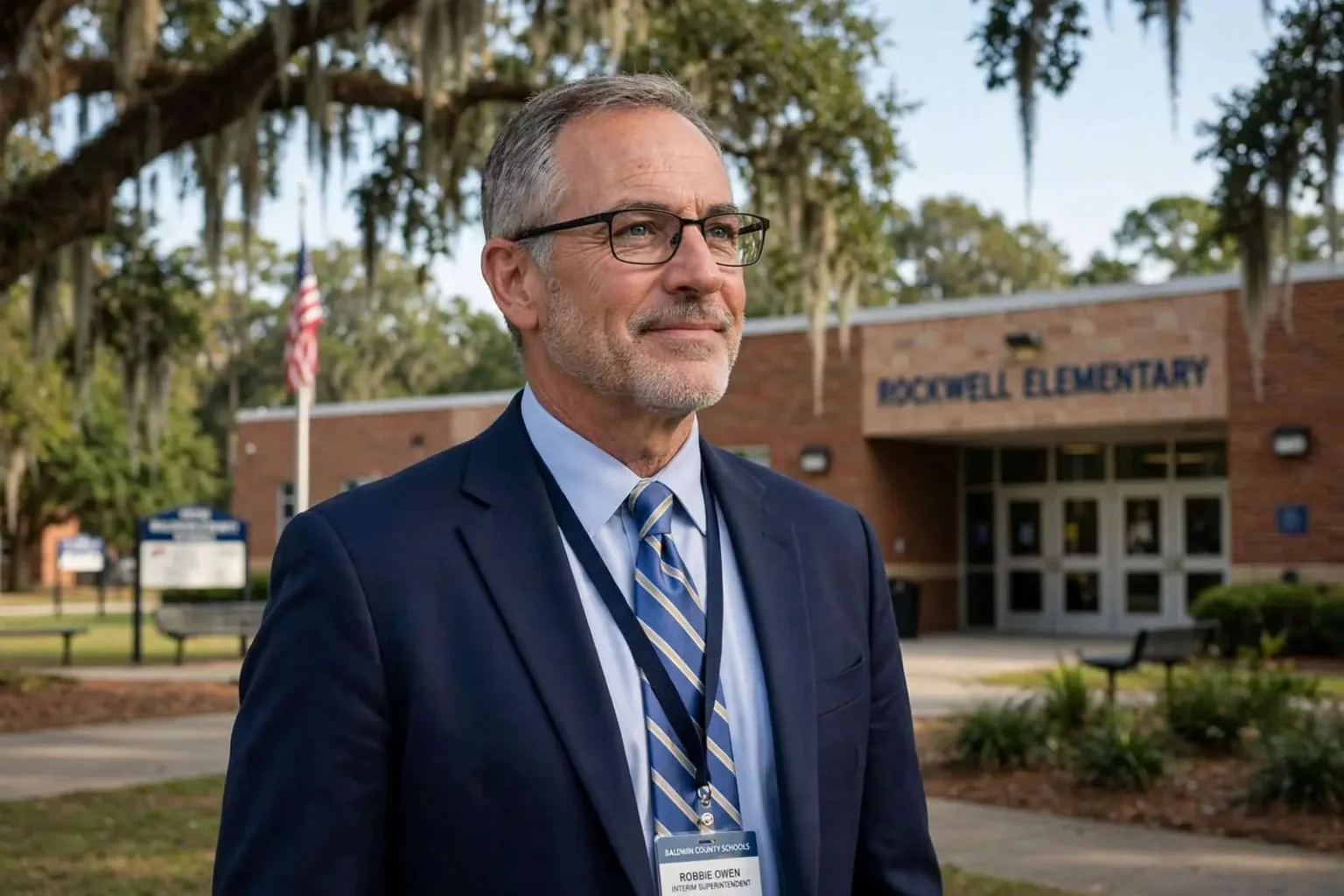
Facing the departure of its superintendent just as a new school year opened, the Baldwin County school board turned to a familiar and highly regarded figure from within its own ranks. Meeting at Robertsdale Elementary School, the board selected Robbie Owen, longtime principal of Rockwell Elementary, to serve as interim superintendent after Alan Lee steps down on Nov. 1. The decision came during a narrow window when the district needed steady leadership most, with classrooms filling and teachers settling into new routines across one of south Alabama’s largest and fastest-growing school systems.
The handoff was arranged to be quick. Owen was set to begin his new duties almost immediately, with Lee moving into an advisory role, according to board President Norm Moore. The arrangement was designed to smooth the transition at the top of the district while the board prepared for the longer task of finding a permanent replacement. Rather than leaving the system adrift during a search for a new chief, the board effectively installed a caretaker leader it already knew and trusted, keeping day-to-day operations in familiar hands.
A familiar face at the top
Owen brought deep experience to the assignment. He had been principal at Rockwell Elementary in Spanish Fort since 1997, an unusually long tenure that spanned the school’s growth alongside the rapid residential development of the Eastern Shore. Spanish Fort, which sits along the eastern edge of Mobile Bay just across the causeway from the city of Mobile, has expanded steadily in recent decades, and its schools have grown with it. Rockwell Elementary, serving families in the heart of that corridor, has been Owen’s professional home for the better part of two decades.
His record had earned him recognition well beyond Baldwin County. In 2011, he was featured on the White House website as a “Champion of Change,” a distinction the administration used to spotlight educators, community leaders, and innovators making a measurable difference in their fields. In 2008, he was named Alabama’s National Distinguished Principal, an honor connected to the National Distinguished Principals program that recognizes outstanding leadership at the school-building level. Both accolades marked him as a figure whose reputation carried weight not just in Spanish Fort but across the state.
Owen’s academic background traces back to the University of Mobile, a private university located just across the county line in Mobile County. He earned a bachelor of science in elementary education and a bachelor of arts in sociology there, credentials that reflect the two sides of his career — the instructional foundations of an elementary educator and the people-centered perspective of a sociologist. That combination shows in the way longtime observers describe his work: disciplined about academics, attentive to families, and quick to invest in the adults who work around him.
The superintendent’s office he inherits is one of the most consequential jobs in south Alabama public education. Baldwin County Public Schools stretches across the entire county, from Bay Minette in the north to Gulf Shores and Orange Beach on the coast, taking in fast-growing communities like Daphne, Spanish Fort, Fairhope, Foley, and Robertsdale. Managing a district of that size and pace — with new subdivisions arriving yearly and enrollment pressure following them — demands administrative polish and political steadiness, qualities supporters said Owen has demonstrated across years of school leadership.
A choice with broad support
The board’s confidence in the selection was plain. “We’re looking forward to his leadership, and I’m sure he’ll do a great job,” Moore said. Coming from the board president, whose role requires steering seven distinct perspectives toward consensus, the endorsement carried particular weight. There was no lengthy public debate over alternative candidates, and the tone of the discussion suggested the choice had effectively settled itself once Owen’s name surfaced from multiple directions.
Moore said Owen had been suggested by several sources, including central office staffers and Rockwell Elementary parents. The recommendation did not come from a single faction; it surfaced from inside the administrative offices that work daily with the superintendent’s team and from the families who know Owen best through years of morning car lines, school programs, and community events. That blend of institutional and grassroots backing gave the board a rare degree of confidence in a decision that could easily have been contentious.
The move to elevate Owen raised an obvious follow-up question: who would lead Rockwell Elementary in his absence? Moore played down any concern. He said the board would likely appoint an interim principal at Rockwell, and he credited Owen with having built a strong bench of leaders beneath him. “He has trained his assistant principals very well, and of course, he’ll go back there when his term is up,” Moore said, according to school system spokesman Terry Wilhite.
That last point matters as much as any other detail in the arrangement. Owen’s interim appointment was framed from the start as temporary, with the expectation that he would return to Rockwell when his service at the central office concluded. For the Rockwell community — parents, teachers, and students who have known one principal for nearly two decades — the promise of his return softened the disruption. For the district, it meant the interim arrangement carried limited long-term risk.
Interim superintendents in Alabama typically serve for a defined stretch while a board conducts its search, and their charge is usually continuity rather than change: keep budgets on schedule, keep construction projects moving, keep the academic calendar intact, and avoid decisions that would bind a permanent successor. Owen’s familiarity with the district’s culture and personnel was seen as an asset in exactly that kind of assignment, since it reduces the learning curve an outside caretaker would face in the job’s opening weeks.
The meeting itself was held at Robertsdale Elementary, a school in the central part of the county that has hosted board sessions before. Holding the vote there, rather than in the board’s usual administrative meeting space, put the decision physically closer to the communities the district serves — a small gesture, but one that matched the tone of a night when the board wanted to show it was acting quickly and locally to solve a leadership problem.
Preparing for a permanent search
With the interim leadership settled, the board turned its attention to the process of finding a permanent successor to Lee, who had submitted his resignation on Aug. 4. The timing of that resignation — barely two weeks before the first day of school — had compressed the board’s decision-making and forced the rapid pivot to an interim solution. Board members were set to undergo training from the state board of education on how to conduct that search, a step Alabama districts commonly take to make sure the process follows state law and accepted practices for hiring a schools chief.
Growth itself is part of what makes the assignment demanding. Baldwin County has ranked among the fastest-growing counties in Alabama for years, and each new roof in Spanish Fort, Foley, or Loxley translates into more students, more classrooms, and more pressure on the system’s budget and facilities. An interim leader does not solve those pressures, but a steady hand at the top keeps the district’s response to them moving on schedule — new school planning, staffing adjustments, and the day-to-day work of stretching resources across a county that spans both farms and beach towns.
The tone of the meeting suggested the immediate pressure had eased. About 40 people crowded into the library at Robertsdale Elementary for the session, a modest crowd by the standards of a major personnel decision, and the audience heard little of the urgency that had marked earlier gatherings. The board did not hold further discussion about hiring a search firm, and afterward Moore said the urgency around that decision had diminished.
“At this point, that’s not critical,” Moore said. That marked a shift from the board’s previous meeting on Aug. 7, when members had stressed the importance of getting an interim superintendent in place before schools opened on Aug. 18. At that earlier session, the absence of a clear leader at the top loomed over every other agenda item, and board members had treated the interim question as the single most time-sensitive matter on their calendar.
By naming Owen, the board met that goal with time to spare, ensuring that a seasoned administrator with a national reputation would be at the helm as students across Baldwin County returned to class. The sequence — resignation, interim appointment, and a measured path to a permanent hire — gave the board room to conduct its search deliberately rather than under deadline pressure, and gave parents and employees a clear answer to the question of who would be leading the district in the meantime.
For the schools themselves, the practical effects are immediate. Principals and central office staff report to a leader they already know, routine decisions move without a leadership vacuum, and the district can present a stable face to the community while the search unfolds. For Rockwell Elementary, the plan is equally clear: an interim principal steps in, trained by Owen himself, with the expectation that the school’s longtime leader will walk back through its doors when his work in the superintendent’s office is done.