Orange Beach Makos Softball Claims National Small Town Title After Sixth Straight Championship
The Orange Beach Makos softball team finished 46-1, won a sixth consecutive Alabama state title and has now been ranked the No. 1 small town team in the nation, the only Alabama program on the list.
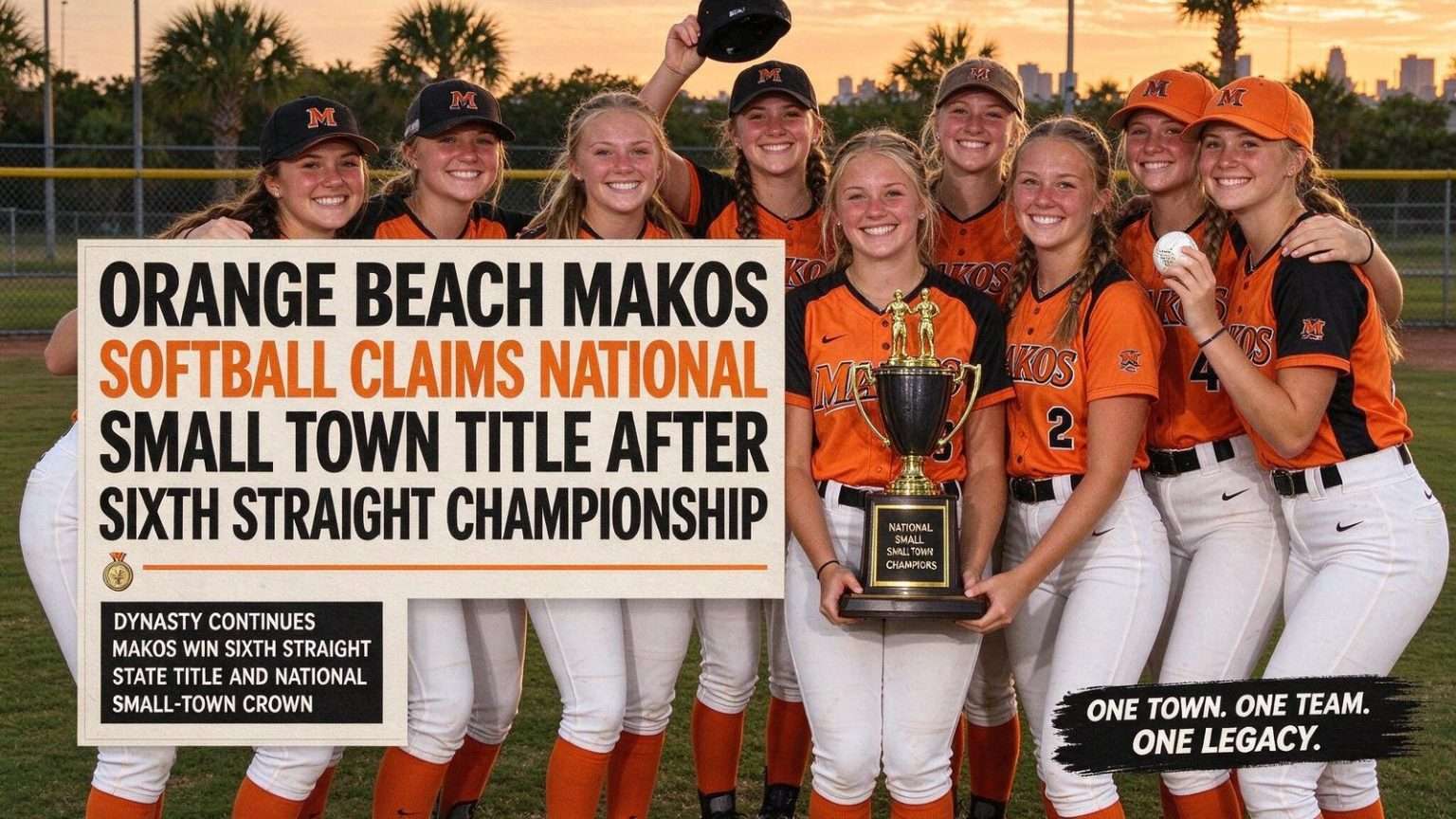
The Orange Beach Makos softball team added another line to a championship résumé that is becoming one of the most decorated in Alabama small-school sports, claiming the national small-town softball title after winning a sixth consecutive state championship earlier this spring. The Makos, who play in the Alabama High School Athletic Association’s smallest classification, have built a dynasty that is unusual even by Alabama standards, and the national title pushed them past a record that USA Softball officials said they could not confirm had been matched by any other small-town program in recent memory.
Most high school softball programs in the state enjoy one or two deep playoff runs in a decade, and the rare program that wins three straight state championships becomes the subject of statewide attention. The Makos have now won six straight, and the latest state title, combined with the national small-town crown, has elevated the program’s profile beyond the beaches and into the broader conversation about sustained excellence in small-town American athletics.
How the run began
The team’s current run began with a senior class that came in with a deep youth program behind it. Orange Beach has long invested in its recreational leagues, and several of the players on the current roster have been on the same teams since t-ball. That continuity matters in softball, where the chemistry between pitchers, catchers and middle infielders often determines the difference between a state title and a second-round exit.
The Makos play their home games at the city’s sportsplex, a multi-field complex that the city has expanded over the last decade as the local population has grown. The complex is small by national standards, but it has produced a disproportionate share of high-level softball talent, in part because of the year-round climate along the Gulf Coast that allows teams to play and practice outdoors from February through November. The city has installed lighting and irrigation at the softball field to keep the playing surface in good condition through the driest months.
Behind the high school program sits a youth pipeline that runs from the city recreation department through travel ball and into the high school feeder programs. Several of the Makos’ starters have played together since elementary school. The familiarity shows up in the fielding, where the team committed fewer errors than any of its state-tournament opponents, and in the running game, where the Makos stole bases at a higher rate than any other team in their classification.
The state title
The state championship came in late May at Montgomery’s Lagoon Park, the longtime host of the AHSAA softball championships. The Makos faced a familiar opponent in the final, a team they had beaten twice during the regular season, and won the deciding game by three runs after falling behind by one in the first inning. The victory gave the Makos their sixth straight 1A title and set up the national tournament appearance.
The state tournament itself was a near-perfect run for the Makos, who outscored opponents by an average of more than five runs per game and never trailed after the third inning in any contest. The pitching was dominant. The defense was error-free over the first three rounds. The offense hit better than .350 as a team and produced a record number of extra-base hits for a single AHSAA tournament.
The national title
The national small-town title is awarded by a national softball organization that considers enrollment size, school classification and the population of the host community when selecting teams. The Makos qualified by winning the Alabama 1A state championship, then beat a series of opponents from across the Southeast over a four-day tournament that ended in late summer. The final game was decided by a single run in the seventh inning.
What made the national run notable was the margin of victory across the tournament. The Makos outscored opponents by an average of more than five runs per game, the largest margin in the history of the small-town bracket. Their pitching staff recorded three no-hitters over the four days, and the team’s offense hit better than .400 as a unit in bracket play. In the title game, the Makos fell behind 2-0 in the first inning and then scored unanswered runs over the next six frames to win 5-2.
What the players said
In postgame interviews, the players credited the coaching staff and the local youth program rather than any individual performance. Several players mentioned the team’s seniors, who had been part of every championship run since middle school and who played their last competitive games together at the national tournament. The seniors plan to continue their careers at the college level, with at least three players signing with Division I programs, including Auburn and South Alabama.
The coaching staff, led by head coach Kristin Brown, has now overseen all six consecutive titles. Brown, a former Alabama collegiate player herself, took over the program a decade ago and has built it through a combination of disciplined fundamentals, an aggressive offensive approach and a willingness to schedule difficult non-region opponents in the regular season to prepare for the playoffs. Brown’s staff includes two former college players who joined the program in recent years and who have helped refine the team’s defensive schemes.
What it means for Orange Beach
For the city of Orange Beach, the Makos’ success has become part of the town’s identity in a way that few high school programs ever manage. Local businesses display championship banners in their windows. The high school has added a wall of championship memorabilia to its main hallway. The mayor’s office has issued proclamations after each title, and the city council has recognized the team at formal meetings. The team’s success has been a quiet source of civic pride during a period of rapid growth that has changed the city’s character in other ways.
The Makos’ run has also been a quiet recruiting tool for the city. Several families have moved to Orange Beach specifically because of the school’s athletic programs, and the softball team’s success has drawn the attention of college softball programs across the Southeast who now send scouts to games at the sportsplex every spring. The presence of scouts has, in turn, raised the profile of the city’s travel ball programs and given younger players a clear pathway to college softball.
The economic effect is harder to measure but real. Softball tournaments bring families to Orange Beach in the spring, a shoulder season that the city’s tourism office has worked to fill for years. The national tournament this year alone brought more than 1,500 visitors to the city over four days, many of whom stayed in hotels and ate at local restaurants.
The next chapter
The senior class that just played its last game leaves behind a program that is deep enough to remain competitive even as the next group takes over. Five underclassmen saw significant playing time during the national tournament, and the youth leagues continue to feed the high school program with players who have spent their formative years in the same system. Coach Brown has indicated she plans to return for at least two more seasons, which would give the program a chance to extend the streak to eight straight state titles.
For now, the trophy from the national tournament will join the others in the school’s display case, and the players will return to class for the fall semester. The team will begin its offseason conditioning program in January, with an eye on extending the streak and defending the small-town national title in the summer to come. The Makos have set a standard, and the program’s players, coaches and supporters know that the next season will bring higher expectations and harder opponents. For Orange Beach, that is exactly how a championship program is supposed to work.
Looking back on six years of titles
The current streak began with a regional championship in the lowest classification and has now extended through five reclassification cycles, with the Makos adapting each time to new opponents and new schedules. The team’s success has outlasted the high school careers of more than thirty seniors, each of whom went through the program with the expectation that a state title was the baseline rather than the ceiling.
The senior class of 2026 leaves the program having won four straight state titles and the national small-town championship. The underclassmen who will form the nucleus of next year’s team include a sophomore pitcher who has already drawn Division I recruiting attention and a junior catcher who has been the defensive anchor for two postseason runs. With Coach Brown committed to at least two more seasons, the program has a clear line of succession.
The Makos’ accomplishment is also a reminder that sustained high school excellence requires more than talent. It requires consistent coaching, parental support and a community that takes the program seriously. Orange Beach has invested all three, and the trophy case at the high school is the visible result.