Prichard Council Rejects Proposal for Quarterly Budget Reviews
A Prichard councilwoman's push to require regular independent CPA reviews of the city budget fell short of the votes needed to pass this week.
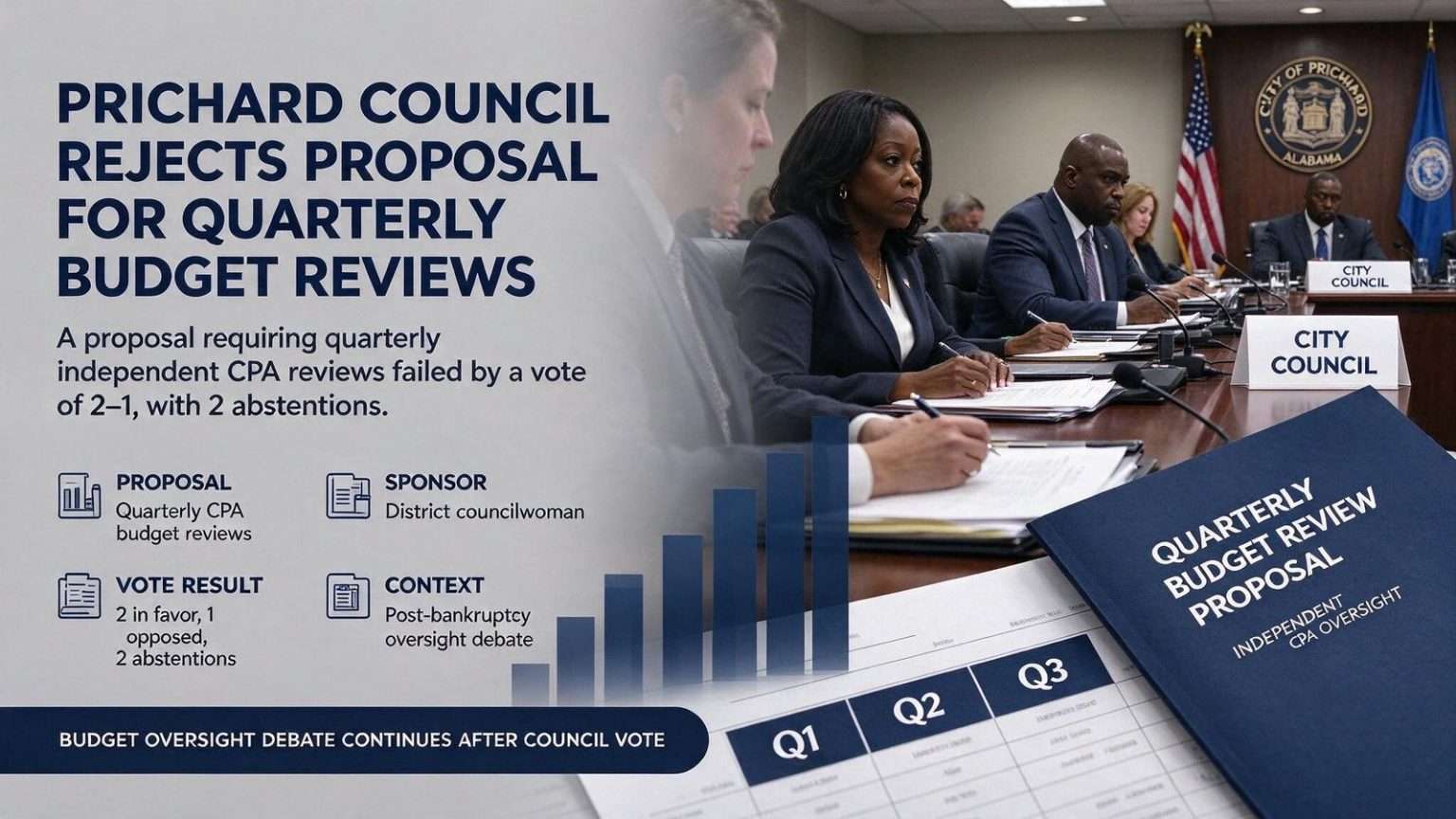
A proposal to require regular, independent reviews of Prichard’s municipal budget failed to gain enough support to pass during a recent City Council meeting, despite pointed arguments from its sponsor about the need for closer financial oversight. The measure, put forward by a district councilwoman, would have required a quarterly review of the city’s budget by a certified public accountant and authorized the city to formally retain a CPA’s services for that purpose.
Only two council members voted in favor of the resolution, while another voted against it and two more abstained, leaving the proposal short of the support needed to move forward. The vote margin — two supporters, one opponent and two members who chose neither side — says as much about the council’s post-bankruptcy politics as the measure itself: a proposal framed as basic fiscal housekeeping could not command a majority even in a city whose financial history would seem to argue for it.
A Voice That Has Raised the Issue Before
The councilwoman who sponsored the measure had been the sole no vote when the council approved an $11.4 million budget for the current fiscal year at its final meeting of 2014. At that time, and again during the more recent debate, she argued that Prichard’s history of financial distress, including a recent municipal bankruptcy, made outside review by a qualified accountant especially important. She had even offered to use discretionary funds from her own district to help cover the cost of a review — an unusual gesture that underscored how seriously she regarded the gap she sees in the city’s financial monitoring.
“When we have the opportunity to stop and take a deep breath and get things in order, we should get things in order,” she told fellow council members during an earlier finance committee discussion, framing the review as a precaution rather than a signal of any specific wrongdoing. The distinction matters: she was not accusing administrators of misconduct, but arguing that a city that has been through bankruptcy should welcome outside eyes on its budget rather than treat them as an insult.
Prichard’s financial history gives the argument its weight. The city of roughly 22,000 residents just north of Mobile filed for Chapter 9 bankruptcy protection in 2009 — its second trip through municipal bankruptcy — after a long-running pension crisis left it unable to meet obligations it had promised retirees for decades. The bankruptcy forced years of austere budgeting, became a case study cited nationwide in discussions of municipal pension risk, and left a lingering trust problem between city hall and the residents who lived through the cuts that followed.
The Case Against Quarterly Reviews
Other council members pushed back, arguing that the city was still working through older budget line items from the prior fiscal year and needed to focus on implementing the newly passed budget rather than adding another layer of review. One colleague noted that the city already pays an outside auditor annually to examine past budgets, arguing that additional quarterly reviews could be redundant given that existing oversight.
The annual audit argument carries real force for a city of Prichard’s size. Municipal audits are required by state law and conducted by independent accounting firms against professional standards, and they already cost small cities tens of thousands of dollars a year. Adding quarterly CPA reviews would layer a second set of professional fees onto a budget of $11.4 million — meaningful money in a city that has spent years cutting. Opponents argued the existing audit, plus the state-mandated reporting that comes with it, gives the council the oversight it needs at a fraction of the cost.
There is also a difference in kind between the two tools, which is where the sponsor’s argument lives. An annual audit looks backward at closed books and renders an opinion months or years after the money is spent; a quarterly review would look at the budget while it is being executed, when overspending can still be corrected before it compounds. Small cities rarely employ full-time internal auditors, so a mid-year problem in Prichard’s budget would surface only when the cash was already gone — the exact pattern that historically let the city’s pension obligations drift into crisis.
A Council Still Divided by History
The debate highlighted broader tension on the council over how closely to monitor city spending following Prichard’s bankruptcy, which forced significant budget cuts and drew scrutiny to the city’s financial management practices in recent years. Supporters of tighter oversight have argued that more frequent outside reviews could help catch problems early, while critics have said the city’s limited administrative capacity makes quarterly reviews impractical. A small municipal staff juggling day-to-day operations, state reporting and the cleanup of prior-year books can only absorb so much additional process, and several members made clear they saw the proposal as one burden too many.
The abstentions were the quiet story of the vote. Two members who declined to take a position on either side left the measure without a working majority while avoiding the record of voting against oversight in a city where financial trust is the town’s defining political issue. In a five-member council, an abstention is not a neutral act — it is a decisive one, and both of this week’s abstentions fell on the side that killed the quarterly review.
No council member indicated an intention to bring a revised version of the proposal back for a future vote, though the debate suggested the underlying disagreement over financial oversight is likely to resurface as the city continues working through its post-bankruptcy budget cycle. The sponsor’s willingness to fund part of the review from her own district’s discretionary money signaled that the issue will not simply go away, and the arguments she made — prevention is cheaper than crisis, trust is built by inviting scrutiny — remain on the record for the next budget season.
What the city does next will be watched closely in a community that remembers what financial drift cost it. Prichard’s bankruptcy was not caused by a single bad quarter, and it will not be prevented by one — which is precisely the sponsor’s point about quarterly reviews, and precisely why her colleagues preferred to rely on the annual audit, the state’s oversight and their own finance committee. The question the council could not settle this week — whether more frequent outside eyes are a safeguard or a redundancy — is the same question facing small cities across Alabama that emerged from the recession and bankruptcy era with thinner margins and longer memories.
What Bankruptcy Left Behind
Prichard’s road through bankruptcy left scars that shape every budget debate since. The city emerged with a repayment plan, a reduced workforce, years of deferred maintenance on streets and equipment, and a pension settlement that gave retirees far less than they had been promised — a human cost that residents have not forgotten. The $11.4 million budget the council finally adopted for the current fiscal year is, in that context, a document of hard-won balance: revenues stretched across obligations the city cannot legally ignore and services residents cannot do without.
That history also explains why the oversight debate is so emotional on both sides. To the sponsor and her supporters, voting against quarterly reviews in a city with Prichard’s past looks like ignoring the lesson of the bankruptcy itself — that the city got into trouble gradually, in quarterly increments no one was watching, and that the annual audit is the kind of hindsight that arrives too late. To her colleagues, repeated references to the bankruptcy read as rehashing a settled matter, and each new oversight proposal carries an implicit accusation that the current administration is managing the city’s money carelessly.
The Smaller-City Dilemma
Prichard’s dilemma is common to Alabama’s smaller municipalities. A city of this size typically fields a finance department of only a handful of employees, relies on the mayor and council to review spending in regular meetings, and depends on the annual audit — delivered mid-year or later — as its only independent check. Between the audit cycles, the council’s own finance committee is the front line, and its effectiveness depends on members willing to question line items month after month, a discipline that varies with the council’s composition and energy.
States and professional associations have been working on the same problem from other angles. Municipal accounting standards have grown more rigorous, state examiners require more frequent reporting from cities with troubled finances, and professional organizations recommend internal control reviews for small governments that cannot afford standing audit staff. A quarterly CPA review, like the one Prichard considered, sits squarely in that trend — but so does the counterargument that a city must eventually trust the systems it already pays for, and that stacking oversight on oversight is no substitute for the daily discipline of managing an $11.4 million budget well.
The council’s decision leaves the annual audit, the finance committee and state reporting as the city’s safeguards for now. Whether that framework holds will become clear in future budget cycles, and the two votes in favor of the quarterly review — plus the sponsor’s standing offer to help pay for it — mark the constituency that will press the question again when the next budget is written.